Summary

How are you coping with the heat?

  1. Temperatures climb to 37C as heat warnings expanded - what's the latest?published at 15:01 BST

    Katie Williams
    Live reporter

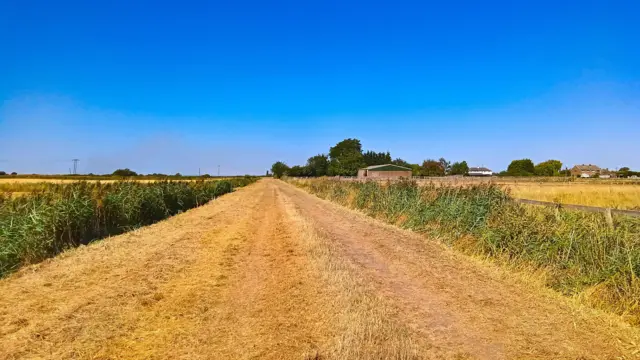
    Ramsey Saint Marys, CambridgeshireImage source, Alpaca Lady / BBC Weather Watchers

    Temperatures have already exceeded 37C in Charlwood, Surrey, as temperatures are expected to rise further this afternoon.

    The mercury could hit 38C in parts of England later this afternoon, the Met Office says, as the UK experiences its fifth heatwave of the year.

    The highest temperature recorded so far this year is 38.0C at Lingwood, Norfolk, on 26 June.

    An amber extreme heat warning is in place until 23:59 BST tonight across large parts of England. It was extended further west this morning to include parts of Cheshire and Greater Manchester, as well as Gloucestershire, Wiltshire, Shropshire and Herefordshire.

    Much of the UK is suffering dry conditions, with 71.3% of England and all of Wales in drought. But in Northern Ireland, a yellow thunderstorm warning is in place over the whole country until 06:00 tomorrow.

    A&Es in England are experiencing their busiest period ever. An ambulance technician has described working in the heat as "vile", while other healthcare workers have described "dripping with sweat from head to toe".

    Meanwhile, a 17-year-old at Birmingham New Street tells the BBC travelling in a heatwave is "like being in a sauna".

    We'll be keeping a close eye on the temperatures throughout the afternoon, stay with us.

  2. Temperatures reach 37.6C in Charlwoodpublished at 14:39 BST

    Ben Rich
    Lead Weather Presenter

    The Met Office has confirmed that a provisional temperature of 37.6C has been recorded at Charlwood, Surrey.

    This means we are not far off the highest temperature recorded so far this year, which was 38.0C at Lingwood, Norfolk on 26 June.

    There may still be time for temperatures to climb a little further this afternoon – we’ll keep you posted.

  3. 'I use gloves full of cold water to keep me cool in hospital'published at 14:21 BST

    Anna Whittaker
    BBC Radio Nottingham

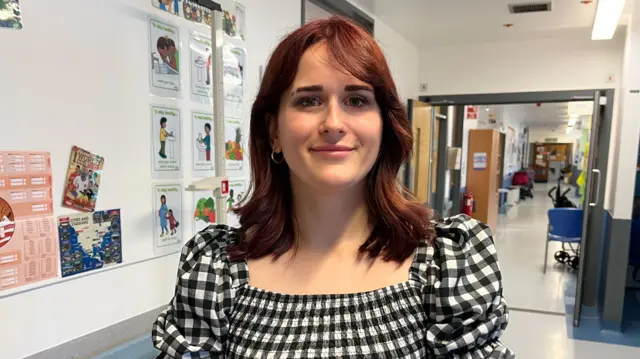
    April sits in a hospital

    As we've been reporting, A&Es in England are experiencing their busiest summers ever and for hospital patients like 13-year-old April, the heatwaves this year have been particularly difficult.

    She's been admitted to the children's hospital at the Queen's Medical Centre six times this year, at one stage staying for three months. Her most recent stay started two days ago.

    She has total intestinal Hirschsprung's disease, a rare disorder of the bowel, which means she is limited on what she can eat and means she can only drink 500ml of water a day.

    "If I have an ice pop, it's like 100ml of liquid, then I'm only allowed 400ml of water, so it's not great," she says.

    "I tend to be more thirsty when it's hot, but I try and stay in front of the fan as much as I can, and that seems to help.

    "It's absolutely roasting, it's ridiculous. There's no air conditioning. We use gloves with cold water in them to keep me cool."

  4. How long will this hot weather last?published at 14:11 BST

    Darren Bett
    Lead weather presenter

    Today is the peak of the heat. A change to a north-westerly breeze tomorrow will bring a drop in temperature.

    That change will be accompanied by an area of cloud and showers that will move out of Scotland and Northern Ireland into northern England and Wales.

    The Midlands, East Anglia and much of southern England will still be dry and hot, though with temperatures of 30C to 34C.

    Although most places will be dry this weekend, temperatures will fall further everywhere with a top temperature of 26C in southeast England by Sunday.

    There could even be rain in more places next week with no sign of 30C temperatures returning.

  5. 'I understand if trains do get delayed because I feel like 35C isn't very normal'published at 14:01 BST

    Aine O'Donnell
    BBC Newsbeat

    Phoebe stands in a relatively quiet Birmingham New Street station
    Image caption,

    Phoebe arrived at Birmingham New Street station expecting delays

    Temperatures in the high 30s in the West Midlands seem to be having an affect on how people are getting around - especially by train.

    National Rail says the heat could affect journey times and travellers should check before they travel.

    BBC Newsbeat found 17-year-old Phoebe Reid looking at the giant screens at Birmingham New Street, checking to see if her train to Stoke-on-Trent had been cancelled.

    "If it got delayed I’d expect it to be honest," she says.

    "It is like super hot, I understand if trains do get delayed because I feel like 35C isn’t very normal in this country."

    Phoebe has travelled by train during the first four heatwaves this year and says it’s "like being in a sauna especially if the trains are packed".

    Her advice is to "bring a portable fan and you might be okay".

  6. Hasn't the summer been one long heatwave?published at 13:39 BST

    People walk on dry grass in Kensington GardensImage source, Getty Images

    The UK is currently in its fifth heatwave of the year, with temperatures over 36C already recorded in parts of the country today.

    But how do experts arrive at this count? For many, it might feel like the entire summer has been one long heatwave with little relief.

    A heatwave is declared when a location records three consecutive days where daily maximum temperatures meet or exceed regional thresholds.

    The threshold varies by UK county, ranging from 25 to 28C.

    "The geographical differences reflect the differences in climate across the UK," the Met Office explains.

  7. A summer of heatwaves, in numberspublished at 13:18 BST

    An aerial view taken with a drone shows a drought-damaged cricket pitch in Cockfosters, North London,Image source, EPA/Shutterstock
    Image caption,

    Drought has been declared in 71.3% of England - including Cockfosters in London, pictured here

    This summer is on course to be the UK's hottest since records began, according to the Met Office, and long-standing heat records have been toppling.

    This is the fifth heatwave of the year for some parts of the UK - which means a place is hotter than normal for the time of year, for at least three days in a row.

    35C has been reached in May, June and July for the first year on record, and has already been passed - near Gatwick airport - today.

    The highest temperature of the summer so far stands at 38C, which was recorded at Lingwood in Norfolk on 26 June.

    The UK had already recorded more days above 30C by 15 July this year than it did in the whole of 1976 - a year that is remembered by many for its long-lasting heatwave.

    71.3% of England and 100% of Wales are in drought, with no rain in the forecast through most of this week across England and Wales.

    More than 27 million people are facing water use restrictions across the UK - is your area affected by a hosepipe ban?

  8. Are more farm reservoirs the answer to drought-hit harvests?published at 13:05 BST

    Malcolm Prior
    Environment correspondent

    A farmer in a field in his tractorImage source, BBC WEATHER WATCHERS/D_LONG

    As the drought continues, the government is being called upon to do more to help farmers store water on their land in their own reservoirs.

    Gavin Lane, president of the Country Land and Business Association (CLA), tells the BBC that more farmers who are currently “watching crops die in the ground” should have been able to capture and store rainfall or river water during the wetter winter months.

    Just 34 “large raised reservoirs” - the official term for the biggest reservoirs that can hold more than 25,000 cubic metres of water - have been built on farms in England in the last five years, according to government figures.

    The CLA, which represents 28,000 landowners, farmers and rural businesses, puts that down to cost and a complicated planning process.

    The National Farmers’ Union (NFU) is also calling for the government to streamline the planning system, and to fund grants for water management schemes.

    A spokesman for the Department for Environment, Food and Rural Affairs (Defra) says the government knows “how hard this summer has been for our farmers” and is making it easier for farmers to build reservoirs and for groups of land managers to work together to store water.

    The spokesperson adds that the government is working on new guidance around the licensing processes for farm reservoir projects.

    But Lane says such changes need to happen before “another dry year leaves even more farmers watching their harvests fail".

  9. When will the drought be over?published at 12:43 BST

    Helen Briggs and Kate Stephens
    Climate and Science team

    A picture taken just above ground level showing cracked and brown earth extending into the distance. On the edge of both sides of the picture are brown grass and the bottom of trees with green foliageImage source, Matthew Chattle/Future Publishing/Getty Images
    Image caption,

    When it rains parched ground can struggle to absorb the water leading to flash flooding

    As everyone watches the sky for rain, scientists say it will take sustained above-average rainfall over many weeks or months to bring the drought to an end.

    But a drought isn’t just about a lack of rain. Heat causes moisture to evaporate from soils and reservoirs.

    Drought conditions can persist long after the weather breaks, because the lack of rain spreads through the wider water system.

    Rivers may respond relatively quickly when rain returns, but drained reservoirs, depleted groundwater stocks and bone-dry soils can take months or even years to fully recover.

    "A landscape can look green again and rivers can rise while significant water deficits remain," says Dr Jeff Da Costa of the University of Reading.

    Experts also warn that the first significant rainfall could bring new hazards.

    After months of dry weather, hardened soils can struggle to absorb intense downpours, increasing surface runoff and raising the risk of flash flooding even while drought conditions persist.

  10. Charlwood records 36.3C, and temperatures expected to keep climbingpublished at 12:28 BST

    Darren Bett
    Lead weather presenter

    Heat continues to build today.

    The temperature at Charlwood in Surrey - near Gatwick Airport - has now been recorded at 36.3C.

    That makes nine days this year when the temperature has reached 35C - extending the record.

    Temperatures will continue to climb over the next three hours or so because skies are blue and the ground is parched.

    The Met Office has indicated that there is now a 30% chance that the UK August temperature record will be broken today.

    The record stands at 38.5C recorded in 2003.

  11. Europe counts financial cost of record-breaking heatpublished at 12:07 BST

    Nick Beake
    Europe correspondent

    A woman in Paris fans herself at restaurantImage source, Getty Images
    Image caption,

    Temperatures have rocketed in European cities like Paris over the summer

    Governments across Europe are highlighting the economic damage this summer’s extreme heat is causing.

    France’s environment minister is among the latest politicians to offer an estimate of the potential financial hit.

    Monique Barbut warned that data from the country’s national statistics agency, INSEE, suggests the recent heatwaves could rack up €10bn to €15bn (£12.8bn) in direct and indirect costs.

    This week the EU’s climate monitoring service, Copernicus, announced that western Europe had experienced its hottest June-to-July period on record.

    Economists say Europe's record heat and drought in 2026 will have a significant ongoing impact, pointing to the disruption to power supply, shipping and the construction market.

    Two of Europe’s key waterways, the Rhine and the Danube rivers, are suffering low water levels which is severely limiting traffic.

    The continent’s agricultural sector has also taken a noticeable hit.

    Italy’s largest agricultural trade association, Coldiretti, says climate-related damage - such as hail, drought and wildfires could exceed €3bn ($2.6bn).

    The Dutch bank Triodos believes the extreme heat and its consequences could wipe out much of the projected economic growth for the EU.

    The European Commission had forecast growth of 1.1%, while the IMF expected the euro area to grow by around 0.9%.

  12. Temperatures could hit 35C again in parts of Walespublished at 11:35 BST

    Rowenna Hoskin
    BBC Wales

    Llansteffan in Carmarthenshire - dog pictured in sea playing with ballImage source, Siani/Weater Watchers

    Wales is set for another hot day today with a maximum temperature of 35°C expected, according to the Met Office.

    It comes as it provisionally reached its hottest August day on record yesterday with 35.3°C (96F) in Gogerddan, Aberystwyth.

    Some clouds will develop during the afternoon and it will feel hot, the Met Office added, with sea breezes offering some relief to those on the coast.

    Meanwhile emergency services continue to fight wildfires across Wales, with a major incident declared by South Wales Fire and Rescue earlier this week.

    The first minister is urging Welsh retailers to stop selling disposable barbecues amid the wildfire risk driven by this summer's droughts.

    Rhun ap Iorwerth said he was behind Andy Burnham’s call for "all retailers big and small" to adhere to voluntary guidance to suspend sales during extreme heat.

  13. Burnham has urged shops not to sell disposable BBQs during extreme heatpublished at 11:31 BST

    Britain's Prime Minister Andy Burnham speaks to the media after chairing a Cobra meeting at Downing Street on the UK's ongoing response to extreme heatImage source, Reuters

    As we've been reporting, temperatures in parts of England could hit 38C today. It's the fifth heatwave of the summer, with more than two-thirds of England and all of Wales in drought.

    Prime Minister Andy Burnham chaired a Cobra meeting on extreme heat on Wednesday - the second such meeting on heat so far this year, with the previous one coming under the Keir Starmer government in June.

    A potential ban on disposable barbeques was discussed in yesterday's meeting, with increased wildfire risk being driven by the droughts.

    The prime minister said he was urging "all retailers big and small" to adhere to voluntary guidance to suspend sales during extreme heat.

    He added that in the "longer term" the government would look at potentially banning single-use grills during summer months.

  14. Yellow thunderstorm warning in effect for Northern Irelandpublished at 11:15 BST

    Darren Bett
    Lead weather presenter

    Map showing yellow thunderstorm warning over Northern Ireland

    It is very warm and humid in Northern Ireland and that could help develop scattered heavy showers and thunderstorms. By the evening, these could merge into longer spells of rain.

    The Met Office has issued a yellow thunderstorm warning for the whole of Northern Ireland from 11:00 BST today to 06:00 tomorrow morning.

    The storms could be accompanied by hail and gusty winds.

  15. Some heat-related travel disruption on the railwayspublished at 11:13 BST

    Hot weather often brings transport disruption - so it's worth checking your route before you travel and having a water bottle on hand.

    We're seeing some disruption so far this morning:

    Transport for Wales is reporting cancellations and possible cancellations on several routes due to "issues with air conditioning" on older trains and a "shortage of trains as a result of extreme heat".

    Chiltern Railways says it will be running a "significantly reduced" service due to the heat, and advises customers "to travel only if essential".

    East Midlands Railway is also advising against travelling unless essential. Some trains are altering their routes and cutting planned stops from their journey.

    There are also planned service alterations on c2c, CrossCountry, Great Western Railway, Northern, and West Midlands Railway.

  16. More than 45 million people living in a drought area in Englandpublished at 11:00 BST

    Some 71.3% of England is now in drought, the Environment Agency announced on Monday.

    The East Midlands, Lincolnshire and Northamptonshire, Kent and East Sussex, and Solent and the South Downs were moved into drought status, joining seven previously-announced areas in England and the whole of Wales.

    A total of 45 million people are now living in a drought area in England, with more than 27 million facing water use restrictions, the Environment Agency said.

    Yorkshire and the North East were moved to a "prolonged dry weather" status, the stage before drought, meaning nowhere in England is currently under a "normal" status.

    A map of England and Wales which shows all of Wales, southern England and the Midlands are now in drought, with Yorkshire and north-east England in "prolonged dry weather" status
  17. Temperatures hit 30C - for 38th day in UK this yearpublished at 10:49 BST

    Darren Bett
    Lead weather presenter

    Temperatures have now reached 30C at Charlwood and Kenley in Surrey, and Herstmonceux in East Sussex.

    That makes 38 days now that the temperature has hit 30C in the UK this year.

    For context the previous record was 34 days in 1995. Last year there were 17 days and in the summer of 1976 there were 22 days.

    Another example that climate change is making extreme weather more likely, more extreme, and lasting longer.

  18. Thousands of Thames Water customers without running water as temperatures risepublished at 10:39 BST

    Harry Low
    BBC London News

    Roadworks shows hole in ground and red/white/blue fences around it

    Thousands of households in east London and Essex affected by a major water outage are expected to have supplies restored by Friday after Thames Water completed repairs to three burst mains.

    It's nearly a week since about 10,000 homes were left with low water pressure or no water after a series of bursts in South Woodford last weekend.

    The water company had previously told residents it would be fixed by Wednesday and Thursday having said the broken pipes "are proving to be more difficult to repair than first thought".

    Many have expressed anger as they join long queues at bottled water stations, demanding refunds.

    Thames Water said it was "working towards all customers being back in supply by Friday", although it warned recovery times would vary depending on how quickly the network stabilised. The company said some households could regain water sooner.

    It has repeatedly apologised for the outage, and said it would "continue to deliver to customers who are registered as water dependent on our priority services register" - but some customers on the register told the BBC on Tuesday that this had not happened.

  19. Firefighters tackle New Forest wildfire for fifth straight daypublished at 10:27 BST

    Toby Wadey
    BBC South

    Trees next to a barren landscape in the New Forest that has been hit by wildfiresImage source, Forestry England

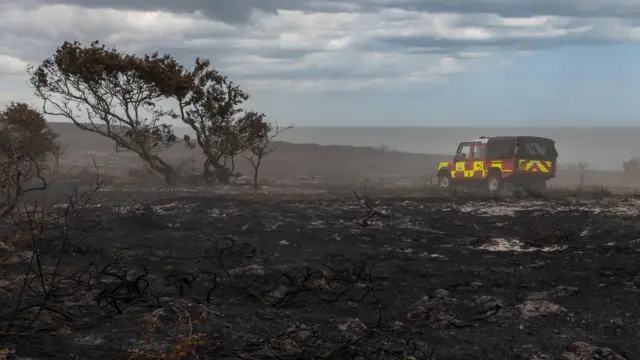
    Firefighters are battling a wildfire in Hampshire's New Forest National Park for a fifth day.

    The blaze has burned through 1.6 sq km (400 acres) of heathland, an area roughly the size of 230 football pitches.

    Crews say the fire's perimeter is now under control, but motorists have been warned about smoke affecting nearby roads this morning.

    Temperatures in the area are expected to reach 31C later, raising concerns that conditions could hamper efforts to fully extinguish the fire.

  20. Met Office expands amber warning area as high temperatures expected further westpublished at 10:18 BST
    Breaking

    Darren Bett
    Lead weather presenter

    The Met Office has expanded the area covered by its amber extreme heat warning further west.

    The length of the warning has not changed and still remains in place until 23:59 today.

    In its update, the Met Office says: "The highest temperatures will be in parts of the the Midlands and western England, where 37C or even 38C could be reached."

    A map showing an amber warning - updated to cover more parts of western England