Summary

  1. Bank of England holds UK interest rate at 3.75%, but hints at rises to comepublished at 14:22 BST

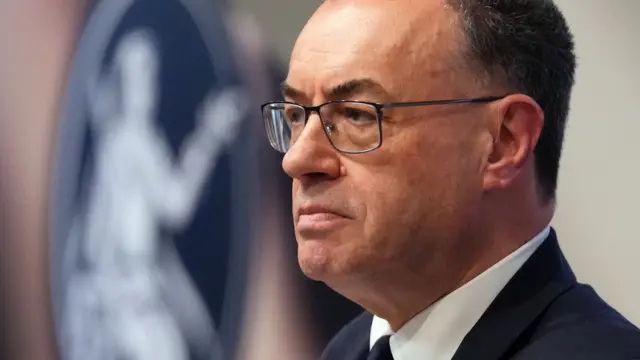
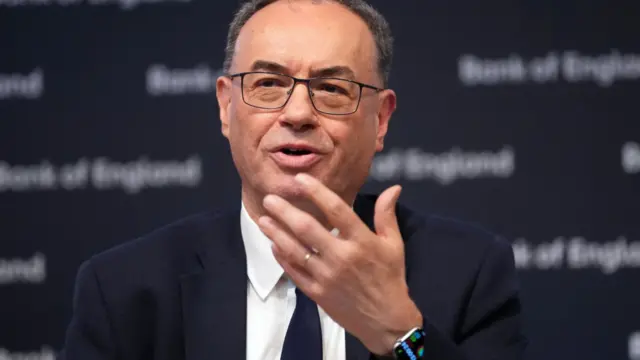
    Governor of the Bank of England Andrew Bailey speaks during the Bank of England Monetary Policy Report press conference, at the Bank of England in the City of London. Picture date: Thursday April 30, 2026Image source, PA Media

    The Bank of England has held the interest rate at 3.75%, but signalled rates could rise later this year owing to inflationary pressures from the Iran war.

    Here's an overview:

    • The Bank's nine-member rate-setting committee voted 8-1 in favour of holding the rate, with the Bank's chief economist Huw Pill voting for a rise to 4%
    • However, in its announcement, the Bank says further rises were likely and pointed to the possibility of "forceful" rises to come
    • Bank of England Governor Andrew Bailey stressed how difficult it is to predict which way things will go, due the volatility caused by the Iran war and its impact on energy prices - we've looked at three scenarios examined by the Bank
    • Chancellor Rachel Reeves said the UK is in a "stronger position" in relation to the Iran war due to choices Labour has made
    • But shadow chancellor Mel Stride said Reeves has "weakened" the UK economy and left it "vulnerable" to an energy shock

    We’re ending our live coverage now, but you can read more in our full article here.
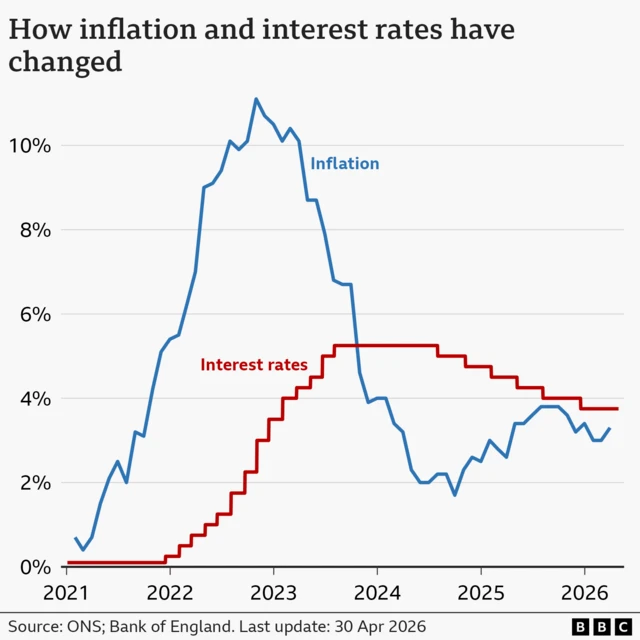
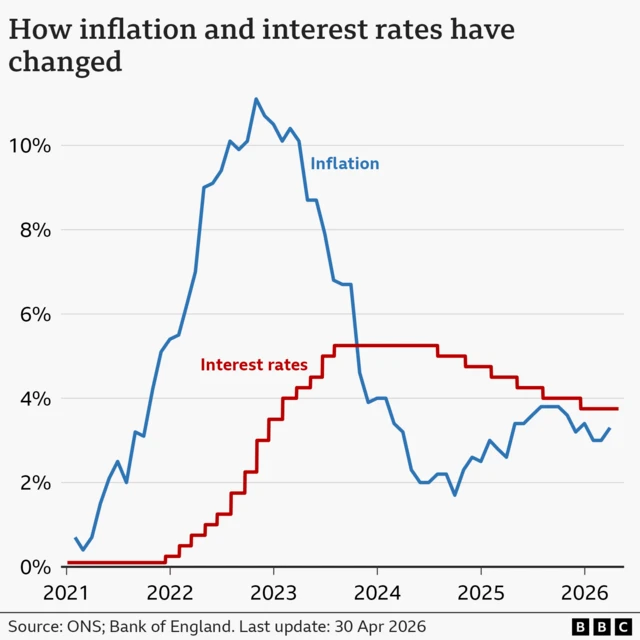
    A line chart showing interest rates and CPI inflation in the UK, from January 2021 to April 2026. Interest rates were at 0.1% in January 2021. They were increased from late-2021, reaching a peak of 5.25% in August 2023. They were then lowered slightly to 5% in August 2024, to 4.75% in November, to 4.5% on 6 February 2025, to 4.25% on 8 May 2025, to 4% on 7 August, and to 3.75% on 18 December. At the Bank of England's latest meeting on 30 April 2026, rates were held at 3.75%. The inflation rate was 0.7% in the year to January 2021. It then rose to a peak of 11.1% in October 2022, before falling again to a low of 1.7% in September 2024 and then starting to rise again. In the year to March 2026, it was 3.3%, up from 3.0% the previous month.
  2. Bank expects food prices to rise due to both energy and fertiliser costspublished at 14:22 BST

    Dearbail Jordan
    Business reporter, reporting from the Bank of England

    Food prices are expected to rise further than they have already this year, Bailey says, but not just because of energy prices, but also owing to the availability of fertilizer.

    The Middle East is a major source of the materials needed to make fertilizer, such as urea.

    The Bank reckons that food price inflation could rise to 4.6% in September. But it could get worse towards the end of the year, just in time for Christmas.

    Asked if this could mean more expensive Christmas dinners this year, Bailey tells me "unfortunately a lot can happen between now and Christmas".

    He adds that it's impossible to generalise due to the way different foods are manufactured, but that the final impact on food prices "remains to be seen".

    Some businesses that the Bank’s agents speak to up and down the country to gauge what conditions on the ground are actually like suggest that food price inflation could rise to 6% or even 7%.

    But, again, it all depends on what happens with the Iran war.

  3. The three scenarios the Bank considered as part of its assessmentpublished at 13:54 BST

    Shanaz Musafer
    Business reporter

    In these uncertain times, the Bank’s Monetary Policy Committee set out three scenarios for how the UK economy might react to changes brought about by the war in Iran:

    In scenario A, energy prices fall back and inflation, as measured by the Consumer Prices Index (CPI) rises to 3.6% at the end of this year before falling below 3% by autumn next year.

    In scenario B, energy prices fall back more slowly than in Scenario A, inflation rises to 3.7% this year and remains elevated for longer.

    In scenario C, the most adverse scenario, oil stays above $120 a barrel for the rest of the year and inflation peaks at 6.2% at the beginning of next year. Such a scenario could see as many as six interest rate rises to 5.5%.

    The price of oil has been volatile since the start of the Iran war but is much higher than it was beforehand. This morning, it was trading at $120.

    The Bank did not give probabilities as to how likely each scenario was. However, the Bank’s governor said he placed more weight on scenario B.

  4. Bank must be 'careful' in reacting to volatility from Iran war - Baileypublished at 13:34 BST

    Governor of the Bank of England Andrew Bailey speaks during the Bank of England Monetary Policy Report press conference, at the Bank of England in the City of London. Picture date: Thursday April 30, 2026.Image source, PA Media

    Bailey is asked about how the volatility in the last week of the Iran conflict and its economic affects has impacted his thinking.

    The Bank's governor speaks about the volatility of oil prices and the perception of events in the Middle East since the Iran war began.

    On the last week alone, he says: "You look at the oil price curve, it went up, then you had a period where it was coming back down again, and now it's gone back up again.

    "All of that hangs off, frankly, what's going on in the Gulf and... even more so actually sometimes what's being said about what's going on in the Gulf."

    "We have to be quite careful here," he says, adding he doesn't pin his reading of the world on one particular period of time "because frankly we've seen such changes over the period since this whole conflict began".

  5. A gloomy outlook for energy bills amid Iran war uncertaintypublished at 13:09 BST

    Kevin Peachey
    Cost of living correspondent

    The Bank's governor, Andrew Bailey, has been stressing the volatility of the situation, and so how difficult it is to make predictions.

    However, the longer the upheaval in the Middle East, the more likely the impact on domestic energy prices.

    Energy regulator Ofgem's price cap affects the bills of millions of households in England, Scotland and Wales. For a household using a typical amount of gas and electricity, the current annual bill is £1,641. The Bank suggests this will rise "close to £1,900" in July and stay there for the rest of the year.

    However, nearly 40% of households are on fixed tariffs for electricity and gas, higher than the roughly 25% of households with fixed tariffs when prices shot up following Russia's invasion of Ukraine in 2022. These households will be protected from higher prices until their contracts end.

    Those on prepayment meters can use less energy during the warmer summer months. "If prices are still high in the winter, then these households will face larger rises in costs," the Bank says.

  6. Bailey cannot give 'cast iron assurance' of no rate increases in lower inflation scenarios examinedpublished at 13:06 BST

    The BBC's economics editor Faisal Islam asks Bailey to clarify that, if oil prices fall going forward, rather than remain at the high level they are currently, will it avoid the necessity for further rate rises.

    There had been interest rate cuts assumed before the energy price increase, and "there is a good deal of room to accommodate the type of tightening" that would be needed in the Bank's lower inflation scenarios.

    But Bailey says he cannot give a "cast iron assurance" that there will be no increases in any of the scenarios the Bank has examined, adding: "A good deal of space was available to accommodate that."

  7. 'Where we go depends on size and duration of energy shock,' says BoE governorpublished at 12:40 BST

    Dearbail Jordan
    Business reporter, reporting from the Bank of England

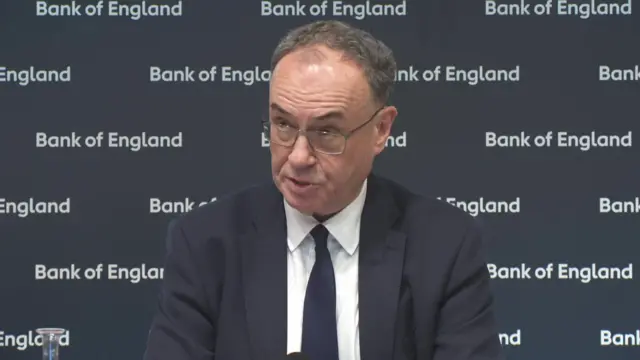
    Bank of England governor Andrew Bailey in suit and tie sitting down during a press conference

    Bank governor Andrew Bailey has started speaking.

    He says that where we go from here – which means what will happen to interest rates - will "depend on the size and duration of the energy price shock".

    You can watch live above.

  8. New fixed mortgage could cost £80 a month more during next three years - Bankpublished at 12:39 BST

    Kevin Peachey
    Cost of living correspondent

    People coming to the end of their fixed mortgage deals will be looking with some trepidation at the news coming from the Bank today.

    In its report, the Bank's rate-setting committee says that, over the next three years, average monthly payments for those moving on to a new deal (or getting a first one) are expected to rise by approximately £80.

    But it stresses that is an average and there could be considerable variation, and that estimate will depend partly on the outlook for energy prices and all that affects.

    About 53% of UK mortgage holders are expected to see their payments rise, the Bank says, but around 25% of those who fixed at higher rates should see their payments fall, despite recent increases in rates.

  9. UK in 'stronger position' due to government choices, Reeves sayspublished at 12:25 BST

    A file photo of Reeves, sitting on stage at an eventImage source, Getty Images

    In a statement released after the Bank of England's decision to hold interest rates at 3.75%, Chancellor Rachel Reeves says the war in the Middle East is "not our war, but it is one we have to respond to".

    "Every choice I make will be about keeping costs down for families and businesses, without repeating the mistakes we’ve seen in the past that resulted in higher inflation and higher interest rates," she says.

    "We entered this conflict in a stronger position because of the choices this government took to build economic stability, and we are going further to take back our energy security."

    She adds that the government is also "backing British industry" to "build a Britain that is stronger, more resilient, and prepared for the future".

  10. Reeves has 'weakened' economy and left UK 'vulnerable' to energy crisis - Conservativespublished at 12:22 BST

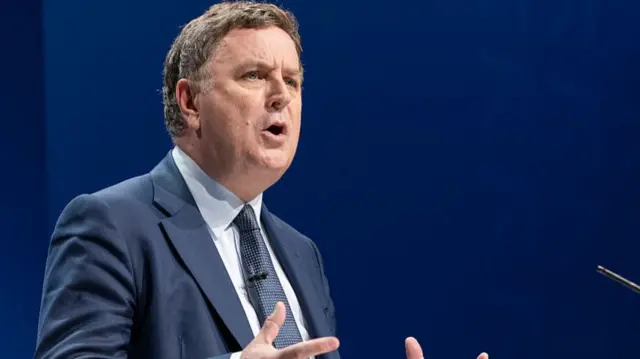
    Mel Stride Shadow Chancellor of the Exchequer delivers a speech to the Conservative Conference on October 6, 2025 in Manchester, EnglandImage source, Getty Images

    Shadow chancellor Mel Stride says Rachel Reeves has "weakened" the UK economy, following the Bank of England's decision to hold interest rates at 3.75%.

    He adds that the Labour chancellor has "left us vulnerable in the run up to the latest energy crisis".

    "The conflict in the Middle East is pushing up prices - but the UK already had the highest inflation in the G7 thanks to Labour’s choices," he writes on X.

    "Tax hikes, reckless spending and disastrous energy policies have paved the way for high inflation and interest rates staying higher for longer."

  11. Committee almost united over decision to holdpublished at 12:15 BST

    Kevin Peachey
    Cost of living correspondent

    At its last meeting in March, the committee was unanimous in its decision to hold interest rates.

    This time, the vote was 8-1.

    The Bank’s chief economist, Huw Pill, voted for a rise to 4%. Other members said the Bank should wait to see the extent of the inflationary pressure, despite some considering to vote for a rise.

  12. Bank outlines three energy price scenarios, reflecting Iran war uncertaintypublished at 12:13 BST

    Faisal Islam
    Economics editor, reporting from the Bank

    The Bank reflected the uncertainty over the war in the Middle East by outlining three scenarios for energy prices.

    Its experts seem to endorse a modest rate rise or two even in a more benign scenario, with energy prices moderating from here.

    The Bank’s chief economist Huw Pill voted for a rise this month, alone. Other members said the Bank should wait to see the extent of the inflationary shock.

    In an adverse scenario with oil above $120 a barrel for the rest of the year and much higher natural gas prices, as many as six rate rises to 5.5% are hinted at, by the end of the year, to try to manage inflation down from a forecast 6%. The economy would be much weaker in such a scenario and unemployment higher.

    The oil price was already around this range this morning, after President Trump indicated the US blockade of Iranian ships could last months longer.

    It is the relatively modest reaction of gas prices, for example compared with the Ukraine crisis two years ago, that has helped the Bank hold off rate rises.

    It also said that the pass through of inflation to wages - which can become a reinforcing upward spiral - might be limited by the fact that most pay deals for the year were concluded before the start of this energy shock

  13. Bank points to likelihood of higher inflation and interest rate rises later this yearpublished at 12:09 BST

    Faisal Islam
    Economics editor, reporting from the Bank

    While the Bank of England held interest rates at 3.75% just now, it pointed to the likelihood of higher interest rates, and the possibility of what it called "forceful" rises.

    Up to six rises could be possible in a worst case if oil prices remain at today’s levels approaching $130 a barrel for the rest of the year, and gas prices rise further, with inflation almost doubling to above 6%, it says.

    The Bank’s nine member committee has sent the message with its deliberations and forecast that higher inflation is on the way and higher rates are likely this year.

    Exactly how much higher both will go, remains as uncertain as the underlying prospects for reopening the Strait of Hormuz.

    A line chart showing interest rates and CPI inflation in the UK, from January 2021 to April 2026. Interest rates were at 0.1% in January 2021. They were increased from late-2021, reaching a peak of 5.25% in August 2023. They were then lowered slightly to 5% in August 2024, to 4.75% in November, to 4.5% on 6 February 2025, to 4.25% on 8 May 2025, to 4% on 7 August, and to 3.75% on 18 December. At the Bank of England's latest meeting on 30 April 2026, rates were held at 3.75%. The inflation rate was 0.7% in the year to January 2021. It then rose to a peak of 11.1% in October 2022, before falling again to a low of 1.7% in September 2024 and then starting to rise again. In the year to March 2026, it was 3.3%, up from 3.0% the previous month.
  14. No surprise the interest rate was held, but what next?published at 12:03 BST

    Kevin Peachey
    Cost of living correspondent

    There’s no great surprise in that decision by the Bank of England to hold interest rates at 3.75% – it was widely predicted by analysts.

    But now every page of the committee’s report and every word spoken by the Bank’s governor will be pored over by the markets.

    Any indication of what the members of the rate-setting committee might do at future meetings can shift their expectations.

    In turn, that can have an impact on what lenders charge borrowers, and what banks and building societies offer savers.

  15. Interest rate held by Bank of England at 3.75%published at 12:00 BST
    Breaking

    The Bank of England holds its interest rate at 3.75%.

    Our teams are looking over the announcement now and we'll bring you more shortly.

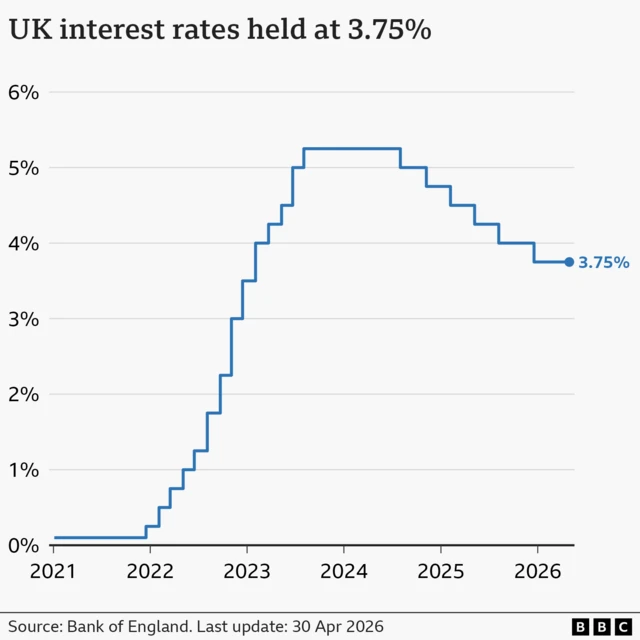
    A line chart showing interest rates in the UK from January 2021 to April 2026. At the start of January 2021, rates were at 0.1%. From late-2021, they gradually climbed to a high of 5.25% in August 2023, before being cut to 5% in August 2024, 4.75% in November, 4.5% in February 2025, 4.25% in May, 4% in August, and 3.75% in December. At the Bank of England's latest meeting on 30 April 2026, rates were held at 3.75%.
  16. Bank of England's interest rate decision expected shortlypublished at 11:58 BST

    At 12:00 BST we will hear the Bank of England's decision on interest rates, which many experts expect to be held at 3.75%.

    We'll bring you the news as soon as we have it, followed by analysis from our team of expert on what it means for you.

  17. Analysis

    Beyond the rate decision, people will be looking closely at the Bank's language todaypublished at 11:56 BST

    Dearbail Jordan
    Business reporter

    It is unlikely - not impossible - but highly unlikely that the Bank of England will change interest rates today.

    What we'll be looking at is the language the Bank uses and what it could mean for rates in the coming months.

    What impact will the Iran war have on Britain's finances? What will it mean for energy bills, inflation and, by extension, the cost of living?

    The Bank may talk about the prospect of stagflation - stagnant economic growth and rising inflation at the same time.

    Or it could repeat what it said in February, that it stands ready to act. Because, at the moment, we just don't know when the conflict will end.

  18. The last 24 hours shows how unpredictable things arepublished at 11:51 BST

    Kevin Peachey
    Cost of living correspondent

    Members of the rate-setting committee will be earning their crust today as they weigh up all the complicated factors affecting economies here and around the world.

    Last night added another important issue to consider as oil prices jumped to their highest level since 2022 before dipping in the last hour or two.

    A wait-and-see approach, and a hold in interest rates, may seem like the easy option when faced with a whole load of economic unpredictability. It is, however, a very active decision.

    As one analyst says, the committee is likely to "resolutely do nothing".

    As our economic editor notes, the latest reports of US plans to strike Iran will not be factored into today's decision - read Faisal Islam's analysis.

  19. Ups and downs of mortgage rates are tricky to predictpublished at 11:43 BST

    Kevin Peachey
    Cost of living correspondent

    One thing is clear: the economic upheaval created by the war in Iran has pushed up the cost of mortgages for homeowners getting a new fixed deal.

    Remember, for borrowers, the interest rate on a fixed mortgage does not change until the deal expires, usually after two or five years, and a new one is chosen to replace it.

    The average rate on a two-year fixed deal was 4.83% at the start of the conflict, but rose to a peak of 5.90%, according to financial information service Moneyfacts. That has now dropped to 5.79%.

    A host of lenders have announced cuts in the last 24 hours, but brokers say that fixed rate rises in the coming weeks cannot be ruled out.

    "The standard advice in uncertain economic times stands: secure a mortgage rate you think suits your circumstances or looks reasonable value for money as soon as you can, then try to switch to a cheaper deal with the lender before your mortgage is due to complete," said Aaron Strutt, from mortgage broker Trinity Financial.

  20. Savers urged to shop aroundpublished at 11:41 BST

    Kevin Peachey
    Cost of living correspondent

    Savers are keen for interest rates to go up. Borrowers are keen for rates to go down. Most people actually fall into both camps.

    When interest rates are held, the temptation for savers, in particular, is to stick with what they've got.

    But experts say that "apathy" can mean they are missing out on the possibility of a better return on their nest eggs.

    Half of UK savings accounts can beat 3.75% - the current Bank of England benchmark rate - but it is usually those who haven't switched provider for a long time who get the worst deal, according to financial information service Moneyfacts.

    The danger is that if prices rise sharply, then the buying power of those savings is diminished, especially if the interest received on those savings is poor.