Summary

Media caption,
Watch: Canada will negotiate if US has the "right attitude", says Mark Carney speaking on Monday
  1. Analysis

    Carney sees little support from EU countries over developing US trade warpublished at 18:10 BST

    Paul Kirby
    Europe digital editor

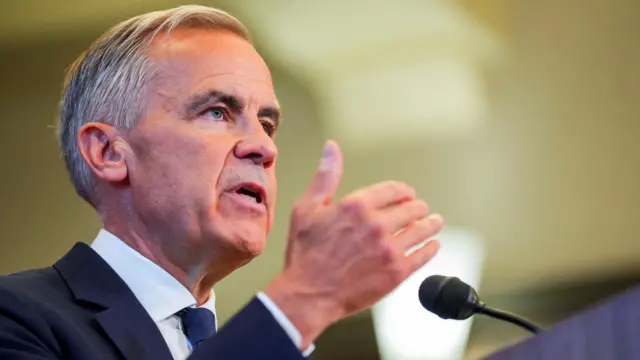
    Canada’s Prime Minister Mark Carney speaks with the news media after he suspended trade negotiations with the United States, in Ottawa, Ontario, Canada August 22, 2026Image source, Reuters

    Canada's Mark Carney has successfully courted European leaders in recent months - but so far he has seen little support from Europe over the developing trade war with the US.

    Carney was widely praised at the Swiss resort of Davos in the winter for warning that "middle powers" should work together in the face of more powerful nations flexing their economic muscle.

    But EU countries are also in Trump's crosshairs over tariffs and they have their own concerns. Little over a year ago, the EU agreed maximum US tariffs of 15% on most European exports.

    That was already a hard deal to swallow, but then last month Trump accused the EU of "robbing American companies" after it imposed an €890m ($1bn) fine on Google for breaching digital antitrust rules.

    That story isn't over yet.

    And while the EU does have powers to hit back - such as its so-called "trade bazooka", if non-EU countries threaten economic coercion - it will want to keep its power dry.

    And as the European Commission leads on trade policy, you can expect national leaders in Europe to keep quiet too.

  2. A closer look at the US goods impacted by Canada's tariffspublished at 17:55 BST

    Krystyna Gajda
    Live reporter

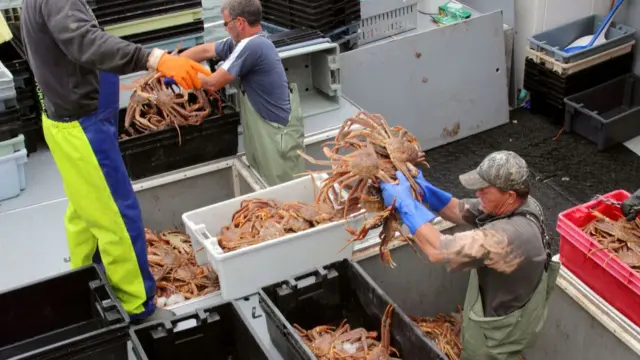
    Fisherman holding crabs in Nova Scotia, Canada, as other crabs are placed in boxes on the ground.Image source, Getty Images

    Canada has now outlined its response to Donald Trump's tariff hikes.

    It's a "dollar for dollar" set of retaliatory tariffs which will impact US goods - here's a closer look at the list of products in Canada's 99-page document:

    The following products will see a 25% tariff:

    Fish: live fish, including eels and varieties of bluefin tuna, fresh fish including tuna and dried, salted or smoked fish.

    Crustaceans and molluscs: such as crabs and lobsters, oysters and scallops and snails.

    Some dairy products: including milk and cream, concentrated, or containing added sugar or other sweetener. Cheese and curd - some famous brand names like Gouda, Havarti and Parmesan.

    Carpets: and other textile floor coverings of wool or fine animal hair.

    Subject to a 50% tariff:

    • Molasses resulting from the extraction or refining of sugar
    • Perfumes, beauty, make-up and hair preparations
    • Tableware, kitchenware, other household and hygienic or toilet articles
    • Toilet paper and similar paper - serviettes, tablecloths (ranging from 25% to 50%)
    • Flat-rolled products of iron or non-alloy steel
  3. Mexico watching Canada-US trade war closelypublished at 17:29 BST

    Will Grant
    North America correspondent

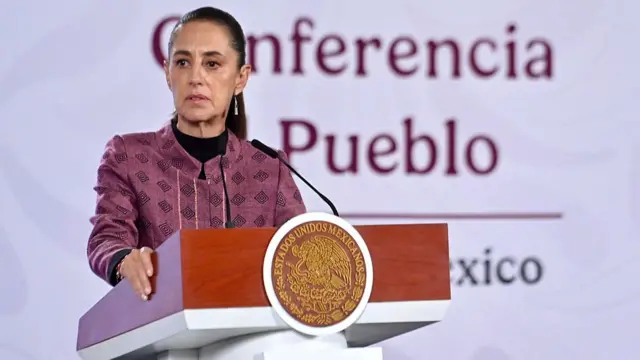
    President of Mexico Claudia Sheinbaum speaking into a microphone behind a podium.Image source, Getty Images
    Image caption,

    President of Mexico Claudia Sheinbaum

    The US tariffs on Canada aren't just a trade crisis for those two nations, they affect all of North America and all three signatories of the USMCA free trade agreement. That includes Mexico.

    So far, the Mexican President Claudia Sheinbaum has remained typically guarded. In her morning press briefing earlier this week, she said she remained "optimistic that an agreement could be reached".

    Sheinbaum remains upbeat, at least publicly, that Mexico enjoys "some of the lowest tariffs in the world".

    However, in a sign of the concerns on the Mexican side, she also despatched her Economy Secretary Marcelo Ebrard to Washington for emergency talks.

    Mexico has headaches of its own with Washington. Tariffs remain in place at the rate of 50% on steel and aluminium, and 25% on automobiles and car parts. So far, the diplomatic effort to reduce those figures have borne no fruit.

    Certainly, the stakes remain high. Mexico is the United States' top trading partner with around $900bn USD in annual trade and over 80% of Mexican exports heading to the US market.

    Washington's relations with Ottawa have been frostier under the Trump Administration than they have with Mexico, and President Trump has repeatedly praised Sheinbaum as a partner he can work with.

    However, the 1 July deadline for USMCA re-negotiation passed without agreement. There is no guarantee that Mexico can always avoid the imposition of more tariffs if the Trump administration decides its trade deficit with its southern neighbour merits them.

  4. 'We'll always call it Lake Ontario,' industry minister says after Trump said US would change namepublished at 17:23 BST

    Joly is next asked about Trump's comments that the US is "seriously considering" changing the name of Lake Ontario to Lake America.

    "We'll always call it Lake Ontario," she says, adding while these "shenanigans" are happening "we'll be strategic and we'll fight back".

    The news conference has come to an end, stay with us for more updates shortly.

  5. Industry minister defends importance of bilingualism in Canadapublished at 17:21 BST

    Industry Minister Mélanie Joly is next asked what she makes of Trump's comments around the French language in Canada.

    It comes after Prime Minister Mark Carney had said one of the sticking points in reaching a trade deal was a US request for Canada to drop its requirement of American businesses to write manuals and labels in French for Quebec consumers - something US negotiators have denied.

    Earlier today, the US President said he would "never interfere with Canadians speaking French", insisting "I love French Canadians".

    Joly says having two official languages - English and French - is at the "core of the creation of our country" and is part of its DNA.

    Making sure Canada is able to make its own decision when it comes to the protection of bilingualism is key, she adds.

  6. Canada's retaliatory tariffs and support package - in a nutshellpublished at 17:09 BST

    Grace Eliza Goodwin
    US reporter

    Canadian ministers today announced the country's response to US President Donald Trump's tariffs - here's a recap:

    • Canada announces $20bn of retaliatory tariffs on US goods including milk, steel, clothing and plywood
    • Counter-tariffs of 15%, 25%, or 50% will be imposed on some imports from the US - - here's a closer look at which goods are impacted
    • It will effectively match US tariffs - imposed by Trump - "dollar-for-dollar", Canada's finance minister says
    • A package of measures aimed at supporting business and workers will include an investment of C$1.5 billion(around $1bn) for small and medium-sized businesses
  7. Finance minister says Canada's response to tariffs is 'proportionate'published at 16:56 BST

    Back to the news conference now, where the Canadian ministers we've just heard from are taking questions.

    Finance Minister François-Philippe Champagne is asked why the government is not bringing Canadian exports levies against Canadian energy or potash - mined and manufactured salts - which are two areas critical to the US economy.

    Champagne responds by saying they have been proportionate in their response, and have been in this trade conflict for quite some time, so know what products need to be tariffed.

    He says the new tariffs imposed by the US are going to be "disproportionately affecting" small and medium-sized businesses.

    Champagne says this is why they've announced a "substantial support package" and they are focused on ensuring companies can be competitive in the Canadian market.

    "That's what's driving our response. That's what is going to drive our response for the days and weeks ahead," he says.

  8. Analysis

    Escalation of trade war comes at bad time for Republicanspublished at 16:54 BST

    Gary O'Donoghue
    Chief North America correspondent, reporting from Washington DC

    Now that Canada has announced its dollar for dollar retaliatory tariffs, the escalation of this trade war could not have come at a worse time for Republicans.

    The potential fallout threatens a bunch of those states that could decide control of the US Senate.

    Maine, Ohio, Michigan and Alaska rely on industries like fisheries, auto parts and lumber that cross the northern border - and all feature competitive Senate races.

    Maine's Republican Senator Susan Collins, one of Democrats' top targets this year, warned the fallout would hurt US businesses and consumers, citing lobsters and blueberries. Iowa, even though it's not a border state, counts Canada as one of its more important export markets.

    One key respected tracker of electoral races recently pushed Iowa from the lean Republican column, into the toss-up column.

    With affordability dominating voters' minds, Republicans defending not just Senate seats, but also their narrow majority in the House could well do without this flare up with their neighbour to the north.

  9. We didn't ask for this trade conflict but we're ready for it, Canadian minister sayspublished at 16:46 BST

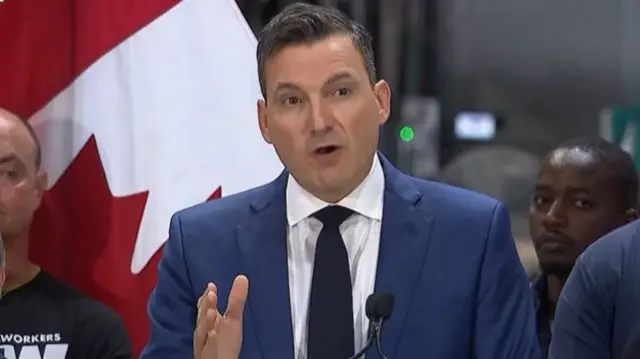
    Evan Solomon speaking at a podiumImage source, Reuters

    Evan Solomon, Canada's Minister for AI and Digital Innovation, is up at the podium.

    He says Canada "didn't ask for this trade conflict, but we're ready for it".

    Canada is ready to make a good deal, he says, but won't sign a bad deal. "We won't now, we won't ever."

    "We're not going to bend, we're not going to break, we're going to build."

  10. 'This is not the first time Canada has faced unjust tariffs'published at 16:41 BST

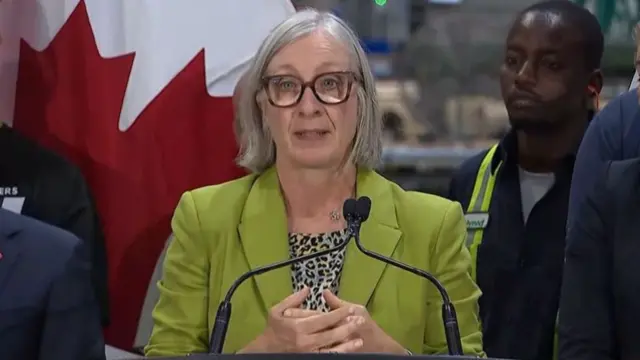
    Patty Hadju wearing a bright green blazer and speaking into a podiumImage source, Reuters

    Patty Hajdu, the minister for jobs and families, says it's not the first time Canada has faced "unjust" tariffs.

    She then outlines the measures the government has already taken to protect jobs and businesses.

    Now, Canada will "double down" and invest an additional $3.5bn to "provide the stability" for individuals and the economy, Hadju continues.

    She says the government will also enhance worker retention and retraining programmes, so that employees can keep their jobs even when businesses are struggling.

  11. What's in Canada's support package for workers and businesses?published at 16:38 BST

    Canadian ministers have just announced a package of measures aimed at supporting businesses and workers in the wake of fresh tariffs imposed by the US.

    Here's a breakdown of some of the measures included:

    • An additional C$1.5 billion (around $1bn USD) investment to help small and medium-sized businesses, including liquidity supports to manage the pressures related to tariffs
    • A new C$500 million liquidity stream to help businesses "manage immediate cash-flow pressures in addition to targeted programs for the forestry, steel and aluminium sectors"
    • Lowering the minimum revenue requirement for applicants of the Business Development Bank of Canada’s tariff related programs to C$1 million
    • An additional C$2 billion investment to support tariff-affected businesses "with shovel-ready projects that support ongoing capital maintenance"
    • A new suite of C$3.5 billion Rapid Response Supports for Workers and Employers to help Canadians affected by tariffs

  12. Analysis

    Canada packs punchy response as trade war reaches flashpointpublished at 16:33 BST

    Michael Race
    Business and economics reporter, in New York

    The news conference is ongoing, but we can bring you some analysis from our business reporter following Canada's retaliatory tariffs announcement:

    Placing taxes on trade between what are historically two of the world's closest trading partners will undoubtedly lead to pain on both sides of the border.

    Supply chains which have been developed over decades are set to see increased trading costs due the latest tariff announcements made from both the US and Canada, ultimately hitting businesses of all sizes and consumers through potentially higher prices.

    Today, Canada has levied import taxes on goods ranging from fish, cheese and milk to plywood, toilet paper and even knives and forks being imported to the country from the US.

    The list is 99 pages is long and a punchy response to the fresh wave of US tariffs on a wide array of Canadian goods coming into effect on Saturday.

    Canada has shown it can pack a punch in this trade war to date through the decision by most provinces to ban American alcohol from liquor stores last year, which dealt a heavy blow to the US industry, with US wine exports plunging.

    But America's might as the world's largest economy gives it increased clout to not only hit back, but perhaps weather more easily the economic pain.

    Only time will tell which industries are hit hardest, but it's clear this trade war has reached a flashpoint.

  13. If you see a Canadian product, support it - industry ministerpublished at 16:30 BST

    Mélanie Joly pleads with Canadians: "If you see a Canadian product, please support it."

    "When you choose a Canadian product you're not only putting pressure on the US, right now, you are protecting jobs."

    She says this is what people can do to launch "a movement of resistance" against the tariffs imposed by the US.

    "We cannot wait for Washington to decide our future, we're strengthening our economy, and building a more sovereign Canada."

  14. Industry minister outlines package to support businessespublished at 16:28 BST

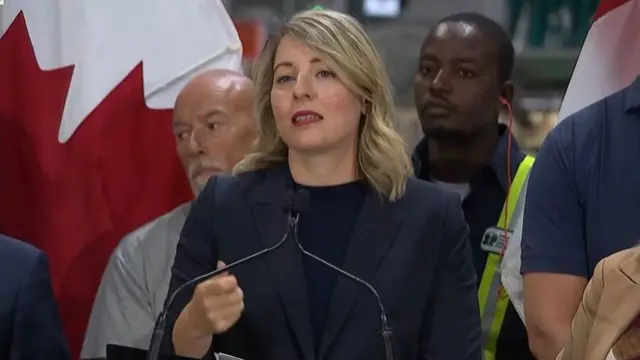
    Melanie Joly speaking at a podium in front of Canadian flagImage source, Reuters

    Industry Minister Mélanie Joly outlines further details about the government's C$7.5bn package of new enhanced measures to support workers and businesses.

    It will give small businesses access to C$3m ($2.1m) of non-repayable loans and up to C$2m ($1.4m) of interest free loans, she says, adding that businesses that will have access are those that have around $1m ($722k) in revenues.

    She acknowledges that business leaders and workers across the country are anxious and concerned, but says we will protect them and your jobs.

  15. Finance minister says counter-tariffs only one part of Canadian responsepublished at 16:20 BST

    Finance Minister Champagne says counter-tariffs are only one part of Canada's response.

    He adds the government must also provide businesses with liquidity and keep Canadians working, and that his colleagues will outline more "new and very substantive" measures.

    Champagne concludes by saying that when the US "asked too much and offered too little, we chose Canada".

    Industry minister Mélanie Joly is now at the podium.

  16. Milk, steel, clothing: Which US goods will be hit by tariffs?published at 16:15 BST

    Mark Carney has followed through on his threat to match Donald Trump's tariffs "dollar for dollar".

    Here's a breakdown of some of the US goods included:

    • A 50% tariff on steel and aluminum products that were previously only subject to a 25% counter tariff
    • A 50% tariff on various other goods including natural honey, furniture, clothing and apparel
    • A 25% tariff on goods including appliances, dairy products, such as cheese, fish and seafood, and certain steel and aluminum derivative products
    • A 15% tariff on certain types of tools and machinery, including forklifts and air conditioning machines
  17. Canada is facing an unprecedented challenge - finance ministerpublished at 16:12 BST

    Shortly before announcing $20bn of retaliatory tariffs on US goods, François-Philippe Champagne said Canada is facing an "unprecedented challenge" but adds "Canadians will meet the moment".

    He says targeted counter measures also include a C$7.5bn ($5.4bn) supportive package for workers and businesses.

    When Canada stands together nothing can stop us, he adds.

    As a reminder, you can watch the news conference live at the top of this page.

  18. Canada announces $20bn of retaliatory tariffs on US goodspublished at 16:10 BST
    Breaking

    Nadine Yousif
    Senior Canada reporter

    We've just heard an update from Finance Minister François-Philippe Champagne.

    Canada says it will effectively match US tariffs "dollar-for-dollar" and impose counter levies on American steel, dairy, appliances and a range of other goods.

    The latest action is in response to 50% tariffs imposed by the Trump administration on a small percentage of Canadian goods as of Friday after trade talks collapsed, in addition to existing US tariffs on Canadian steel, aluminium, automobiles and lumber.

    Around C$28bn - roughly $20bn USD - worth of American imports will be tariffed by Canada by a range of 15% to 50%, with the levies set to take effect at midnight on 8 September.

  19. Analysis

    Trump has sharpened his rhetoric, but political fallout could be damagingpublished at 16:04 BST

    Anthony Zurcher
    North America correspondent

    While we wait for Canadian ministers to provide an update, we can bring you analysis from our North America correspondent:

    US officials were reportedly surprised that Canada walked away from trade negotiations over the weekend.

    The next step for America’s northern neighbour, to announce a series of targeted retaliatory tariffs, has been telegraphed for days, however.

    It represents the latest ratcheting up of a growing dispute between two nations that, combined, account for more $872bn in bilateral trade in goods and services.

    Donald Trump has sharpened his rhetoric, repeatedly accusing Canada of "ripping off" the US. But the political fallout here in America is likely to be damaging to his Republican Party.

    While there are certain segments of the US economy that will ultimately benefit from the administration’s confrontational approach to trade negotiations, the pain will be more widely shared - particularly in states like Michigan and Ohio, which depend heavily on trade with Canada.

    Midwest states in particular have been a key part of Trump’s political coalition - and will be prominent battlegrounds in November’s midterm congressional elections - raising the stakes for the administration as it seeks to prevail in what is becoming an increasingly contentious economic confrontation.

  20. Canadian officials about to respond to Trump tariffs - watch and follow livepublished at 16:00 BST
    Breaking

    In the next few minutes, several Canadian officials will announce the country's response to Trump's tariffs.

    Finance Minister François-Philippe Champagne will be joined by other ministers to outline measures that will be taken to "protect and support Canadian workers and businesses".

    We're expecting the news conference to get under way at 11:00 ET (16:00 BST) - part of the update will be in French.

    You can watch live at the top of this page, and we'll bring you the latest updates. Stay with us.