Summary

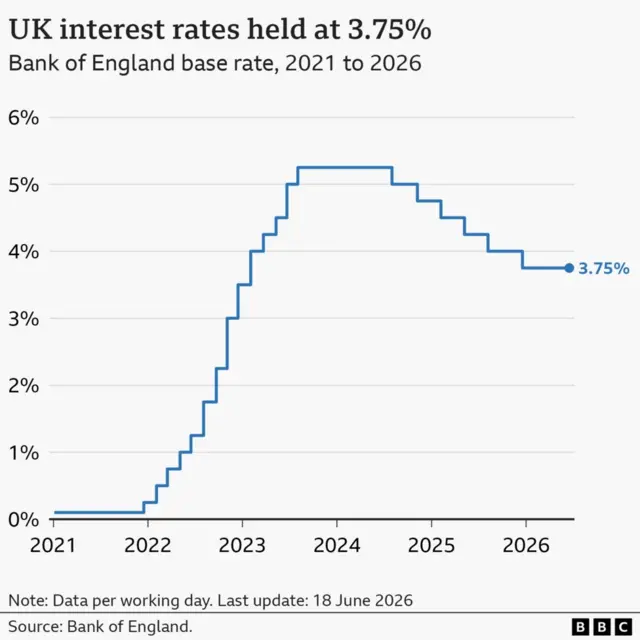
  • The Bank of England (BoE) holds interest rates at 3.75%

  • Three of the Monetary Policy Committee's nine members voted in favour of raising rates to 4% - but six voted to hold

  • It is the fifth time the Bank has kept the rate unchanged, as it assesses the impact of the US-Iran war

  • Andrew Bailey, governor of the Bak of England, warns "high and volatile energy prices" will "cause inflation to rise again later this year"

  • Last month, the UK's rate of inflation fell to 2.6% in the year to June, but is expected to rise in July

  • The interest rate influences rates set by other lenders, affecting things like consumer loans, mortgages and savings - here's what to know

Media caption,
Why are interest rates important?
  1. Decorators force change of location for Bank of England news conferencepublished at 12:51 BST

    Dearbail Jordan
    Senior business and economics reporter

    The entrance of Bloomberg

    The post-interest rate press conference isn’t taking place in the Bank of England this time because they’ve got the decorators in.

    Instead, the press conference will be held around the corner at Bloomberg’s offices which are a mix between very fancy and somewhere a Bond villain might hatch a plan for world domination.

    Stay tuned.

    A mural on a wall
    Image caption,

    A mural on the wall at the location of the press conference

  2. No change doesn't mean homeowners should do nothingpublished at 12:45 BST

    Kevin Peachey
    Cost of living correspondent

    It is easy to think that an interest rate hold means nothing changes if you are soon to renew a mortgage.

    But even though the Bank rate hasn't changed for some time, 30 lenders have increased their mortgage rates on new fixed deals in recent weeks.

    The risk to borrowers of the next Bank rate change being up, rather than down, means it could be time to act, according to Adam French, of financial information service Moneyfacts.

    "Anyone planning to take out a mortgage within the next six months should consider securing a deal sooner rather than later to protect themselves against further increases," he says. "If rates do fall before their mortgage completes, they can usually switch to a cheaper deal."

  3. Labour has left country 'poorly prepared' for shocks - shadow chancellorpublished at 12:40 BST

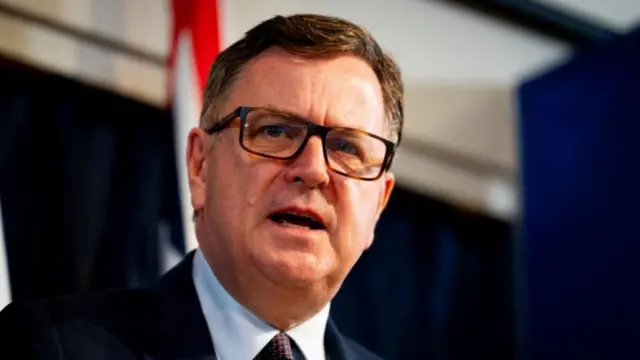
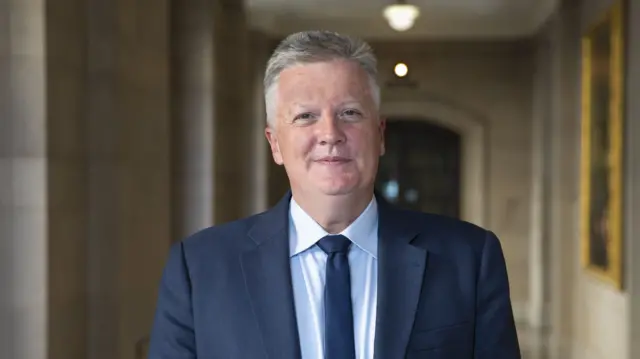
    Mel Stride wears a blue suit and black glasses.Image source, PA Media

    Reacting to the Bank of England's announcement, shadow chancellor Mel Stride says that "rates are staying higher for longer because Labour have left us poorly prepared for global shocks".

    "There's little trust Burnham's first budget won't do more damage," he says.

  4. Bank of England shares reasons behind holding ratespublished at 12:34 BST

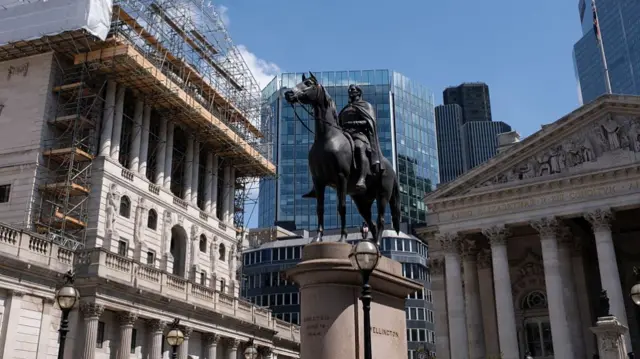
    The Bank of England building with the equestrian statue of the Duke of Wellington visible. The sun is shining on the building and statue.Image source, Getty Images

    The Bank of England has said interest rates are currently at "about the right level" to reduce inflation back to the 2% target in the medium term.

    It cites several points behind its decision to hold them:

    • Inflation has fallen "a bit further" than expected to 2.6%, the Bank says, but higher energy prices and their knock-on effects could force businesses to increase their prices
    • The conflict in the Middle East has disrupted energy transportation and supplies, pushing up households' motor fuel costs and utility bills
    • Mortgage rates and borrowing costs are also higher than before the conflict
    • It adds that there are more people looking for work than jobs, so employers may feel less pressure to increase salaries - thus containing the effects of energy price rises
    • The Bank says it is monitoring the situation "very closely", adding that monetary policy cannot affect global energy prices
  5. Analysis

    A highly conditional message emergingpublished at 12:25 BST

    Faisal Islam
    Economics editor

    This is a highly conditional message emerging from the Bank of England.

    It is ready to raise rates, if the war in the Gulf continues to re-escalate, and leads to $100 per barrel oil and in particular elevated market prices for gas as Europe refills its storage capacity ahead of winter.

    The one member of the nine member rate setting committee who changed her mind to vote for a rate hike, cited the collapse of the US-Iran memorandum of understanding.

    The judgement on that changes day-to-day, depending on the responses of the US and Iran.

    If, as some in the markets however firmly believe, and seemed to be the case just a month ago, a ceasefire returns and holds, then energy prices could fall rapidly and even according to a Bank of England deputy governor, justify thinking about rate cuts.

  6. Uncertainty isn’t ideal when planning your financespublished at 12:17 BST

    Kevin Peachey
    Cost of living correspondent

    The only thing that’s certain in the global economic outlook is uncertainty.

    Investors are watching events in the Gulf and waiting to see whether there is any chance of a lasting truce. The movement of shipping has a direct impact on the cost of food and fuel.

    So, for individuals, some big financial decisions - such as whether to move home - have been put on hold.

    But it’s the cost of essentials that’s worrying lots of families. Debt charity StepChange suggests that one in 10 UK adults have used a credit card to pay for essential household bills in the past three months, the equivalent to around five million people.

  7. A clear shift in how the nine-member committee votedpublished at 12:10 BST

    Kevin Peachey
    Cost of living correspondent

    Investors look for any hints in the committee's thoughts as they study every word of the MPC meeting's minutes.

    But one change is clear. Last month the nine-member committee voted 7-2 in favour of a hold. This time it was 6-3.

    That signals the greater global uncertainty compared with last time, and some borrowers may worry the next move could be up rather than down.

  8. Three out of nine members vote to increase rate to 4%published at 12:09 BST

    Dearbail Jordan
    At the Bank of England

    The Bank of England examined a range of scenarios of what might happen to inflation and the economy depending on the Middle East conflict.

    Inflation was previously expected to reach 3.5% this year. In a worst-case scenario, where oil prices reach $100 a barrel, the Bank now projects that inflation could reach 3.2% in 2026.

    In a scenario where oil prices are around $76 before falling back to $71, inflation could reach 3%. While better than previously forecast, that remains above the Bank of England’s 2% target.

    The UK economy is expected to grow by 1.1% this year, ahead of forecasts in April.

    While the Bank’s rate-setting committee voted to hold borrowing costs, three of its nine members wanted to increase the rate to 4%.

    Megan Greene, one of the three who voted for a rise, said that while there was uncertainty because of the Iran war, other "risks loom" over inflation.

    These include a second choke point for global energy supplies in the Red Sea – Houti rebels in Yemen recently attacked oil tankers passing through the region. She also warned about El Nino and a slowdown in AI-related hardware should supply constraints continue.

  9. Inflation will rise this year, says Bank of England governorpublished at 12:08 BST

    Dearbail Jordan
    At the Bank of England

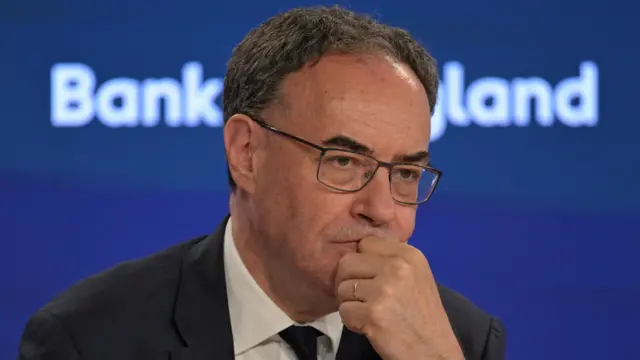
    Bank of England governor Andrew BaileyImage source, Reuters

    Recent data showed that UK inflation eased to 2.6% in the year to June, when diesel and petrol prices fell during a brief lull in hostilities between the US and Iran.

    Governor Andrew Bailey said: "Inflation has fallen faster than expected but the conflict in the Middle East continues to mean high and volatile energy prices. That will cause inflation to rise again this year.

    "However, as the conflict unfolds, our job is to make sure any increase in inflation is temporary and that it comes back to our 2% target."

  10. UK economy expected to grow - but uncertainty remainspublished at 12:05 BST

    Dearbail Jordan
    At the Bank of England

    The UK economy is expected to grow by more than previously forecast this year, according to the Bank of England, although major uncertainties remain because of the Iran war.

    The Bank said it expects the pace of price rises – known as inflation – to pick up due to volatile oil and gas prices caused by conflict in the Middle East.

    But the peak will be slightly lower than previously thought and the UK economy will expand a little more.

    The Bank voted to hold interest rates at 3.75% for a fifth time. They said any change in borrowing costs would depend on how long the energy shock will last – and how severe it is.

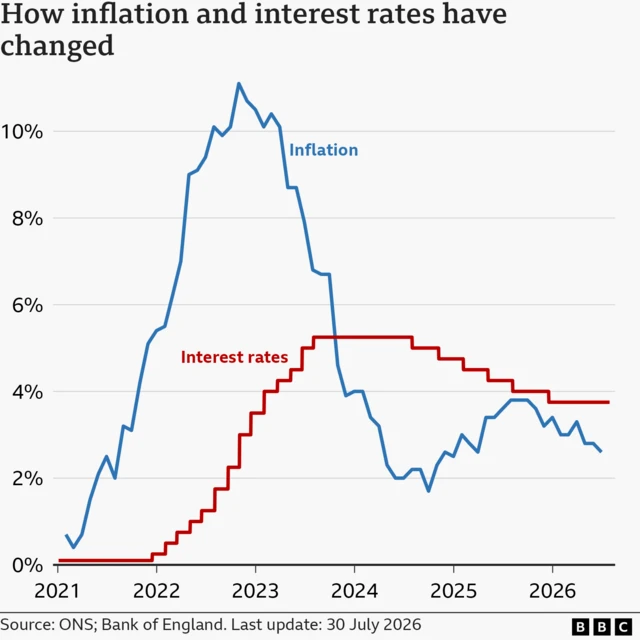
    A line chart showing interest rates and CPI inflation in the UK, from January 2021 to June 2026. Interest rates were at 0.1% in January 2021. They were increased from late-2021, reaching a peak of 5.25% in August 2023.They were then lowered slightly to 5% in August 2024, to 4.75% in November, to 4.5% on 6 February 2025, to 4.25% on 8 May 2025, to 4% on 7 August, and to 3.75% on 18 December. At the Bank of England's latest meeting on 30 July 2026, rates were held at 3.75%. The inflation rate was 0.7% in the year to January 2021. It then rose to a peak of 11.1% in October 2022, before falling again to a low of 1.7% in September 2024 and then starting to rise again. In the year to March 2026, it was 3.3%, up from 3.0% the previous month. However, the picture has changed since then and in the year to June 2026 the inflation rate was 2.6%

    Oil and gas prices have whipsawed in recent days because of the on-again-off-again peace deal between the US and Iran.

    On Monday, the price of crude fell as US President Donald Trump said there were "very friendly negotiations" happening between Washington and Tehran.

    On Wednesday, oil shot up to more than $91 per barrel as Trump said of Iran: "We’ll be hitting them hard. They’re going to get a beating."

    Recent data showed that UK inflation eased to 2.6% in the year to June, when diesel and petrol prices fell during a brief lull in hostilities between the US and Iran.

  11. Interest rates held by Bank of England at 3.75%published at 12:00 BST
    Breaking

    Dearbail Jordan
    Senior business and economics reporter

    UK interest rates have been held at 3.75% for a fifth time by the Bank of England as it continues to assess how volatile energy prices are affecting the economy.

    The rate - which influences how much borrowers are charged for loans and mortgages as well as returns for savers - is at its lowest level since February 2023.

    The Bank was widely expected to keep the rate unchanged despite a slowdown in inflation last month.

    However, more recently, the on-again-off-again peace deal between the US and Iran has seen oil prices swing wildly, briefly touching $100 a barrel.

    Stay with us as we bring you more on what this means for you.

  12. Bank of England's interest rate decision expected shortlypublished at 11:57 BST

    We will be getting the Bank of England's decision on interest rates in just a few minutes, which analysts are expecting will be held at 3.75%.

    The figure will be shared on this page as soon as we have it, with analysis from our team and what it means for your money.

  13. Today's decision follows slight growth in economy in Maypublished at 11:43 BST

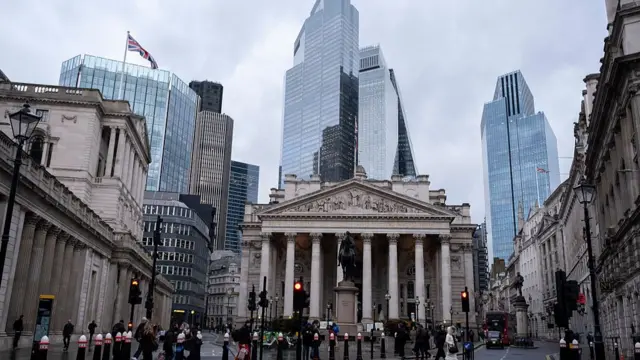
    A view of the City of London, featuring the Bank of England, as well as several tall skyscrapers in the backgroundImage source, Getty Images

    The UK's economy grew 0.1% in May, marking a slight rebound from a small contraction in April.

    Over the three months to May, the Office for National Statistics (ONS) said the economy had grown by 0.7% compared with the previous three-month period.

    It called the three-month performance "robust", but noticed that the pace of growth had slowed in April and May.

    For context:

    • Economic growth is measured by the change in the country's gross domestic product (GDP), which includes the economic activity of companies, governments and people in a country, and is published by the ONS
    • Most economists, politicians, and businesses like to see GDP rising steadily because it usually means people are spending more, jobs are created, more tax is paid, and workers get better pay rises
  14. Watch: How the Bank of England sets ratespublished at 11:38 BST

    Interest rates are determined by the Bank of England's base rate, set by its Monetary Policy Committee.

    The base rate is moved to keep UK inflation at or near its target of 2%.

    Our senior business and economics reporter Dearbail Jordan explains the process in the video below:

    Media caption,

    What happens at the Bank of England has a big impact on your money

  15. Interest rates may need to rise this year - Bank of England's chief economistpublished at 11:30 BST

    Felicity Evans
    BBC Wales money editor

    Huw Pill smilingImage source, PA Media

    While we aren't fortunate enough to know what interest rate decisions the Bank of England will take for the rest of the year, their chief economist did give us an insight earlier this month.

    Speaking to the BBC's Walescast podcast, Huw Pill said he believes interest rates will need to increase this year to keep inflation down.

    Pill is one of only nine people in the UK who decide what the Bank of England's interest rate should be - he and one other Monetary Policy Committee (MPC) member voted for an increase in June.

    "I've been at the bank for 56 months, inflation's been at or below target for three months, it's been above target for 53 months," he said.

    "So I think that's a reflection of the fact that, in part, we've had some bad luck, we've been subject to challenges, but perhaps we've been a little bit over optimistic about what the trend growth in the economy is."

  16. A hold in rates doesn’t mean borrowing costs are unchangedpublished at 11:25 BST

    Kevin Peachey
    Cost of living correspondent

    Even if the Bank holds rates today, some mortgage borrowers renewing or getting a first deal are facing rising interest rates.

    Some of the biggest UK lenders have raised their rates on new, fixed deals in recent days.

    The average rate on a new two-year fixed deal is 5.62%, according to financial information service Moneyfacts - the highest for more than a month.

    Rates are going up because of lenders’ funding costs rising owing to renewed volatility in the Middle East.

    Individual companies don’t want to be inundated with applications so the sector tends to move as a pack.

  17. 'I need mortgage rates to come down so I can pay my bills'published at 11:10 BST

    Priya Patel
    Economics producer

    Priya's portrait, with her looking at the camera and smiling

    Priya Kapadia has owned her home for two and a half years and is coming to the end of her original fixed-term deal with an interest rate of over 5.5%. She says she needs rates to come down to save money on her monthly mortgage payments so she can pay her bills.

    "We are already paying twice what we were paying as rent for our mortgage," she says, adding it's "eroded about 50%" of the money they had to spend on other things.

    "I'm not even talking about luxuries or comforts. I haven't had a holiday... we don't go out to eat because you now have a home, so you need to take care of things."

    Priya says she will fix her next mortgage deal for five years instead of the three years she went for last time, as it will "secure" her for longer.

    And she adds "every other direct debit has gone up", such as gas, electricity and council payments.

    "So, if it stays at the 3.75% as it is now, and if the lenders out there don't come down significantly... then I'm going to probably save about £10 or £20 a month."

    But Priya thinks if the rate goes down further, she could save up to £150 "at most", which will then help her with bills.

  18. Rate-setters may need a crystal ballpublished at 11:00 BST

    Kevin Peachey
    Cost of living correspondent

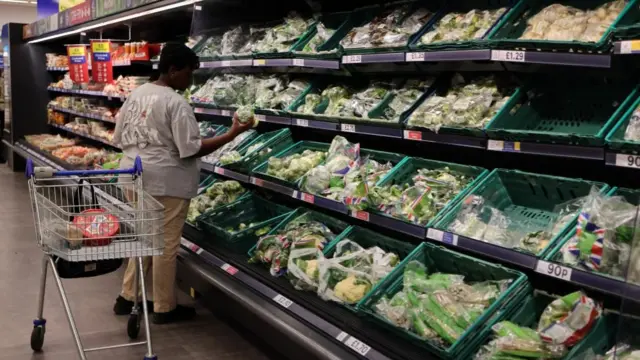
    A woman shops in the vegetable aisle at a UK supermarket with a trolley beside her.Image source, EPA/Shutterstock
    Image caption,

    Andy Burnham has received a letter on impacts to supermarket shoppers

    The Bank’s governor, Andrew Bailey, often says that the interest rate decision is a long-term one. Its impact is seen in the future, not immediate, path of prices.

    But, what’s happened already feeds into that decision.

    Today, a letter to PM Andy Burnham has highlighted the impact of higher costs to farmers, food producers and supermarket shoppers.

    "The UK food system is dangerously exposed to shocks far beyond our borders," says Anna Taylor, executive director of charity The Food Foundation, which organised the letter.

    Growers have faced the surging cost of fertiliser. Struggling families will often turn to cheaper, less healthy food and cut down on fruit and vegetables, she says.

    The letter calls on the government to make the food system a national priority.

    Meanwhile, rate-setters at the Bank somehow need to consider what suppliers and consumers face next.

  19. June's interest rate decision held rates at 3.75% for fourth time in a rowpublished at 10:54 BST

    The Bank of England's most recent interest rate decision, in June, held the rate at 3.75% for the fourth time in a row.

    It was a move many analysts had anticipated, with continued uncertainty surrounding high energy prices that have been impacted by the war in the Middle East and closures to the Strait of Hormuz - the world's busiest oil shipping channel.

    The bank's governor Andrew Bailey said at the time that recent drops in oil prices were "encouraging" but high energy prices during the US-Iran war had still left "inflationary pressure in the pipeline".

    He said he was "very encouraged" by the initial US-Iran peace deal, signed the day before the rate was announced, but added that holding rates "is a sensible decision".

    The situation in the Middle East remains volatile and two of the Bank's nine policymakers had voted for a rise in interest rates in June in light of the uncertainty.

    Graph showing UK interest rates since 2021 to 2026 - it shows them increasing quickly since 2022 but then dipping slightly since 2023/ 2024 and holding since early 2026
  20. How is the UK's inflation rate measured?published at 10:46 BST

    The interest rate decision is impacted by the rate of inflation - with the Bank of England using it as a tool to try and keep inflation as close as possible to its 2% target.

    Inflation measures the increase in the price of something over time.

    The Office for National Statistics measures this by tracking the prices of hundreds of everyday items and services across different retailers, including food and fuel.

    For example, if a bottle of milk costs £1 but is £1.05 a year later, then annual milk inflation is 5%.

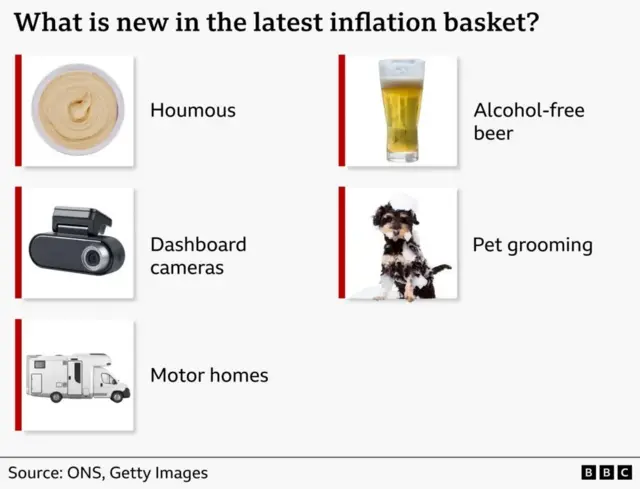
    A virtual "basket of goods" is regularly updated to reflect shopping trends, with alcohol-free beer, dashboard cameras, and pet grooming equipment among items added in March 2026, while premium bottled lager and sheets of wrapping paper were removed (the latter replaced by rolls of wrapping paper which are more commonly sold in shops).

    You can read more in our explainer.

    A graphic of items featuring pictures next to labels - houmous, alcohol-free beer, dashboard cameras, pet grooming, motor homes. Source: ONS, Getty Images
    Image caption,

    Houmous and alcohol-free beer were among 27 items added to the Consumer Prices Index in March