Summary

  1. Welfare takeaways - six ways the system fails young claimantspublished at 14:11 BST

    The report criticises the welfare system as having "badly designed incentives that deter participation and encourage benefit passivity".

    This failure, it says, plays out in six ways:

    1. 'Investment in benefits prioritised over employment support': Milburn estimates that in 2024/25, for every £1 spent on employment support for young people, around £25 was spent on benefits
    2. 'A failure to prioritise early intervention': The welfare system treats interactions with young people as administrative instead of as opportunities to make sure they're supported into work
    3. 'Insufficient practical help to enable young sick or disabled into work': Fitness-to-work assessments are criticised for failing to identify what barriers need to be removed to enable people to participate
    4. 'Support doesn't fit needs of job-seeking young sick or disabled': High caseloads for Jobcentre Plus coaches are cited as an issue, as they struggle to understand specific barriers facing claimants
    5. 'Incentives and process make participation less attractive for many': Claimants can be scared to risk income from benefits by seeking work, with no guarantee they'll be get the same support if a job doesn't work out
    6. 'Assessment process locking in permanence on benefits': The welfare system for young people is dominated by those with mental health and neurodevelopmental conditions, but these often fluctuate, which is not reflected by capability assessments
  2. Neet disability gap is 'devastating', report sayspublished at 14:03 BST

    Emma Tracey
    Senior disability reporter

    Milburn makes clear that disabled people who cannot work should be supported by the benefits system, but describes the disability Neet gap as “devastating".

    He quotes recent figures showing that in 2024/2025, 29.6% of disabled young people were Neet in the UK compared with 8.7% of non-disabled peers. That’s a gap of 20.9 percentage points, which has barely changed in over a decade.

    Young disabled people described to him “almost without exception, systems that were not built for them".

    One autistic person shared that during an internship, they “really, really struggled with my neurodivergence there because it was not an environment that was made for people who are neurodivergent".

    Responding to the report, Abdi Mohamed, head of policy, research and influencing at disability equality charity Scope, says: “This report finally exposes how young disabled people in the UK have been failed on an unforgivable scale.

    “The Milburn Review now needs to develop bold recommendations with young disabled people, and the government must back them with the right support to fulfil their ambitions.”

  3. Milburn: 'It's not a silver bullet you need. It's a round of ammunition'published at 13:55 BST

    Alan Milburn sits down during a broadcast interview. He is wearing a dark blue suit with a darker shirt underneath

    Alan Milburn has been speaking to the BBC following his news conference, and says "these problems go back decades".

    "We have got to stop saying: 'Here is the answer, here is the magic silver bullet.' It's not a silver bullet you need. It's a round of ammunition.

    "If you have not had a job by the time you are 24, you are probably not going to have a job by the time you are 34," he adds. "It just gets worse and worse."

    He says he's never seen an issue that resonates so strongly with the public in the decades he has spent working in politics and policy.

  4. 'You're not a real person you're just a number'published at 13:50 BST

    Rozina Sini
    BBC News

    Holly Jackson

    Holly Jackson, 24, has been applying to over 50 jobs a week but is struggling to find work.

    The 24-year-old who lives in Seaford says she was offered very little career advice when she left university in 2023 and it's been "almost impossible to find a job" since.

    "I’m lucky if I even get a rejection email," she says, explaining it feels like "luck of the draw more than anything".

    "Employers don’t want to train people anymore, and apprenticeship schemes are asking for three plus years experience."

    She adds that it feels like "you're not a real person you're just a number".

    Katie takes a selife with Westminster in the backgroundImage source, Katie

    Despite having six years of job experience Katie, 24, also describes how it has been "extremely difficult to find a job".

    Katie says she has been waiting for an opportunity at two local hospitals near where she lives in Telford but she has been rejected from around 10 different NHS roles.

    "I've applied for everything, from cleaning to office work, and just this morning I got a email from one application saying they aren't going to take my application further," she explains.

    She says she has had one interview out of 30 job applications.

    "I know six young people in my family that are actively seeking employment opportunity in my area and it's extremely upsetting knowing they have very little chance of finding employment," she adds.

    A purple banner displays the words 'Your Voice'
  5. As a young jobseeker, how can you stand out?published at 13:44 BST

    Josh McLaughlin
    South East

    Emily Huns sits for a photo in the University of Sussex's Student Life Centre lobby and communal area. She is wearing full-rimmed glasses, a t-shirt and a blazer, with her hair slicked back. Students in the background sit at tables studying.Image source, BBC/Josh McLaughlin

    Emily Huns, head of careers and entrepreneurship at the University of Sussex, advises young people to submit "fewer high-quality, authentic applications" rather than "identical, poorly researched" ones.

    "[Employers] don't want an AI-generated version of job applicants," she tells the BBC. "Human-centric skills are in demand in the workplace."

    She says she has also noticed "household name employers" getting more applications than small and medium-sized ones who "struggle to find talent".

    Huns says her university has created a "menu of programmes" to connect students and graduates to them.

  6. Five tips to help your teenager in the job marketpublished at 13:37 BST

    A female member of bar staff pulls a pint of bear in a half-crowded bar.Image source, Getty Images

    If you're a parent, BBC Bitesize has some tips on what you can do to help your teenager find work.

    They're provided by writer, educationalist and former headteacher Peter Hyman, who has co-authored a report that feeds into Milburn's wider report being published today:

    • Understand the unique challenges this generation faces - including the fallout from Covid, a difficult labour market, and the implications of AI
    • Help your child recognise their own unique skillset - they have skills and experiences they may not realise they have, such as competing in sports teams or taking part in extra-curricular activities
    • Encourage your teenager to get some work experience - anything from gardening and babysitting to local volunteering services
    • Work on communication skills with your teenager - including by encouraging family dinner times without screens or time spent outside the house with others
    • Change the narrative on what a "good" career and education looks like - instead of focusing solely on the exam-based route, there are other options out there

    Read more from BBC Bitesize on how to help your teenager find work.

  7. BBC Verify

    More than six in 10 Neets have never workedpublished at 13:29 BST

    By Daniel Wainwright

    An estimated 61.6% of young people who are not in employment, education or training - Neets - have never had any paid work.

    Data released as part of Alan Milburn’s review of the issues , externalaffecting 16 to 24-year-olds suggests this number has been growing over the past two decades. Before 2013, fewer than half of young people in this situation had never worked.

    The report says how what is “often described as the decline of the Saturday job” is part of a change involving fewer flexible jobs and part-time work that young people could do while studying to gain experience and employer references they may need later on.

    And it talks of jobs that disappeared because the economy changed - such as fewer young people delivering newspapers. But it also points to changes in the rules around hiring people, “which have made casual roles less attractive to offer”.

    This Flourish post cannot be displayed in your browser. Please enable Javascript or try a different browser.

  8. How unemployment is affecting young people's mental healthpublished at 13:19 BST

    Emily Holt
    Education reporter

    Young people are feeling "shut out of the opportunities that work can bring", which is impacting young people's mental health, a leading UK employment and social action charity says.

    Shaw Trust says: "Unemployment is taking its toll on young people's mental health and there's a lot of evidence to back this up. We're also seeing this on the front line: young people are telling us that without work, days lack structure and meaning.

    "They're feeling shut out of the opportunities that work can bring. This would influence anybody, but at this stage of life, confidence and wellbeing takes a real hit. We need to reframe the relationship between work and wellbeing.

    "When young people feel shut out of the job market, the opposite is true. We need to back young people's potential. That means providing the right support to get them work-ready."

    Tina McKenzie, policy chair of the Federation of Small Businesses, says that health policy should factor in “what ill-health means for a young person’s ability to work”.

    She adds: "We should treat the condition and consider the knock-on effects on confidence, routine, and prospects. For many young people, work is as much a part of recovery and stability as any clinical intervention. Health policy designed with that in mind will do more good for more people."

  9. Aspirations, shortage of support and welfare issues - what Alan Milburn told the presspublished at 13:10 BST

    Dan Woodland
    Live reporter

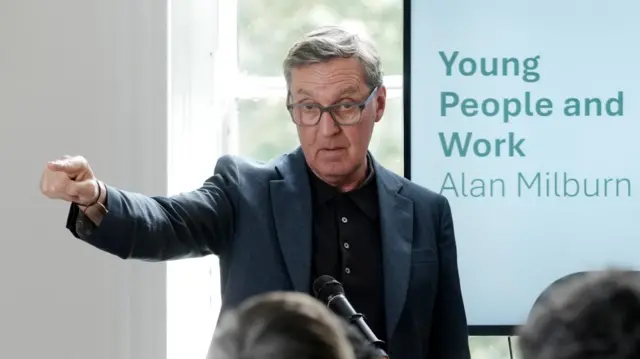
    Following the publication of his Neets report, former cabinet minister Alan Milburn spoke to the press to go over its contents. Here's a recap of what he said:

    We'll continue to bring you live coverage and analysis, stick with us.

  10. What is the government's current policy for encouraging young people into work?published at 12:57 BST

    Rachel Reeves looks on, with a black and blurred white background behind her.Image source, PA Media

    Following the release of Milburn's report on Neets, we've taken a look at the government's current policy for encouraging young people into work.

    In the November Budget, Chancellor Rachel Reeves announced £820m of funding to support 18 to 21-year-olds into education or paid employment.

    Those who have been Neet for more than 18 months were also to be given a six-month paid work placement. Anyone who refuses could risk being stripped of their benefits.

    The chancellor added that the government would fund a scheme to make apprenticeship training for under-25s at small and medium businesses "completely free".

    Association of Colleges head David Hughes said the money would enable colleges to support more young people so they do not end up not in education, employment or training.

    But he said more money was needed for adult education funding, and to ensure "millions of adults are not left behind by the tech and green revolutions we are seeing before our eyes".

  11. 'I'm selling crochet patterns online while looking for part-time work'published at 12:52 BST

    BBC Newsbeat

    Niamh Heron is currently out of work.

    The 21-year-old from North Yorkshire tells us she stopped working in September due to long-term poor health.

    "I am currently looking for part-time work that isn’t too physical. I make crochet and cards and I sell them to a local gift shop," Niamh says.

    "I sell crochet patterns on Etsy, I also am trying to get into UGC via TikTok and am interested in working in social media, just because it is so difficult to get a job."

    A man with his hands on his hips

    Aaron Diangienda, currently at college studying for a level 2 sports diploma, is also out of work.

    The 18-year-old from Brixton, south London has been looking for a job for a year and says he is keen to work in retail, but finding the right job has been tough.

    Aaron doesn’t want to go university and while he is looking for a job in sports specifically, he would gladly take any job.

    The teen is also re-taking his English and maths GCSE so he can improve his prospects.

    You can listen live to Newsbeat's Neet coverage at the top of the page.

  12. Listen: Young people share what it's like trying to get a jobpublished at 12:46 BST

    BBC Newsbeat

    BBC Newsbeat has been speaking to young people across the country today who are struggling with unemployment.

    They've been speaking to people currently studying and applying to jobs, as well as those with degrees failing to find jobs.

    You can listen live at the top of the page - as well as on Radio 1, Radio 1Xtra, Asian Network or catch up on BBC Sounds afterwards.

  13. Key figures from the report - at a glancepublished at 12:34 BST

    We've just heard from Alan Milburn following the release of his report into the number of young people who are Neet - not in employment, education or training, which he warns could rise to 1.25 million over the next five years.

    Here's some of the key statistics we've pulled out from the report:

    • Six in 10 Neets have never had a job. In 2005, this was four in 10, the report says
    • But 84% of Neet young people surveyed want a job or training, it adds
    • Entry-level jobs have sharply declined, with the number of mid- and lower-skilled jobs in the economy falling by around 1.6 million over the past 20 years - according to data from the Office for National Statistics (ONS)
    • Vacancies in hospitality have halved in the last four years alone, ONS data also shows
    • Citing a separate government report, apprenticeship starts among young people have fallen by 35% since 2017
    • The proportion of people who say they are Neet because of a work-limiting health condition has increased by 70% over the past decade, in data published by The Health Foundation
    • While the number of those citing a mental health condition has almost doubled to more than four in 10, according to the Youth Futures Foundation
    • Of people who became Neet for health reasons between 2017-2019, almost eight in 10 are still Neet more than two years later, the Resolution Foundation says
  14. Social media and smartphones may have an impact, Milburn sayspublished at 12:27 BST

    Milburn is asked how social media and smartphones have affected the issue.

    He says the evidence is that "young people are living a different life today".

    Milburn adds that disrupted sleep patterns, doomscrolling and being awake in the early hours seem to be having an impact.

    He says distress, anxiety and depression among young people are rising and "we have to really, really look" at mental health seriously as an issue.

    The news conference has now ended - we’ll bring you a recap of what we’ve just heard shortly.

  15. Is Milburn going to urge the government to rethink youth minimum wage?published at 12:23 BST

    The BBC asks Milburn if he is urging the government to rethink the increases in youth minimum wage and employee national insurance.

    Milburn says there is "no doubt" employers are concerned about this, but many already pay more than the youth minimum wage, so the change has had a "minimal impact" on them.

    He adds that things have become more difficult at the "margins".

    "What we've got to do, as I say, is make sure that if we want to have more young people in work, then we've got to minimise the risks for the employer, we've got to maximise their incentives.

    "But no one should pretend that the reason we've got the Neet problem today [...] that somehow or other that was triggered two years ago."

  16. Milburn compares UK and Dutch vocational education systemspublished at 12:14 BST

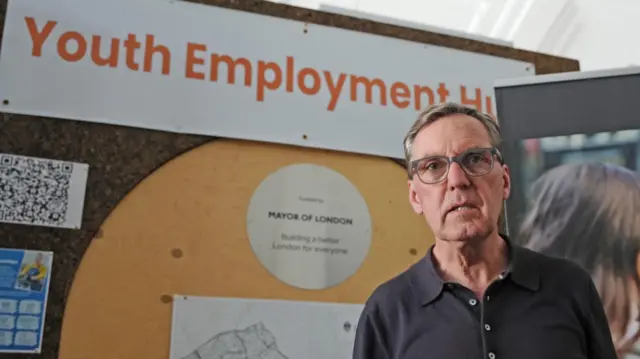
    Former health secretary Alan Milburn speaks to the media on the publication of the interim Milburn Report into Young People and Work, at West Library Youth Employment Hub, north LondonImage source, PA

    Asked whether drops in spending for further education have been part of the problem, Milburn responds, "yes it is".

    He goes on to compare the UK with other countries such as Holland - which has one third the Neet rate of the UK.

    Although there are some other differences, he says the main difference is fundamentally structural.

    Holland makes vocational education and investment in it a priority. The system is also "much more integrated", Milburn says.

    Although the UK can't simply adopt that system, he says there should be something to learn from it.

  17. Milburn: This cannot be just a 'boring report' but a 'change moment'published at 12:04 BST

    Milburn is asked whether businesses understand the current employment crisis.

    He says big businesses that employ lots of young people in entry-level jobs do understand what young people are facing and want to help.

    But, Milburn says, the real question is not whether they understand, but what they are going to do about it.

    He says this can't just be a "boring report" and has got to be a "change moment", adding that if society keeps ignoring this issue, "we will keep getting what we keep getting".

  18. Opportunities for young people need to be flexible, Milburn sayspublished at 11:55 BST

    Alan Milburn speaking to the press at an event in North London

    Milburn is now taking questions.

    He is asked whether he thinks there should be a return to some form of national service - not just military but civic service - to help young people develop their skills.

    Milburn says that opportunities need to be flexible and meet people halfway.

    "So we've got to think about what does that look like? Could be a job, could be an apprenticeship, could be a supported internship, could be some volunteering," he says.

    "That is something that we'll be exploring in the weeks and months ahead".

  19. BBC Verify

    Are Neets costing £125bn a year?published at 11:51 BST

    By Ben Chu, policy and analysis correspondent

    The Milburn report contains an estimate that the total annual cost to the country of just under one million young people not being in employment, education or training (Neet) is £125bn and claims this is more than the country spends on education.

    The details of the report show that the £125bn per year figure is mainly made up of estimates of the lost economic potential of young Neets, rather than direct state spending on benefits for the group.

    £38bn a year is ascribed to lost direct economic potential (the fact that they are not currently in full-time work) and £63bn a year to additional economic “scarring” (due to them being less likely to work in future).

    The direct cost of benefit spending on Neets is put at £3.2bn a year and £200m a year on increased health spending.

    There is also a figure of £2.7bn a year in estimated “wellbeing impacts” on the affected young people - including worse mental health and social isolation.

    The Institute for Fiscal Studies has estimated, external that total public spending on education in 2024-25 - including early years, schools and universities - was £122bn.

  20. Milburn says government effort 'deserves acknowledgement' but not enoughpublished at 11:48 BST

    Former health secretary Alan Milburn speaks to the media on the publication of the interim Milburn Report into Young People and Work, at West Library Youth Employment Hub, north London.Image source, PA

    Milburn says the government has made a start in trying to reset the system - pointing to apprenticeship reforms among other examples.

    He says the effort "deserves acknowledgement" but "no one should pretend they're enough - either in scale or design".

    Milburn says it's not a new programme that's needed - "new initiatives laid on top of a system that is broken cannot work" - and adds that the old welfare state was "built for a different age".

    He stresses there's still an obligation to protect those who cannot work, saying the system must be more than just a safety net - it should also be a springboard.

    Calling for a fundamental system reset, Milburn says this should be a priority for government, before he moves on to questions.