Summary

  1. Analysis

    Burnham sets out his idea of 'Manchesterism' but key details still to comepublished at 14:36 BST

    Chris Mason
    Political editor

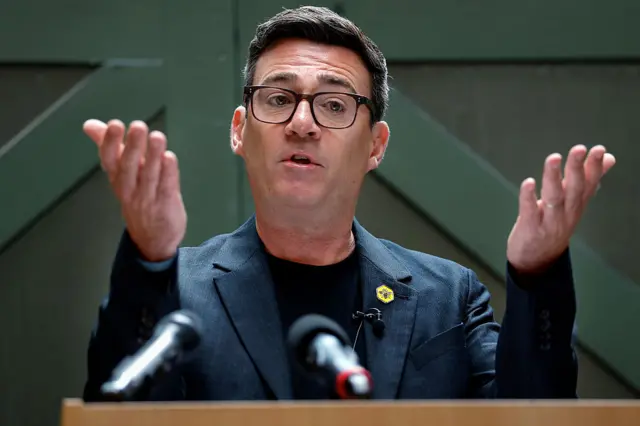
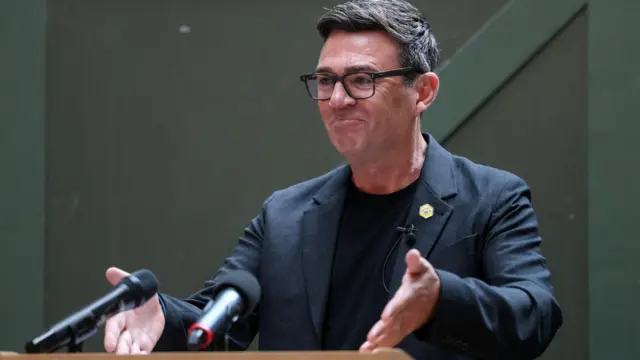
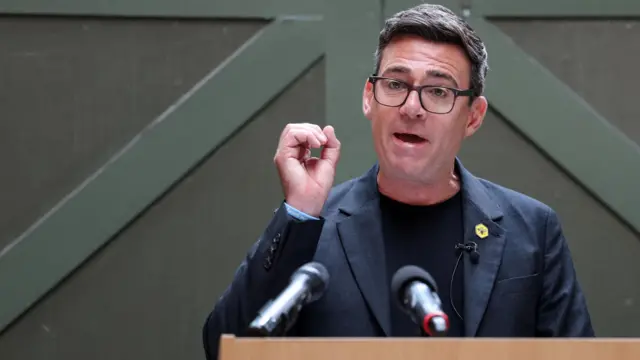
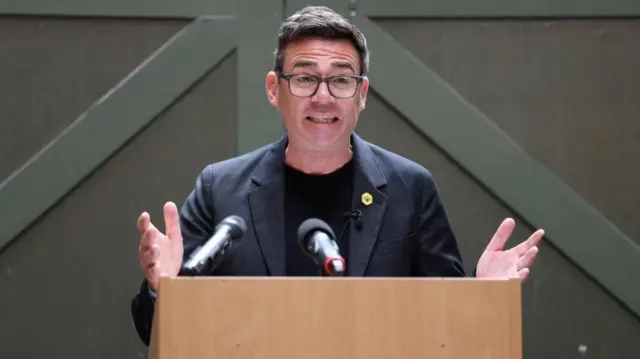
    Andy Burnham, British member of parliament (MP) for Makerfield, delivers a speech at the People's History Museum in Manchester, Britain, June 29, 2026.Image source, Reuters

    This was Andy Burnham very much playing a home fixture here in Manchester to an audience of supporters and a front row of mayors.

    Here was a former mayor arguing that mayors and others deserve considerably more power.

    That was the controlling thought of the whole speech - this idea which Burnham calls "Manchesterism".

    His diagnosis is that devolution to the nations and English regions has not given those on the ground sufficient power.

    This was a big picture speech and many of the key details are still to come.

    The idea Burnham has is that he will have a branch of his No 10 office in Manchester that will be absolutely essential, he argues, to the devolution agenda.

    He went out of his way to try and address the concerns that someone in Cornwall or the northern tip of Scotland, where Manchester may be just as distant as London, may have.

    The argument he is trying to make is this is about a mindset detached from Westminster.

  2. No 10 North will 'mean very little to the people of Wales', says Welsh first ministerpublished at 14:24 BST

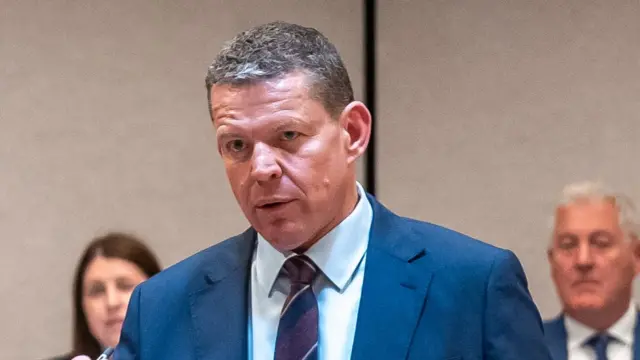
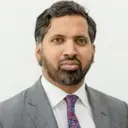
    Rhun ap Iorwerth is wearing a blue suit, a light blue shirt and a red tie.Image source, Senedd Cymru

    The first minister of Wales, Plaid Cymru's Rhun ap Iorwerth, has criticised Burnham's vow to move some Downing Street functions to Manchester.

    "A Number 10 of the North will mean very little to the people of Wales," he says.

    He said that regardless of who leads the UK government, he will make the case for "fair funding" and for Wales to have the same powers as Scotland, as a "bare minimum".

    Meanwhile the Welsh Liberal Democrat MP David Chadwick warned Wales was being left at the "back of the queue" for more powers.

    "If Labour can find the ambition to devolve powers across England, they should have the ambition to give Wales the same powers as Scotland," he said.

  3. No 10 North will be a 'powerful reimagining' of government machinery, says Powellpublished at 14:00 BST

    Andy Burnham's reformed education budget for the country's regions will see a greater emphasis placed on developing the skills young people need for "the jobs of the future", the deputy leader of the Labour Party has said.

    Lucy Powell tells Radio 4's World at One programme: "We know what that pipeline is but we're not able to shape the skills supply in our area so that young people can really go straight into those new opportunities that we know are coming."

    Speaking from Manchester Piccadilly station, she says No 10 North will be a "really powerful reimagining" of government machinery to give areas the power and resources they need.

    Paul Bristow wears a navy suit while sitting in what appears to be a hotel room. A clock is on the wall behind him.
    Image caption,

    Paul Bristow says there is a "psychodrama" currently in the Labour Party

    Paul Bristow, the Conservative mayor for Cambridgeshire and Peterborough, says Burnham's speech today raises more questions than it does answers, adding that there is currently a "psychodrama" in the Labour Party.

    He tells World at One that mayors want a focus on other parts of the country, not just the north, in regions such as the East of England, "where we're net contributors to the economy, rather than net recipients".

  4. Devolution of power away from Westminster was at the heart of Burnham's speechpublished at 13:43 BST

    Paul Seddon
    Politics reporter

    Andy Burnham, British member of parliament (MP) for Makerfield, applauds on the day he delivers a speech at the People's History Museum in Manchester, Britain, June 29, 2026.Image source, Reuters

    The central theme of the speech was devolution of power away from Westminster, while making central government “more streamlined”.

    Key to his plans is the creation of a new No 10 unit based in Manchester, which he said would help local leaders take greater “public control” of housing, transport, water and energy.

    Another big theme was housing, where he repeated his promise to deliver the biggest programme of council house building since the post-war period.

    Specific proposals mentioned included promoting building on vacant public land to reduce costs, and promoting higher density residential development in towns.

    Burnham said he wanted to bring down welfare spending, but did not outline cuts to specific benefits. Instead, he said expenditure could be reduced in a “fair and lasting” way by giving regional mayors more power over employment support schemes, and greater “in work” mental health support.

    After nearly a decade outside Parliament, he also laid out an ambition to change the political culture at Westminster, including to the ‘whipping’ system of party management, which he argued had been used to “create fear” and shut down debate.

    He also said he wanted to end an “adversarial” culture in Whitehall, in which government departments battle the Treasury for cash.

    He made a pledge to restore “sovereign manufacturing” capabilities in sectors such as steel, defence, energy and farming. He said this could be achieved by offering British firms greater chances to win government contracts, in exchange for offering more work placements.

  5. Who attended Andy Burnham's speech - in picturespublished at 13:32 BST

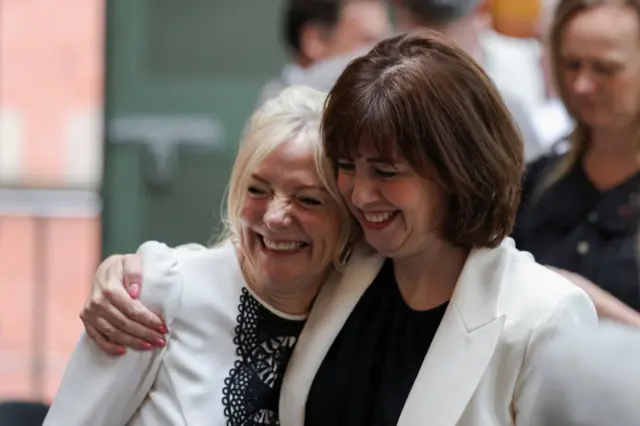
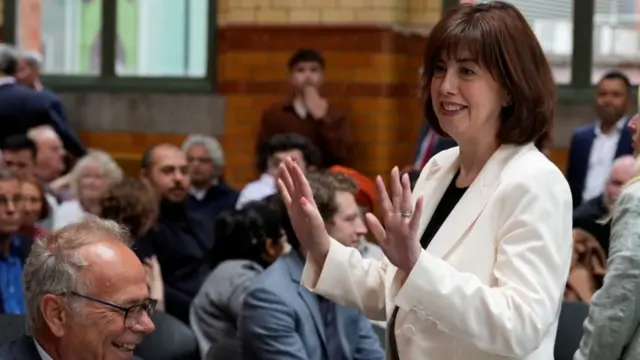
    Lucy Powell stands up and raises her hands to people in a crowd sat in front of her. She has long brown hair and is wearing a white blazer over a black top.Image source, PA Media
    Image caption,

    Labour deputy leader Lucy Powell was among the party's senior figures who attended Andy Burnham's address

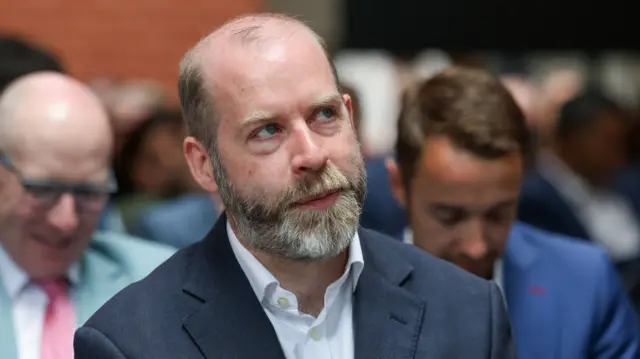
    Jonathan Reynolds is straight faced and looks upwards while sat on a chair in the front row of a seated crowd. He is bald with a grey and black short beard. He is wearing a navy blazer and white shirt without a tie.Image source, Reuters
    Image caption,

    Labour Chief Whip Jonathan Reynolds also watched on from the crowd in Manchester

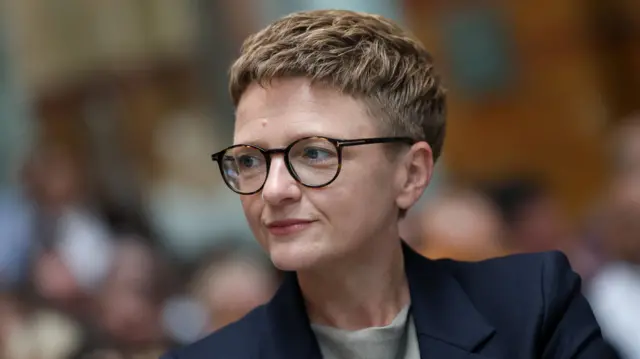
    Bev Craig, who has short blonde hair, is wearing tortoise shell coloured glasses, a navy blazer and grey top underneath. She is standing in front of a seated crowd who appear blurry in the background of the photoImage source, Reuters
    Image caption,

    Manchester City Council leader Bev Craig, who introduced Burnham to the stage, is Labour's candidate for mayor of Greater Manchester

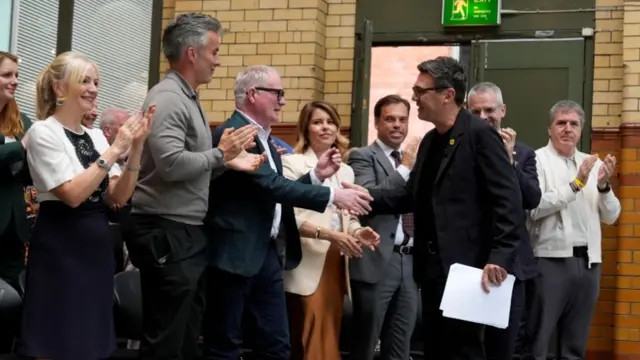
    A row of people stand up to greet Andy Burnham.One of them, a man in a blazer and white shirt, is shaking Andy Burnham's hand while the others around him are clapping.Image source, PA Media
    Image caption,

    The front row was taken up by regional mayors. From left to right: Mayor of West Yorkshire Tracy Brabin, Mayor of York and North Yorkshire David Skaith, Mayor of the West Midlands Richard Parker, Mayor of the North East Kim McGuinness, Interim Leader of Welsh Labour Ken Skates, Mayor of South Yorkshire Oliver Coppard and Mayor of the Liverpool City Region Steve Rotheram

  6. Burnham makes argument on how Britain is wiredpublished at 13:21 BST

    Faisal Islam
    Economics editor

    The general approach from Burnham seems to be to take what has happened in fast-growing Greater Manchester, where he has been mayor for 10 years, and to try to apply it across the UK in very broad terms.

    The list of things he wants to change was fairly extraordinary: a new renaissance on our high streets, changed business rates, apprenticeships for all, new transport infrastructure, housebuilding, as well as a “little bit” more help with living costs - there's a little hint there potentially at some small tax cuts, dare I say.

    All the while saying we're going to stick to the fiscal rules.

    The central argument there is about how Britain is wired and run. The power of Whitehall will be “streamlined” and flow to the cities and regions, closer to the people, as occurs in major European economies.

    This devolution revolution is not the central focus of the political-economical debate that we have had in the UK over the past few years. It is not the first thing businesses mention as holding back growth, though many will appreciate a general tone of upbeat optimism.

    There are many detailed questions about what this would actually mean in practice, and how universally applicable is a model that has worked for an international city.

    It appears we will have to wait for that detail, alongside the cast list for cabinet including the chancellor, for a few weeks yet.

  7. Think tank praises Burnham for 'direction of travel', but says more detail neededpublished at 12:59 BST

    Akash Paun, who leads the devolution programme for the Institute for Government think tank, says he welcomes "the direction of travel" set out by Burnham, but that there is "a huge amount more detail we'll wait to hear".

    Paun says by talking about "a fundamental rewiring and rebalancing of the state and a new way of delivering growth across the country", Burnham is "raising the expectations" of seeing something "quite different to what we've seen before".

    "He's building on a devolution process that's been under way over the past decade," Paun says.

    But he adds Burnham needs to give more detail about the scale of his plans.

    "Is he intending new mayoralties and strategic authorities all across the country?" Paun adds.

  8. Recap: Burnham lays out his vision for 'No 10 North' and a 'rewired Britain'published at 12:53 BST

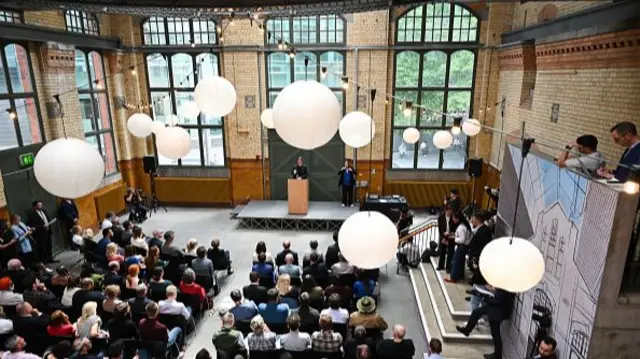
    A crowded room watch as Andy Burnham delivers a speech at the People's History Museum in ManchesterImage source, Getty Images

    Andy Burnham has vowed to bring about the "biggest rebalancing of power our country has seen" in his first major policy speech since launching his bid to become prime minister.

    In a wide ranging speech at the People's History Museum in Manchester, Burnham says:

    • He will "take the power out of the centre" and create what he calls "No 10 North," expanding the PM's office to Manchester
    • Burnham described No 10 North as the "nerve centre of a rewired Britain" and says that it will be about “offering new opportunities to extend devolution in Scotland, Wales and Northern Ireland by taking power deeper down"
    • "The people of Dundee and Bangor feel just as distant from Holyrood and the Senedd as they do from Westminster," Burnham said

    Burnham's decentralisation strategy is bold - but a gamble, writes our economics editor, while our chief political correspondent says No 10 North sounds like a substantial part of the civil service.

  9. Analysis

    Unions will welcome promise to favour UK businesses in procurementpublished at 12:25 BST

    Simon Jack
    Business editor

    The private consortium trying to take control of Thames Water will not have enjoyed a section of the speech where Burnham promises greater regional control of vital utilities including water, housing, energy and transport.

    Unions will approve of a promise to favour UK businesses when it comes to procurement - including defence.

  10. Analysis

    Decentralisation strategy is bold - but a gamblepublished at 12:21 BST

    Dharshini David
    Deputy economics editor

    Burnham giving speechImage source, Reuters

    Put more money in pockets: Andy Burnham's economic goal is no different to Keir Starmer's.

    The difference is how he wants to achieve it.

    Over 90% of tax revenues go to the Treasury, central government.

    It makes the UK the most centralised of any major economy.

    Yet OECD statistics suggest that the more decentralised countries are, the more decisions taken at a regional or local level, the higher wages tend to be.

    That underpins Burnham's vision.

    The question is exactly how it’ll work - and crucially, if mayors and local authorities have the know-how and motivation.

    You can give people more money, but they have to spend it wisely to deliver results.

    It's a bold strategy - but a gamble.

    It is, after all, a feeling that the economy has failed to deliver which means we are now looking at a seventh prime minister within a decade.

  11. Burnham promises major reform of business ratespublished at 12:19 BST

    Simon Jack
    Business editor

    Burnham has promised major reform of business rates to revive high streets - as they are a barometer for the success and happiness of UK regions.

    Business rates currently raise around £27bn - half of which goes to local authorities, half to central government.

    A cut to rates bills would mean less money for either central government, local government, or both.

    But listening to the rest of the speech you'd have to bet that local authorities would not be the ones to take a hit.

  12. Burnham ends with optimistic note, but doesn't take questionspublished at 12:18 BST

    Burnham says he will introduce a national housing-first philosophy and will seek to regenerate the nation's towns and highstreets.

    He says he will reform business rates to support pubs and high street businesses, asking "shouldn't we make highstreets a symbol of Britain's renaissance?"

    "Ours is a 10-year mission to raise living standards," Burnham says, adding "people can't wait forever".

    He says he will not take risks with public finances and seek to give Britain "breathing space" as soon as I can.

    Burnham ends his speech by saying "imagine good growth in every postcode and hope in every heart".

    He then finishes with: "Imagine no more, let's make it happen."

    He ends without taking questions.

  13. Burnham pledges biggest council house building programme since the post-war periodpublished at 12:16 BST

    Burnham says the country is "in a housing trap", saying what he describes as a housing crisis is having a "ruinous" impact on the UK's public finances.

    He adds that Number 10 north will oversee "the biggest council house building programme since the post-war period".

  14. 'We will reduce the welfare bill in a way which is fair and lasting'published at 12:15 BST

    Burnham says every pound raised from tax payers will "work harder for them", which will apply "fully" to the Defence Investment Plan.

    He says he will make sure all eligible public contracts are subject to "proper social value weighting" and will make sure British based companies are in a better position to win those contracts.

    He also says there needs to be "a rethink" in education.

    "The days of a school system configured entirely around the university route will be brought to an end," he says.

    He asks "when will we focus on life chances" of kids who "want something different".

    Burnham says they will be "giving every young person a clear path into a reindustrialised Britain".

    "We will answer the call for devolution of employment support," he says, adding "this is the difference mayors can make".

    "In doing that, we will reduce the welfare bill in a way which is fair and lasting."

  15. 'The whole of Whitehall will now be required to get behind our places'published at 12:13 BST

    To more applause, Burnham says as mayor he has fought the "Whitehall machine" for 10 years and he will not the accept that for any other area.

    "The whole of Whitehall will now be required to get behind our places," he says.

    He adds it's a "10-year mission" to raise living standards "across the land".

    To do this, he says No 10 North will support the regions on three tasks which he describes as:

    1. Reform of essential utilities
    2. Reindustrialisation
    3. Regeneration of places

  16. 'No 10 North will be the nerve centre of a rewired Britain'published at 12:08 BST

    A close up picture shows Andy Burnham holding his glasses during his speechImage source, PA Media

    Burnham says the job of his so called "No 10 North" will be to make power flow into different regions across the UK.

    "No 10 North will be the nerve centre of a rewired Britain," he says.

    It will be the "conduit" through which power and resources are redistributed across the UK, he adds.

    He adds "No 10 North" will be given a mission to deliver equivalent living conditions in all parts of Britain and make place-based collaboration the "new operating principle".

  17. Burnham says plans will be backed by stability of 'sound public finances'published at 12:07 BST

    Burnham says his pledges will be backed from the stability of "sound public finances" and the discipline of the current fiscal rules, adding that this promises "a new era of possibility for Britain".

    He says this will be the biggest change in our lifetimes in how the country is run, but it will remain consistent with Labour's 2024 manifesto.

    The former mayor says he will create a streamlined state with clear purpose, powering up all parts of the country with a "laser-like focus on growth and regeneration".

    He adds this change will be driven through the prime minister's office "in an extended operation based here in Manchester".

  18. Manchesterism is 'rejection of the old trickle down model'published at 12:06 BST

    Andy Burnham holds his finger up as he speaks in ManchesterImage source, Reuters

    "Manchesterism," Burnham says, "is a vision for good growth and a rejection of the old trickle down model".

    Burnham says all parts of the UK "should be given the chance to develop their own version of the same".

    "Good growth in every British post code," he says, and "places no longer forgotten or written off like they have in the past."

    He continues and adds there should be "powers for rural economies" to address issues specific to them like "inadequate transport".

    And Burnham says there should also be more powers for areas undergoing industrial transition and proud coastal towns, along with more powers for London "over education and housing".

  19. Analysis

    'No 10 North' sounds like a substantial part of the civil service, rather than just handful of staffpublished at 12:04 BST

    Henry Zeffman
    Chief political correspondent

    Andy Burnham stands on a stage and speaks to politicians, activists and journalists sat on chairs in front of himImage source, PA Media

    It’s little surprise that Andy Burnham chose to give his first speech as the presumptive prime minister in Manchester. His speech began with affectionate reminiscences about the past nine years he has spent as the combined authority mayor.

    It’s also little surprise that in announcing that he wants to move a major part of the prime minister’s office out of London, he has chosen Manchester. This new "No 10 North" sounds like a really substantial part of the civil service, rather than just a handful of staff.

    Burnham has been at pains to describe his vision of "Manchesterism" as a blueprint for other areas, praising the "positives in all places and all postcodes" in the UK, vowing to help rural areas and boost coastal communities.

    And London, he said, is the world’s greatest capital city.

    That may have been a response to the sprinkling of unease - no stronger than that - that is already being expressed by some of the many Labour MPs who represent seats in London and the south-east of England about Burnham’s strong association with the north-west.

    I was speaking to a minister earlier who said it is crucial for Labour’s electoral fortunes that Burnham’s condemnation of the Westminster system is not perceived as a broader condemnation of the capital city itself.

  20. Burnham vows 'biggest rebalancing of power our country has seen'published at 12:03 BST

    Andy Burnham delivers a speech at the People's History Museum. Several lights can be seen in front of Burnham as he delivers his speechImage source, PA Media

    Burnham vows to bring about the "biggest rebalancing of power our country has seen".

    He adds that Whitehall must accept "growth cannot be ordered from top down" but must instead be ordered from the "bottom up".

    This must include giving businesses "stability and confidence" to invest, committing to "decent" infrastructure in all parts of the UK and providing security for a good home and good employment, he says.