Summary

  1. BBC Verify

    AI fake claims to show Russian warehouse’s message to Ukraine drone operatorpublished at 14:35 BST

    An AI-generated image of a warehouse with the words, in Russian, "This is not Wildberries. Fly past” written on its roof. We have added the label "AI-generated"

    By Thomas Copeland, BBC Verify, and Fridon Kiria, BBC Monitoring

    This image claiming to show a message on the roof of a warehouse belonging to Wildberries’ competitor Ozon saying in Russian “This is not Wildberries. Fly past” has spread widely across social media and has been used by some news outlets - but it’s AI-generated.

    OpenAI’s online verification tool detected a SynthID digital watermark on the image. This tells us it was made using one of OpenAI’s tools.

    We’ve traced the image back to a post on TikTok that has been viewed nearly eight million times.

    TikTok has added an AI-generated label to the post but it has since spread across other platforms where it’s being presented as real.
  2. Wildberries warehouse fire contained after a fourth person injuredpublished at 14:22 BST

    A fourth person has been injured as a result of a fire at the site of the Wildberries warehouse in Russia's Vladimir region, the local governor has said.

    Alexander Avdeyev says in a post on Telegram that the blaze has been contained after stretching over an area of 100,000 sq m (0.1 sq km).

    He adds the incident led to the deployment of 203 firefighters and 67 pieces of equipment, including specialists and a government helicopter.

  3. Moscow denies online retailer provides goods for Russian militarypublished at 14:17 BST

    Russia has denied that online marketplace Wildberries provides Russian military gear.

    Kremlin spokesman Dmitry Peskov denied accusations during a news conference on 21 July, following attacks on Wildberries hubs in the cities of Kotovsk and Elektrostal on 18 July.

    "That's not true," Peskov said in response to a question on the matter, Moscow's state news agency Tass reports.

    Last week, the Ukrainska Pravda news website reported that Wildberries had removed the product tag "Everything for the SMO" [special military operation] from its website, citing The Moscow Times.

  4. Putin hopes to 'drag war out further', Zelensky tells diplomatspublished at 13:59 BST

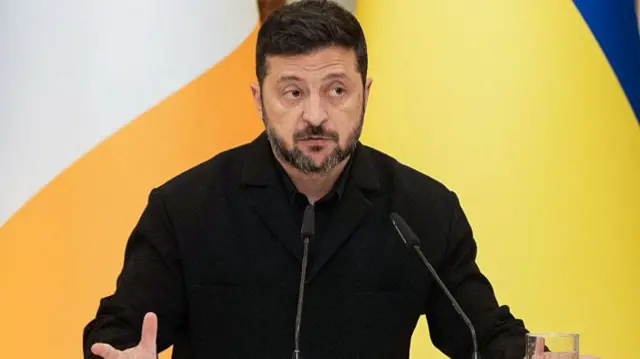
    UKRAINE-IRELAND-RUSSIA-CONFLICT-WAR Ukraine's President Volodymyr Zelensky speaks during a joint press conference with Ireland's Prime Minister following their meeting in Kyiv on July 23, 2026Image source, Getty Images

    Ukrainian President Voldymyr Zelensky says that Russian President Vladimir Putin hopes to "drag this war out further" as Ukraine launches fresh strikes on targets across Russia.

    In a speech delivered to Ukrainian diplomats, Zelensky says he cannot predict "with 100% certainty" when Ukraine's diplomatic efforts, sanctions and strikes against Russia will leave Russia with "no alternative but peace".

    He says Ukraine will do what it can to ensure this "happens in the autumn", but says "we clearly understand who we are dealing with", adding that Putin "hopes to drag this war out further".

    "We see Russia’s true intentions [and] are uniting our partners and putting pressure on the aggressor," he adds.

  5. Ukraine's latest strikes come as it ups attacks on Russian infrastructurepublished at 13:49 BST

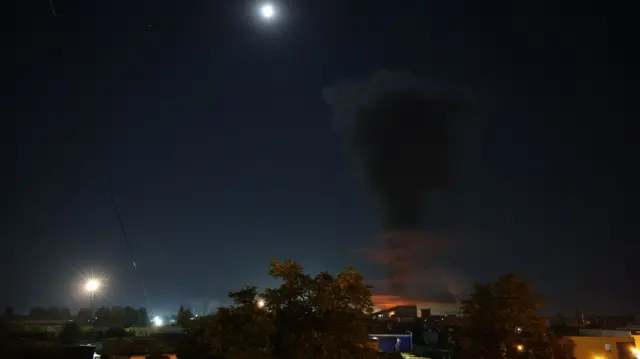
    A plume of black smoke rises into the night sky following a reported drone strike by Ukrainian forces in Belgorod, Russia, on August 3, 2026Image source, Getty Images
    Image caption,

    A plume of black smoke was seeing rising following reported Ukrainian strikes against a fuel depot in Belgorod overnight

    Ukraine's Ministry of Defence says it struck a number of Russian military targets overnight, in addition to apparent Ukrainian strikes against sites belonging to Russian retailer Wildberries.

    It says it hit several logistics and communications hubs in Crimea, a drone launch site in Bryansk and a fuel depot in Belgorod.

    It comes amid increasing Ukrainian attacks on Russian infrastructure, with Volodymyr Zelensky on Sunday announcing strikes against an oil refinery and military air base in Russia's Stratov region.

    "We are bringing the war back to where it came from," he said, adding that Ukraine continues to expand its "long-range capabilities".

    Other notable infrastructure strikes in recent months include:

  6. Crimea deaths come as Ukraine ramps up attempts to isolate regionpublished at 13:34 BST

    The latest set of blows between Russia and Ukraine has led to three deaths in the Russian-controlled territory of Crimea, the Moscow-installed governor has said, in what he described as a "barbaric attack".

    The region, which is internationally recognised as being Ukrainian, was illegally annexed by Vladimir Putin in 2014.

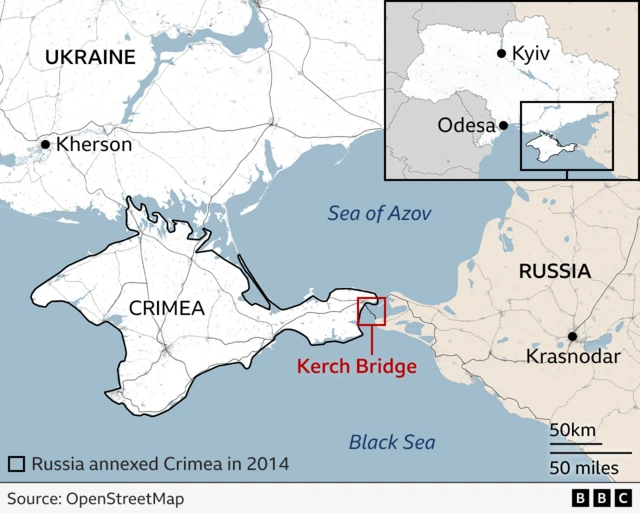
    It has since become linked to Russia by road and rail connections along a land corridor through occupied areas of southern Ukraine, and since 2018 by a road and rail bridge across the Kerch Strait.

    The future of the territory has remained a central point in peace talks between the two countries, with Ukrainian President Volodymyr Zelensky refusing the possibility of Kyiv recognising Russian control.

    Efforts from Ukraine to isolate Crimea have ramped up in recent months as multiple blackouts have been reported amid attacks on power facilities, with Kyiv also targeting key bridges connecting the peninsula to Russia, leading to fuel shortages.

    Map shows where the Kerch Bridge is located, also showing Crimea, Russia and Ukraine.
  7. Six people killed in Russian village, governor sayspublished at 13:30 BST

    The number of people killed in a Russian village in the south-west of the country has risen to six, the governor of Krasnodor Krai says.

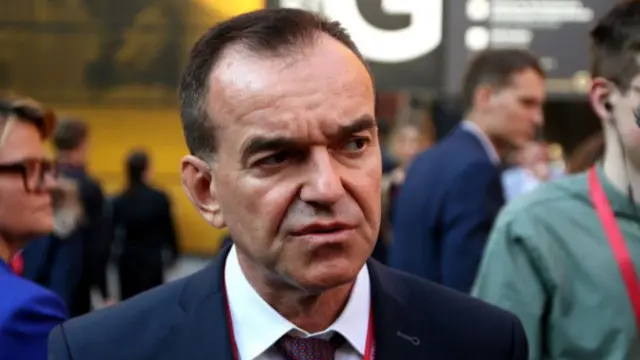
    In a post on Telegram, Veniamin Kondratiev says three of the six people dead are children and around 40 others are injured.

    Earlier, the governor said preliminary reports initially suggested three people had been killed in the area by falling drone debris.

    Kondratiev describes it as "a targeted attack by the Kyiv regime".

  8. Casualties and recruitment: The latest on the battlefieldpublished at 13:15 BST

    Kieran Kelly
    Live reporter

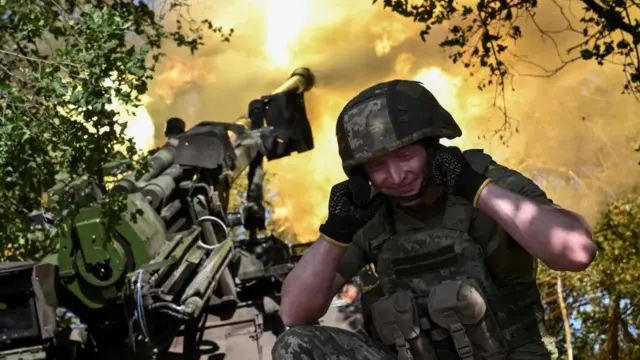
    A serviceman of the 148th Separate Artillery Zhytomyr Brigade of the Armed Forces of Ukraine fires a CAESAR self-propelled howitzer towards Russian troops at a position on the front lineImage source, Reuters
    Image caption,

    Ukrainian forces - pictured above - have been able to launch succesful counterattacks

    Progress on the battlefield

    Russia advanced on average 1.22 sq km per day in July, according to a recent report by, external Institute for the Study of War (ISW).

    The ISW says that Russia's rate of advance has remained largely unchanged since February 2026 and that its summer offensive - launched the following month - has "failed to make any operationally significant gains".

    Casualty rates

    Russia reportedly suffered its highest monthly casualty rate of the war in July, with the Ukrainian army estimating 42,860 Russian casualties, a number that includes people killed or injured in the conflict. The Kremlin has repeatedly denied Ukrainian casualty estimates.

    The BBC's Russian service, working with Mediazona, has confirmed 236,066 Russian military deaths between 24 Feb 2022 and 26 July 2026.

    For Ukrainian soldiers, President Volodymyr Zelensky last acknowledged 55,000 deaths in February 2026.

    Recruitment struggles

    Ukraine is continuing to struggle to recruit enough men to fight in the war, with the country's military ombudswoman reporting "regular" attacks against recruitment officers as a "major problem".

    Russia, meanwhile, is increasingly turning to universities to boost recruitment. BBC Russian found evidence of recruitment activity in at least 95 universities and colleges by late February.

  9. The war is now in its fifth year - how did we get here?published at 12:54 BST

    It started when Russia launched its full-scale invasion of its neighbour on 24 February 2022.

    Russian President Vladimir Putin said his goal was to "demilitarise and denazify" Ukraine - he has repeatedly painted the country as a Nazi state. Our explainer looks at the distortions and untruths that Russia has previously spread about Nazis in Ukraine.

    The Russian leader has long questioned Ukraine's right to exist, claiming that "modern Ukraine was entirely created by Russia" after the communist revolution in 1917.

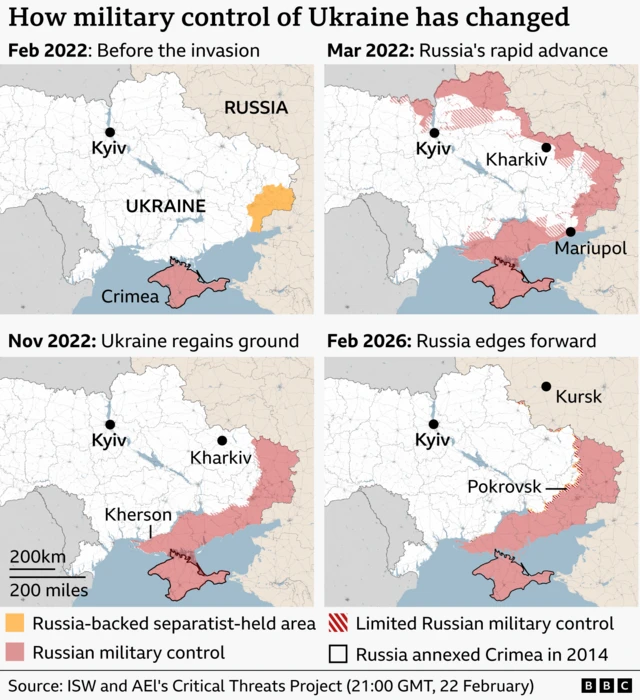
    Series of four maps showing changes in Russian military control in Ukraine from February 2022 to August 2025. Feb 2022: No Russian military control (except in Crimea which was annexed in 2014) but there is a patch to the east shown in yellow as being held by Russia-backed separatists. Mar 2022: Rapid Russian advance with areas in red (control) and red stripes (limited control). Nov 2022: Ukraine regains territory; Russian-controlled areas reduced. Feb 2026: Russia edges forward; controlled areas increase again. The maps highlight cities including Kyiv, Kharkiv, Mariupol, Kherson, Kursk, and Pokrovsk. Source: ISW
    Image caption,

    How the war progressed - from before the invasion until February 2026

    In February 2022, troops moved in quickly, accompanied by dozens of missile strikes on cities across Ukraine.

    Within a few weeks, Russian forces were in control of large areas of eastern, northern and southern Ukraine - and had advanced to the suburbs of the capital Kyiv.

    However, they met strong Ukrainian resistance - and by November 2022 the picture had changed dramatically. Ukraine had regained ground in the north and Russia failed to take Kyiv.

    Since then, progress on both sides has slowed. In recent months, Russia has been gradually expanding the amount of territory controls - particularly in the east - but gains have been minimal.

  10. Drone attacks have affected up to a fifth of Wildberries' warehouse spacepublished at 12:41 BST

    Yaroslava Kiryukhina
    BBC Russian

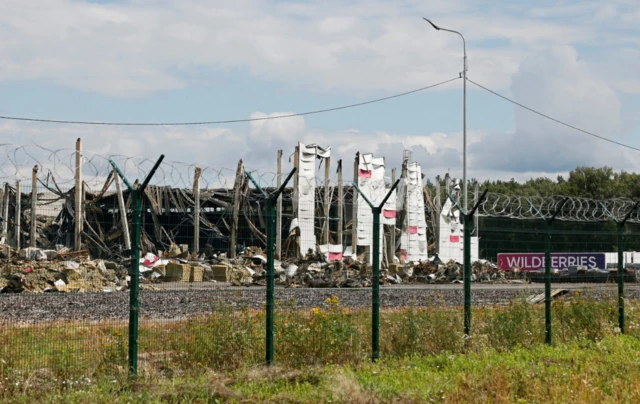
    Remains of the internal structure of a Wildberry site in Elektrostal photographed from a field outside the building's perimeter. Parts of the external walls (in white and purple) remains up, a Wildberries' lorry is parked in the backgroundImage source, Reuters
    Image caption,

    Ukrainian forces have targeted multiple Wildberries sites in recent weeks. Pictured: The remains of the Elektrostal site struck on 18 July

    Between 17% and 22% of Wildberries' total logistics space had been affected by drone attacks by 2 August, according to an estimate by the research agency Data Insight published by Forbes Russia.

    The agency calculated that between 893,000 and 1.15 million square metres of warehouse space had been damaged. Wildberries' parent company, RWB, has previously said its logistics infrastructure covers about 5.2 million square metres.

    This does not mean that a fifth of the company's warehouses has been completely destroyed. Some facilities suffered only partial damage, and several have since resumed operations.

    The independent Russian outlet Vyorstka produced a higher estimate of about 27%, but it used a different method. It counted the full size of every warehouse that was hit, rather than only the parts believed to have been damaged.

  11. BBC Verify

    New footage shows fire and smoke over Wildberries warehousepublished at 12:36 BST

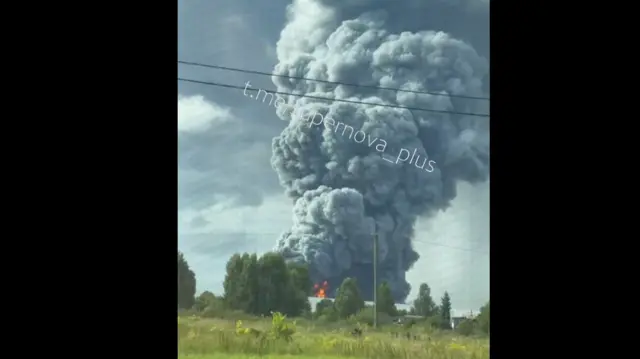
    A thick cloud of grey smoke billows from a Wildberries facility in Russia's Vladimir regionImage source, Supernova+

    By Shayan Sardarizadeh

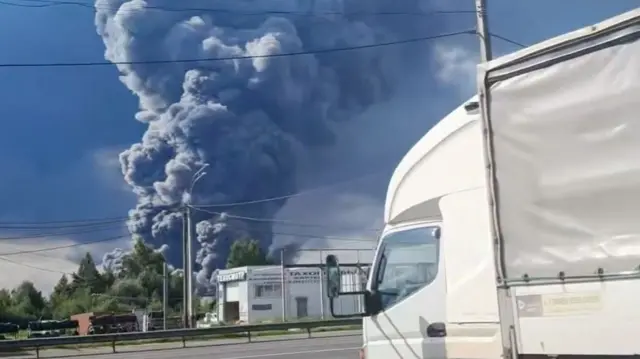
    Footage posted on social media shows smoke rising from a Wildberries warehouse in Russia’s Vladimir region following an apparent Ukrainian drone attack today.

    The video, filmed from a passing vehicle on a motorway, shows a fire burning and a thick column of black smoke billowing from the complex.

    The warehouse is about 160km (100 miles) east of the Russian capital, Moscow.

    Earlier, we verified a video showing a drone striking close to the warehouse.

  12. Drone strikes and interceptions: What's happened so farpublished at 12:25 BST

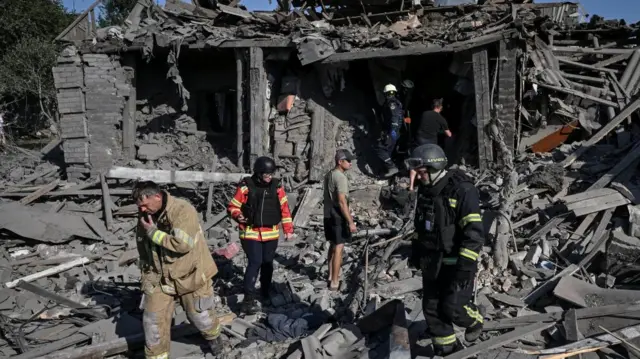
    Rescuers work at Ukrainian site of houses destroyed yesterday by a Russian air strikeImage source, Reuters
    Image caption,

    Rescuers work in Ukraine after a site of houses was hit yesterday by a Russian strike

    For those just joining us, here's a quick recap of what we know so far:

    • An apparent Ukrainian drone has hit a warehouse for Russia's biggest online retailer Wildberries - often described as "Russia's Amazon"
    • It follows a number of attacks on Wildberries warehouses and logistics hubs across Russia since mid-July
    • In the past few days, deadly aerial attacks have intensified between Russia and Ukraine, with hundreds of drones intercepted by both countries in the last 24 hours
    • Three ships carrying military goods in Ukraine's part of the Black Sea have been struck by Russian drones, according to Russia's defence ministry
    • A special task force has been set up by Russia to navigate the "tense situation in the Sea of Azov" - a strategic route for Russian grain exports

    Stick with us as we continue to bring the latest updates and analysis.

  13. Wildberries pays compensation to victims and businesses affected by strikespublished at 12:00 BST

    Smoke rises near a Wildberries warehouseImage source, Reuters

    Ongoing attacks on warehouses belonging to Wildberries have led to the company making support payments to victims and merchants whose products were damaged, the online retailer said last week.

    A statement last Tuesday said over 40m rubles (£373,000) of financial compensation has been paid by the company to "seriously injured" personnel and the families of those who have died.

    It added in a statement two days later that more than 97,000 small and medium-sized businesses had received support in a second round of payments, with over 88,000 merchants being supported in an initial round.

    Wildberries, widely described as "Russia's Amazon", employs about 48,000 staff. Both statements were made before further strikes on the company's warehouses over the weekend - including one in the Vladimir region.

  14. BBC Verify

    Verified videos show strikes on nine Wildberries sitespublished at 11:49 BST

    By Thomas Copeland

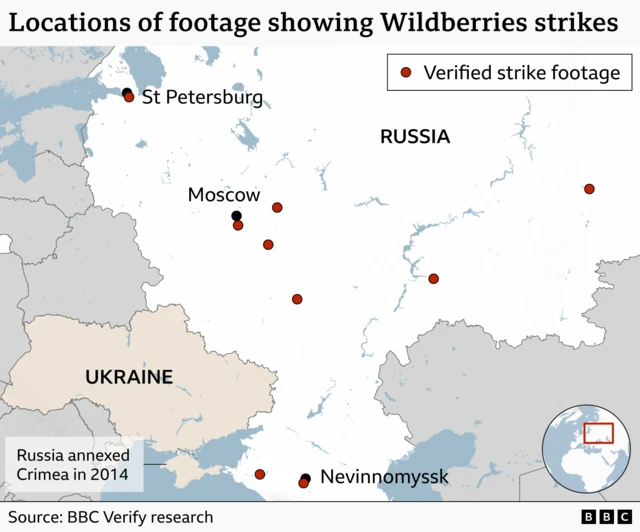
    BBC Verify has been tracking Ukraine’s campaign of strikes against Wildberries warehouses and logistics hubs across Russia since mid-July.

    So far we’ve verified footage showing nine of these strikes:

    • 18 July: Kotovsk
    • 20 July: Koledino
    • 22 July: Nevinnomyssk
    • 22 July: Krasnodar
    • 24 July: St Petersburg
    • 25 July: Yekaterinburg
    • 29 July: Ryazan
    • 2 August: Novosemeykino
    • 3 August: Khryastovo
    A map showing the locations across Russia where Wildberries sites have been attacked

    Correction 13:45: The map originally used in this post incorrectly stated that Crimea was annexed by Russia in 2024, not 2014. This has now been corrected.

  15. Analysis

    Wildberries strikes are bringing the war closer to Russianspublished at 11:22 BST

    Steve Rosenberg
    Russia editor

    To many Russians, until recently, war was something happening far away; something that didn’t seem to impact their lives.

    That’s changing.

    Ukrainian drone attacks on Russian oil refineries have sparked a summer fuel shortage in many parts of Russia.

    Now the targeting of Wildberries warehouses is bringing the war closer to home.

    Wildberries is Russia’s largest online retailer, accounting for just over 50% of all online orders in the country.

    Recently the company’s CEO Tatiana Kim claimed that "every person in Russia" uses it. That’s tens of millions of Russian customers potentially facing disruption because of Ukrainian strikes on Wildberries hubs.

    Not to mention the hundreds of thousands of sellers who use the online platform. For them the strikes are making an already difficult economic situation even worse. Some small businesses have watched their stock go up in smoke.

  16. Three people killed by falling drone debris - Russian officialpublished at 11:12 BST

    The Governor of Krasnador Krai, Veniamin KondratievImage source, Getty Images
    Image caption,

    The governor of Krasnodor Krai, Veniamin Kondratiev

    Three people have been killed by falling drone debris, says the governor of Krasnodor Krai.

    In a post on Telegram, Veniamin Kondratiev says preliminary reports suggest 13 people, including children, were also injured in the area which is in south-west Russia.

    Kondratiev adds the attack "targeted civilian infrastructure".

  17. Russia increasing protection in key shipping route over 'tense situation'published at 10:51 BST

    A satellite image of the Sea of Azov, July 13, 2026. 2026Image source, COPERNICUS SENTINEL-2/Reuters
    Image caption,

    A satellite image of the Sea of Azov as taken on 13 July

    Russia says it is stepping up protection of ships in the Azov-Black Sea basin following Ukranian drone attacks on its maritime vessels.

    In response to what it describes as the "tense situation in the Sea of Azov", the Russian transport ministry says it has set up a special task force to coordinate transportation, redirect cargo and find alternative routes.

    Together with the defence ministry, it says additional measures are being taken to "ensure the safety of navigation and protect maritime vessels in the Azov-Black Sea basin".

    It comes as both sides continue to escalate attacks at sea, with Russia reporting strikes on three ships carrying military goods in Ukraine's part of the Black Sea on Monday.

    For context: The Sea of Azov is an inland sea linked to the Black Sea by the Kerch Strait, which sits between the Moscow-annexed Crimea and Russia. The route is used by Russia for around a quarter of its grain exports.

  18. How Ukraine's attacks have placed a strain on Russian businessespublished at 10:35 BST

    Sofia Volyanova, Yaroslava Kiryukhina, Amalia Zatari and Tatiana Kovtun
    BBC News Russian

    Two women enter a pick-up point in Moscow, with WB brandingImage source, EPA/Shutterstock

    Supporting small and medium-sized businesses, many of which depend on online marketplaces like Wildberries, has been among Vladimir Putin's priorities even in wartime.

    It has been framed as a backbone of resilience in the face of Western sanctions.

    But the Russian state has been unable to shield the sector from the war's impact, and there have been several shocks to businesses since the start of the year.

    VAT went up from 20% to 22% in January, with extra funding earmarked for defence - and tax breaks for some businesses were scrapped.

    Some 209,000 small and medium-sized companies closed in the first quarter of 2026, according to business intelligence platform Kontur.Fokus. That is 9% more than in the first three months of 2025.

    "I've lost 1m roubles (£9,500; $12,700)... We're already getting screwed over from every direction as it is," one woman complained in an expletive-laden social media post that went viral.

  19. What is Wildberries?published at 10:30 BST

    A woman leaving a Wildberries pick-up pointImage source, Reuters
    Image caption,

    A Wildberries pick-up point in Moscow

    Wildberries is Russia's biggest online retailer, and is often described as "Russia's Amazon".

    Founded: 2004.

    USP: It connects independent sellers with buyers across Russia, storing and delivering their goods, and handling payments.

    CEO: Tatyana Kim, one of Russia's first female billionaires.

    Staff: About 48,000.

    Value: The merged RWB group, which combines Wildberries with advertising company Russ, was valued at about $12.6bn (£9.3bn) by Forbes Russia in 2026.

    Involvement in the war: Ukraine has hit a number of Wildberries logistics hubs, describing them as legitimate targets because they provide the Russian military with drone components, navigation equipment and other gear. Russia denies this.

  20. BBC Verify

    Video shows drone hitting Wildberries warehouse sitepublished at 10:05 BST

    By Fridon Kiria and Shayan Sardarizadeh

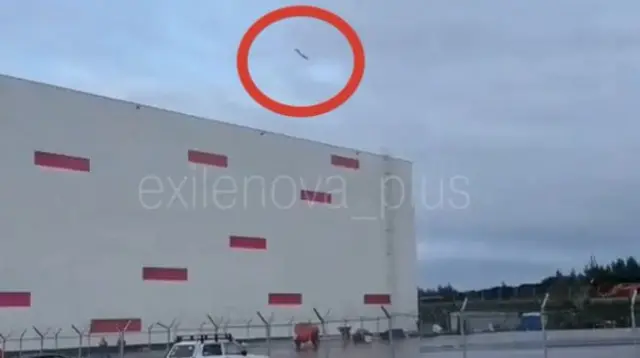
    Drone passing near warehouse site
    Image caption,

    A drone, seen in the red circle, can be seen passing overhead...

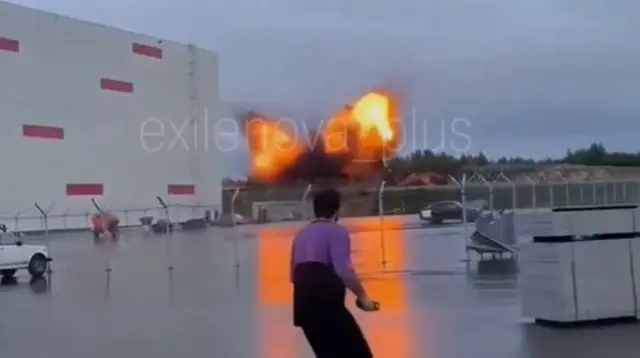
    Explosion
    Image caption,

    ... Seconds later an explosion is seen

    BBC Monitoring and BBC Verify have authenticated footage showing the moment an apparent Ukrainian drone struck a major Russian Wildberries warehouse this morning.

    The video, filmed in the car park of a Wildberries warehouse in Khryastovo, Vladimir region, shows a blast and a subsequent fire near the complex.

    BBC Verify has confirmed that the footage is recent and has not been manipulated with generative AI.