Summary

  • Tens of thousands of people are beginning to arrive in Belfast city centre for one of the busiest days of the Fleadh Cheoil na hÉireann

  • It is the largest celebration of Irish music and culture in the world

  • Gigs and concerts started around 12:00BST across the city

  • The city is hosting the event for the first time, and it is expected to bring an economic boost of more than £50m

  • Organisers are expecting 800,000 people to visit Belfast this week

  • Northern Ireland's transport operator Translink say they have recorded over 1 million passenger journeys already this week

  • Traffic disruption is expected as large parts of the city centre have been pedestrianised

  • Watch our short documentary about the Fleadh and the young people in the Ed Sheeran Foundation., external

What are your experiences of the Fleadh so far?

  1. From trad to samba as Fleadh brings the Belfast beatpublished at 17:31 BST

    While much of the Fleadh's festival of tunes and songs are focused on Irish folk and traditional, other genres do get a look in.

    Below we've got Buail Feirste bringing a Brazilian samba sensibility to the Fleadh - close your eyes and you could almost be in Rio (or Ri-yeeeeoooww if you prefer).

    Media caption,

    Fleadh: Belfast beat as samba band take to the street in Belfast
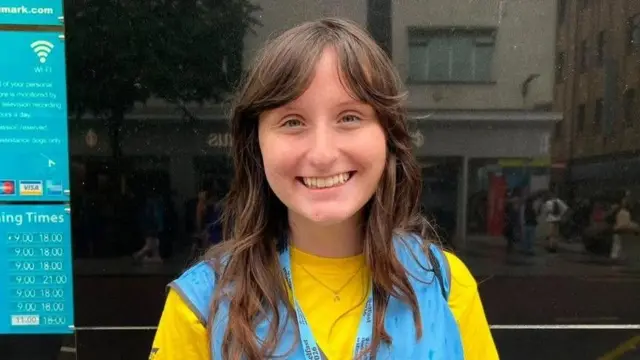
  2. The volunteers helping the Fleadh run smoothlypublished at 17:25

    A young woman, Addyson McGowan pictured outside Primark home on Royal Avenue. She is wearing a yellow t-shirt with a blue bib on top and a blue lanyard. She has brunette hair.Image source, Volunteer Now
    Image caption,

    Addyson McGowan from Florida says the Fleadh has been "so much fun"

    More than 1,300 volunteers have been helping visitors throughout the Fleadh, from welcoming people to Belfast to giving directions across the city centre.

    The people giving up their time to help this week – for free - have come from across Ireland and further afield with ages among the volunteer force ranging from 17 to 80 years old.

    Among them is Addyson McGowan, who has travelled almost 1,500 miles from Florida as part of a study abroad programme.

    “It’s awesome. I love seeing all the instruments, I love the music,” she says. “Everyone’s admiring everyone and it feels like such a safe place to be - it’s so heartwarming.”

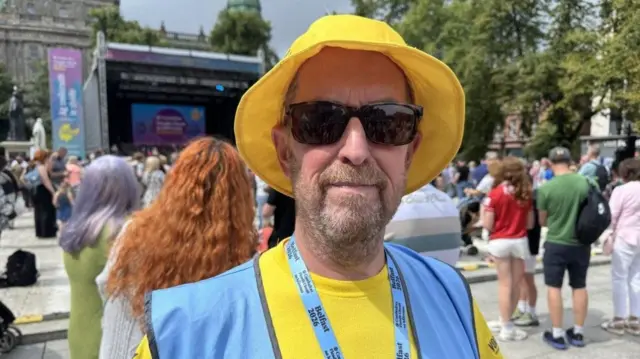
    Kevin McVeigh, a man with a yellow hat, dark glasses, a beard, yellow t-shirt and also wearing a blue bib.
    Image caption,

    Kevin McVeigh played a key role as a welcome ambassador at the opening ceremony of the Fleadh on Sunday afternoon

    Belfast volunteer Kevin McVeigh says he’s proud to help showcase his home city.

    “I’m a big fan of volunteering. It is the social glue that helps foster good relations with people.”

    You can read more about the volunteers here.

  3. Listen: The history of the Fleadhpublished at 17:22 BST

    William Crawley, on our Talkback radio programme, delved into the history of the event - from its origins to the present day, with Niall McClean -Chairman of Ards branch of Comhaltas Ceoltóirí Éireann, and Méabh Ní Fhuartáin - Author of "Heading to the Fleadh: Festival, Cultural Revival and Irish Traditional Music".

    You can listen to that discussion below.

    Media caption,

    Everything you need to know about the history of the Fleadh Cheoil na hÉireann

  4. "It's important to show all the different cultures we have in Belfast"published at 17:14 BST

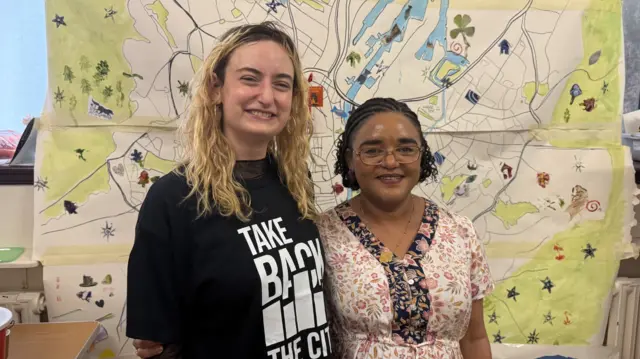
    Two women smile at the camera, the women to the left is wearing a black tee shirt and white writing. She has curly blonde hair. The women on the right is shorter and is wearing glasses and flowery pink and white top and has dark braided hair.
    Image caption,

    Anaka Women's Collective volunteers Twasul Mohammed (right), and Soso Ni Cheallaigh

    Community volunteers in Belfast are using the Fleadh to celebrate the city’s growing diversity through music, food and arts events.

    The programme, organised by volunteers from groups including Anaka Women’s Collective and CATU, features arts and crafts, dancing, film and food from a range of cultures. The café is serving dishes prepared by asylum seeker chefs who are not yet able to work.

    Soso Ní Cheallaigh said the Fleadh was an opportunity to reflect the changing face of Belfast.

    “It’s important to show all the different cultures we have in Belfast throughout the Fleadh. We have an Irish international tradition now that extends to all members of our communities."

    Twasul Mohammed said the space had become a safe way for many women to experience the festival.

    “Many of the women here in Anaka don’t get to see the events of the Fleadh because they don’t feel safe going to any place. This is a safe place where they can come and enjoy part of the Fleadh, see musicians, listen to music and take part in the different events we are hosting.”

    "We want everyone to enjoy the fleadh but also show solidarity with refugees and the homeless community in Northern Ireland."

  5. 'Special time for Irish language speakers'published at 17:00

    Robbie Meredith
    BBC News NI Education Correspondent

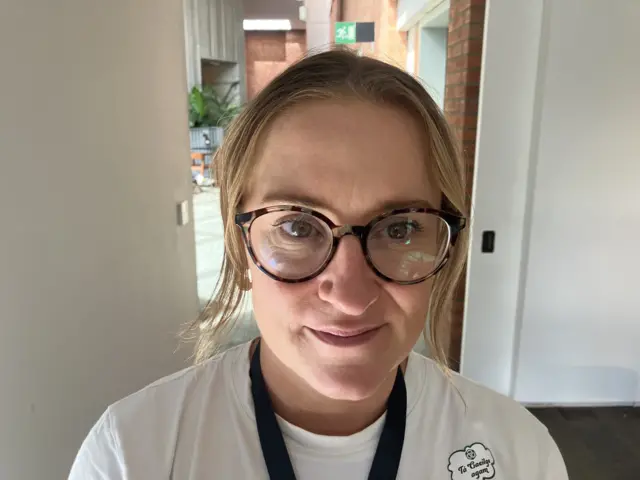
    A woman with blonde hair and round black glasses. She wears a white tee shirt with a black lanyard around her neck
    Image caption,

    Sorcha Campbell says the Irish Language Hub "is open and welcome to everybody"

    The Irish language is playing a central role at this year’s Fleadh, with events for speakers, learners and complete beginners taking place across Belfast.

    At the Irish Language Hub in the MAC, Sorcha Campbell says everyone is welcome.

    “There’s lots going on for families, for learners and for people who don’t speak Irish but just want to have a listen and learn a cúpla focal, or a few words of Irish.”

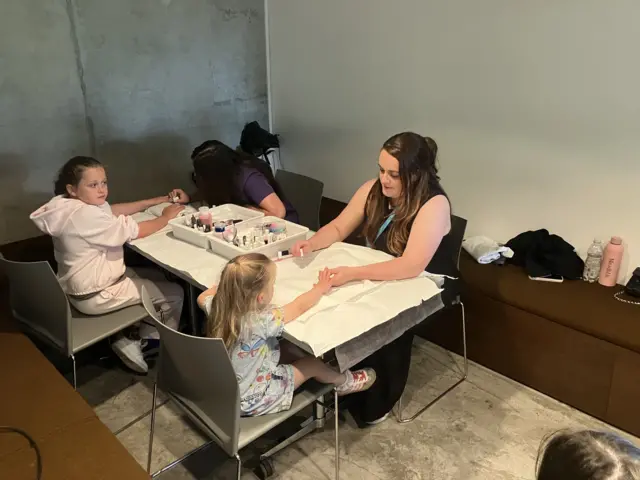
    The two children are getting their nails polished by (sitting opposite) two adults sitting at a table. In the middle of the table there is a box filled with colourful polish and makeup
    Image caption,

    Visitors can try everything from storytelling, film screenings to circus skills, baby yoga and even makeup sessions – all through Irish.

    About 600 students are also taking part in classes at Scoil Éigse in Ulster University. Tutor Kieran Hanrahan said it’s “heartening” to see so many young people eager to develop their Irish language and music skills.

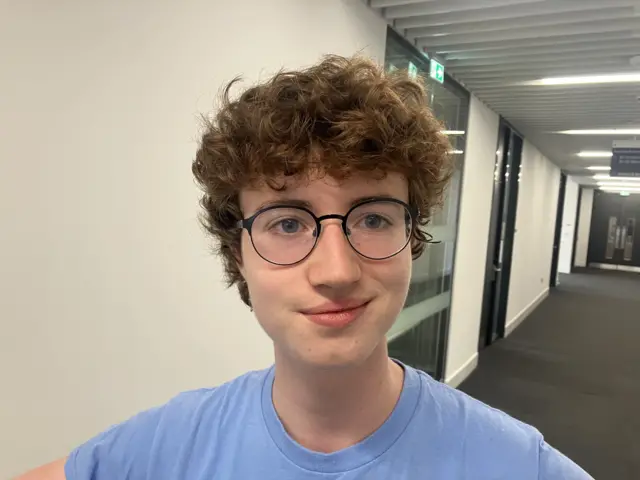
    One of them is 14-year-old Cuán Ó Lorcáin from Dublin, who is competing in fiddle and sean-nós singing.

    “The Irish language is very important… I love singing through Irish, and without it the atmosphere at the Fleadh wouldn’t be the same.”

    A teenager with red curly hair, round black glasses and a blue tee shirt smiles at the camera.
    Image caption,

    Cuán Ó Lorcáin (14) from Dublin is competing this weekend in sean-nós singing (solo singing performed in the Irish language)

  6. Belfast was 'all barricades' 30 years ago, Lúnasapublished at 16:54 BST

    Claire Graham
    BBC News NI

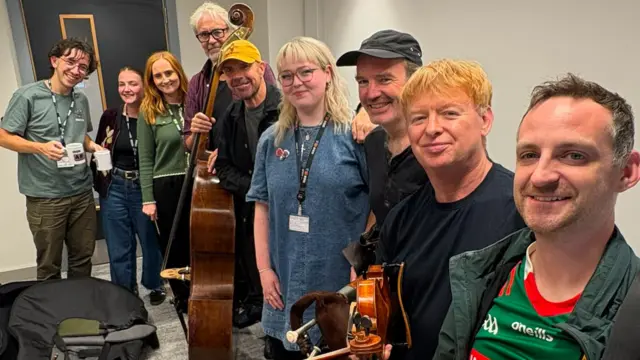
    9 people pose for a picture, some are holding instruments
    Image caption,

    Lúnasa - seen here outside the studio with some of our BBC colleagues - will be performing on Evening Extra this evening and at Belfast City Hall later on

    Cillian Vallely from Lúnasa has told BBC News NI there is some emotion with playing in Belfast as part of the Fleadh.

    "The whole area that's been pedestrianised, that was all barricades and you had nobody playing fiddles and sets of pipes on the street 30 years ago," he said.

    "And it's great outside the City Hall that you have all the main concerts up there.

    "It's going to be great to get the chance to play up there."

    Lúnasa will be performing on Evening Extra tonight, you can listen on BBC Radio Ulster or BBC Sounds from 17:00 BST.

  7. Fleadh 'sounds like a lot of fun' to cruise ship passengerspublished at 16:47 BST

    Finn Purdy
    BBC News NI

    About 2,500 passengers travelling on the cruise ship the Carnival Legends disembarked in Belfast on Friday morning, with many hoping to soak up some of the music and atmosphere at the Fleadh.

    Dennis and Lana Hopping from Missouri are on their first trip Belfast.

    “I’m hoping to see the downtown and I heard there might be a music festival and so we’re hoping to go see all that and hear the music”, Lana said.

    “Sounds like a lot of fun to me,” Dennis added.

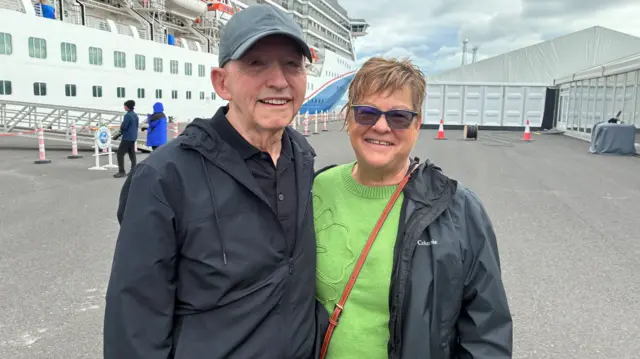
    A man wearing all black and a cap and a woman wearing a black coat and green jumper
    Image caption,

    Dennis and Lana Hopping from Missouri are on their first trip Belfast

    Terri Corson and her daughter Shelby from North Carolina said they had Irish heritage and had always wanted to visit the island.

    “It’s been beautiful so far,” Terri said.

    Shelby said she was looking forward to visiting shops and restaurants in Belfast and experiencing the culture.“We’ve been waiting all week for Belfast,” Terri added.

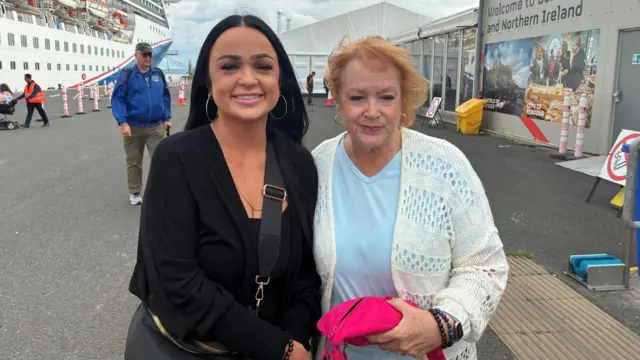
    A woman wearing all balck with dark ahir and a woman wearing a blue top and white cardigan with red hair
    Image caption,

    Shelby and Terri, from North Carolina, said they had Irish heritage

    Tom Cullen from California, also on his first visit to Belfast, said the trip was his retirement gift to his wife.

    He said they were looking forward to music, adding: “My wife will dance to anything”.“I’m with seven women so I’m kinda at the mercy of what they want to see and I’m just tagging along.”

  8. 'Fantastic occasion'published at 16:38 BST

    Some of you have been getting in touch via our contact form (on the left here) to tell us your experiences of the Fleadh in Belfast.

    Mark says: "Loved the atmosphere. Great to see people from all traditions there."

    Susan says: "Went in on Thursday parked in Castle Court, found a disabled bay and off to the Fleadh. Smooth journey - well done to everyone involved."

    And Hugh says: "A fantastic occasion and a credit to all visitors as to how clean the streets are, free from rubbish."

  9. Fleadh 'covering up major issue' in the citypublished at 16:34 BST

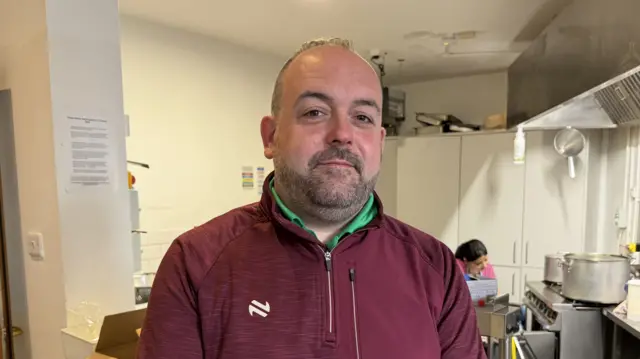
    A man with a purple half zip sports top, with a green collared shirt showing underneath. He is bald and has a dark beard. In the background you can see a kitchen with a silver stove, pots and pans .

    A Belfast councillor has called for more support for homeless people as the Fleadh continues in the city.

    Paul McCusker says more must be done to help people sleeping rough, as homeless people have been "pushed to the peripheries of the city centre".

    He said homeless services had dealt with five overdoses since Sunday, adding: “When people are being moved on it’s more difficult for services to link with them.

    "We are seeing more people in Botanic and more people around Queen's University," he told the Nolan Show this morning.

    The Housing Executive say: "26 crash beds are available in Belfast each night for immediate, short-term support while longer-term options for individuals are explored."

    McCusker is curious as to what happens next - "Is that person going to return to the streets?”

    He said: “Moving people on does not solve the issue... It is trying to cover up a major issue we have in Belfast in terms of homelessness and addiction."

    Belfast City Council says a multi-agency approach is in place to ensure support continues to be available for vulnerable residents as the visitor numbers increase.

    The PSNI say their "officers will be present to support public safety" and that they will work to "ensure appropriate safeguarding arrangements are in place for vulnerable people".

  10. Overnight stays with a view of Belfast's iconic yellow cranespublished at 16:28 BST

    Mark Simpson
    BBC News NI

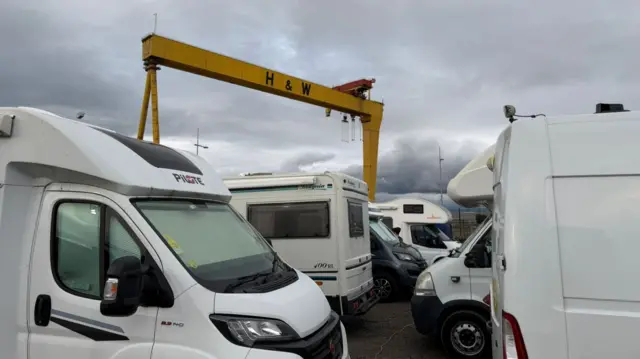
    camper vans and motorhomes parked closely together, with a big yellow crane (labelled H&W) in the background

    More than 300 campervans and caravans are parked beside Belfast’s famous yellow cranes.

    It’s an official site for overnight stays during the Fleadh.

    The shipbuilding cranes - nicknamed Samson and Goliath after Biblical giants - date to 1969 and 1974. They have become emblematic of the city, and everything from keychains to plantpots shaped like them are purchasable.

  11. From lockdown music lessons to the Fleadh stagepublished at 16:22 BST

    Mike McBride
    BBC News NI

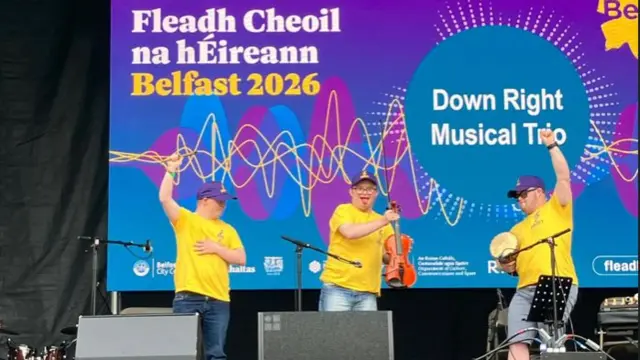
    Three men with yellow tee shirts holding irish traditional instruments are onstage perfoming. Two have their hands in the air, all are wearing purple hats and blue jeans.Image source, Down Right Musical Trio
    Image caption,

    Jack Rogers, Conor Collins and Bernard Goodwin putting on a show for crowds of spectators attending the festival

    The Down Right Musical Trio, made up of Jack Rogers, Conor Collins and Bernard Goodwin, are celebrating a remarkable journey that began with online music lessons during the Covid-19 pandemic and has led to them performing at this year’s Fleadh Cheoil na hÉireann.

    The three musicians, who all have Down’s syndrome, share a passion for traditional Irish music and have been supported throughout their musical journey by the Foyle Down Syndrome Trust.

    Speaking on BBC Radio Foyle’s North West Today programme, Conor Collins said they thoroughly enjoyed their performance in Belfast and that many people in the crowd were incredibly supportive. Jack said that, despite performing in front of a huge audience, they were surprisingly not nervous.

    He added that playing music is the best way to relax.

  12. The visitors for whom the Fleadh is a happy surprisepublished at 16:15 BST

    Darran Marshall
    BBC News NI

    Some people we spoke to didn't know the Fleadh would be on in Belfast when they came for other things - but they were happily surprised.

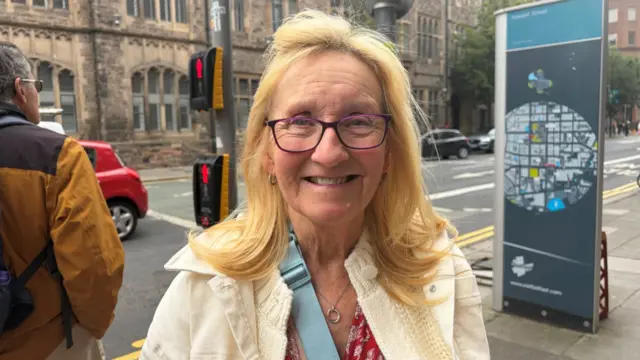
    a woman in a cream jacket smiling at the camera
    Image caption,

    'Music everywhere' says Christine from Scotland

    Christine Lennanis fromFraserburgh, north of Aberdeen, and travelled for 15 hours to get to Belfast.

    It’s Christine’s first time in the city and she says she’ll definitely be back.

    She didn’t know the Fleadh would be on when she booked but says “It’s been great. It’s brilliant – music everywhere, lovely, really enjoyed it.”

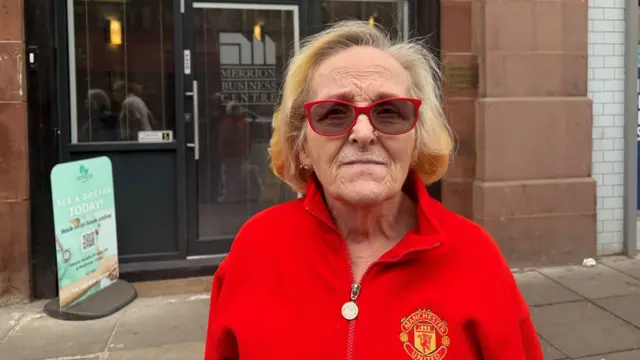
    a woman in a Manchester United top, looking at the camera
    Image caption,

    'It's like being at home' in South Shields

    Karen Burns, from South Shields, in north east England, is on her first visit to Belfast.

    A Manchester United fan, she crossed the Irish Sea to visit George Best's family home.

    “It’s amazing. It's like being at home," she says.

    "Everybody is brilliant and friendly. They help you. I’m getting lost and I’ve asked for directions, ‘oh I’ll show you’, it’s brilliant. The whole place is fantastic.”

  13. People of all ages have taken to the streetspublished at 16:09 BST

    Barry O'Connor
    BBC News NI

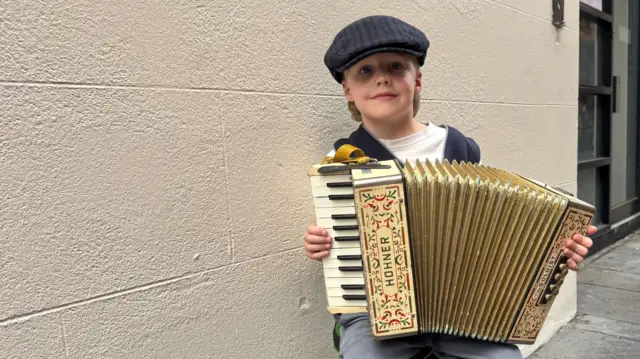
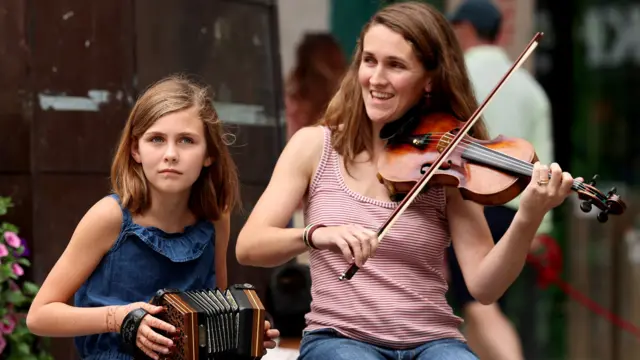
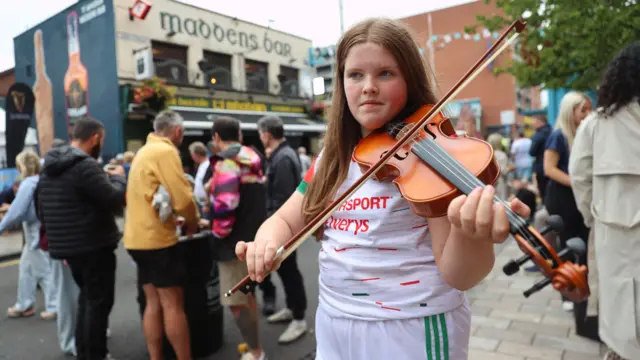
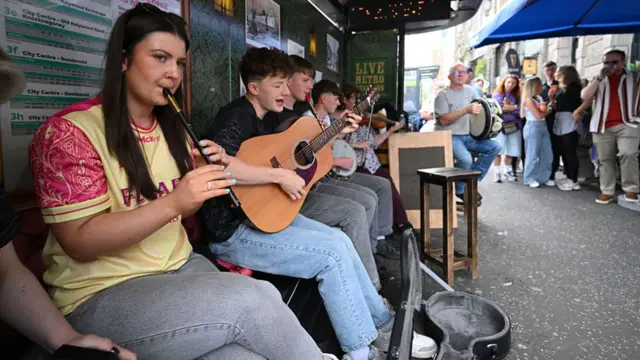
    If you've walked through the city centre this week, there's a fair chance you'll have seen people performing, from céilí bands to marching bands and Irish dancing, there's something for everyone.

    A young boy plays the accordion in a Belfast street
    Image caption,

    Diarmuid was playing the accordion on Monday afternoon

    A girl with dark hair plays music beside her mum who also has dark hairImage source, PA Media
    Image caption,

    Beatrice, aged eight, playing a concertina and her mother Constance Dettman playing the fiddle, from Chicago

    A girl wearing a white GAA top playing the violinImage source, PA Media
    Image caption,

    Tara, 12, playing the fiddle with the Glengormley School of Music

    People play music at a bus stopImage source, Getty Images
    Image caption,

    Street performers play at a bus stop in Belfast city centre

    Three men playing instrumentsImage source, Pacemaker
    Image caption,

    Performers on day four of the Fleadh

  14. Business 'devastated' after 'unintentionally' playing pro-IRA songpublished at 15:58 BST

    In general the Fleadh has been hailed as a success for Belfast, including in the way it has incorporated Protestant and unionist traditions in to its marching band events and at the City Hall - more on that here.

    But there have been a few discordant notes too.

    On Thursday a food business apologised after it was heard to play a pro-IRA song.

    A spokesman for the business, a food van, said they were "absolutely devastated" when they realised a playlist they were playing contained the song, which they played "unintentionally".

    The campaign group Let's Talk Loyalism lodged a complaint about the incident and requested that organisers condemn it, and Moore Holmes from the group told the BBC's Evening Extra programme on Thursday that he wanted the council to review the matter and the Fleadh to condemn the incident.

    "I think it would be very beneficial for the Fleadh to come out and condemn this," Holmes said.

    "If you tolerate it when it's small then it grows into something that it shouldn't be."

    Some politicians also spoke out against what had happened.

    MLA Brian Kingston wrote to the city council, saying: "There is a great deal of positive activity this week and it is essential that council ensures no tolerance of those wishing to promote or excuse terrorism."

    A statement from the business read: "The team were playing a public playlist and due to their busyness in the truck, didn’t notice when the inappropriate song came on."

    Fleadh Cheoil na hEireann wrote in a statement that they "do not support any behaviour or music that could cause offence or intimidation".

  15. Watch: Want to feel like you're part of the Fleadh?published at 15:52 BST

    If you're not able to make it to Belfast, check out our YouTube documentary looking back at the first few days of the Fleadh.

    BBC News NI's Jamie McColgan meets young people from the Ed Sheeran Foundation as well as the band Wilde Rose.

    You can watch it below.

    This YouTube post cannot be displayed in your browser. Please enable Javascript or try a different browser.View original content on YouTube
    The BBC is not responsible for the content of external sites. YouTube content may contain adverts.
    Skip youtube video

    Allow YouTube content?

    This article contains content provided by Google YouTube. We ask for your permission before anything is loaded, as they may be using cookies and other technologies. You may want to read Google’s cookie policy, external and privacy policy, external before accepting. To view this content choose ‘accept and continue’.

    The BBC is not responsible for the content of external sites. YouTube content may contain adverts.
    End of youtube video
  16. How culturally and historically significant could the Fleadh turn out to be?published at 15:40 BST

    Belfast has just come through a week that people are already calling historic.

    The Fleadh Cheoil na hÉireann has brought hundreds of thousands of people into the streets for a festival of Irish music and culture hosted in Belfast for the very first time.

    On Talkback today, presenter William Crawley brought together guests to ask what it says about Belfast right now, and whether this could be a real turning point for the city.

    He spoke to Glenn Miller, from the Belfast Bands Forum, Professor Duncan Morrow from the Ulster University, Irish-language teacher and activist Linda Ervine, and Irish News columnist Chris Donnelly.

    You can listen below.

    Media caption,

    How culturally and historically significant is the Fleadh?

  17. Belfast's busy weekend is just beginningpublished at 15:25 BST

    Barry O'Connor
    BBC News NI

    Music and pints both flowed in the city centre at lunchtime today.

    Dry weather allowed this session to spill out onto the cobblestones and even as competitions were happening in venues around the city centre, craic was mighty in and around the pubs.

    This weekend is only to get busier!

    Media caption,

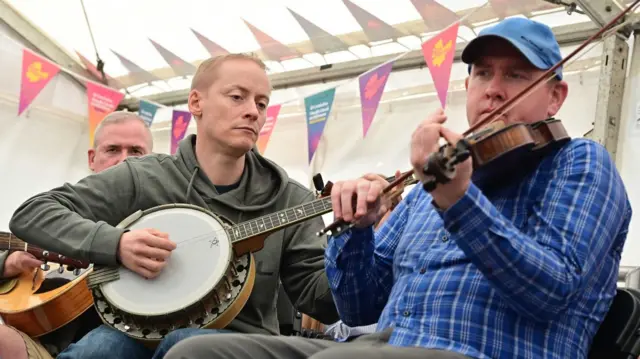
    Musicians entertaining the crowds at the Fleadh

  18. How much is the Fleadh worth to Belfast in economic terms?published at 15:19 BST

    John Campbell
    BBC News NI economics and business editor

    At the start of the week, Northern Ireland's economy minister was saying the Fleadh could bring in £53m; by the end of the week, she thought the boost to Belfast would be more than that.

    It will take some time to get a full estimate, however.

    When assessing the impact of an event like the Fleadh, economists try to work out the ‘additionality’ - the extra economic impact which has only occurred as a result of the event.

    That is more complicated than just multiplying the number of estimated visitors by an estimated amount of spending per head.

    They have to assess ‘deadweight’ - the tourist spending that would have happened anyway and ‘leakage’ - the spending with leaks away from Belfast to businesses based elsewhere, such as international drinks companies.

    There is also the impact of ‘reallocation’ - spending by local people which simply moves from one business to another and ‘displacement’ - spending which doesn’t happen such as people choosing not to do their usual city centre shopping during the event.

    The Fleadh has characteristics which means it is good at generating additionality:

    • it attracts people from outside Belfast and NI
    • it happens over a week which helps drive spending on accommodation
    • it is decentralised with spending across multiple businesses

    The Fleadh was part of Derry’s Capital of Culture in 2013 and a post-event analysis found that it was by far the most significant event in generating additionality across that year.

    Read more on the economic projections here.

  19. Queues build uppublished at 15:12 BST

    Catherine Morrison
    BBC News Northern Ireland reporter

    There's a queue of people already waiting to get in to the grounds of Belfast City Hall. Those inside have come prepared, with camping chairs and picnics.

    This afternoon there's a céilí, some cross-cultural music and two well-known groups: TRIP and Lúnasa - line-up here, external.

  20. "In every corner of the city there are musicians from different cultures"published at 14:55 BST

    The Fleadh is a festival of Irish music and culture, so fiddles, tin whistles, bodhráns and accordions predominate.

    But some musicians are bringing a more international flavour to proceedings, with instruments including the rubab and the daf.

    The charity Beyond Skin invited some musicians to perform traditional instruments from their home countries.

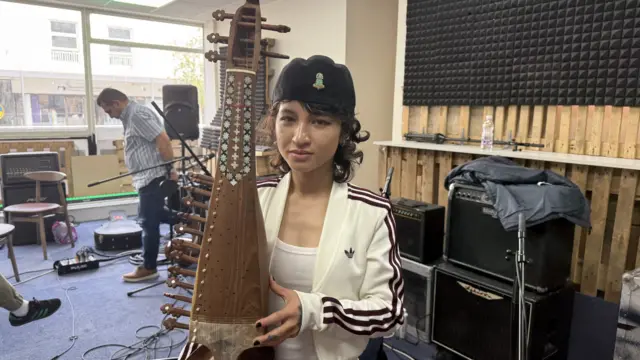
    Soraya Hoesseini, originally from Afghanistan, plays the rubab, which is her country's national instrument.

    "It’s not just about music," she says.

    "It’s about a connection between people and different cultures here.

    In every corner of the city there are musicians from different cultures. I have met with musicians connecting through Persian, Syrian and Irish musical cultures"

    A woman wearing a black hat with a white jacket with three purple stripes down the side. She is holding a Rubab, a traditional guitar from Afghanistan.
    Image caption,

    Soraya will be playing the Rubab, a traditional Afghan instrument

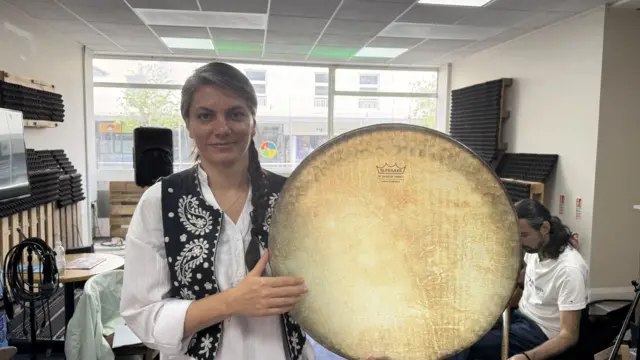
    Sara Fotros, who's originally from Iran but living in London, plays the daf, a drum that is played with the hand, rather than a stick. She has been learning from local musicians whilst visiting.

    "I had the opportunity to meet bodhrán players and play with them and learn some new techniques from them.

    "Throughout this week I’ve noticed how much Irish people love music and they’ve been very really welcoming… they’re not only interested in the music that I play but the culture I come from also.”

    A woman wearing a white shirt, and a black waistcoat with white artwork on it. She is holding a large brown drum in both hands.
    Image caption,

    Sara said that the Persian daf drum that she plays is "very similar" to the Irish bodhrán