Summary

Media caption,
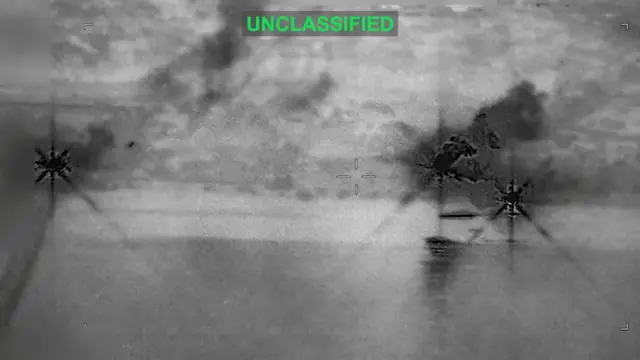
Watch: US strikes target Iranian military boats
  1. Increase in oil prices following US-Iran exchange of strikespublished at 08:14 BST

    Emer Moreau
    Business reporter

    Oil prices have ticked up following the strikes: a barrel of Brent crude, the international benchmark, rose by more than 3% to $76 (£56.88).

    Prices dropped back to pre-war levels following the US-Iran truce agreement signed last month.

    But these fresh attacks will bring back concerns about the flow of traffic through the crucial Strait of Hormuz, which sees about a fifth of all the world's oil go through it under normal circumstances.
  2. Kuwait joins Qatar and Saudi Arabia in criticising Iranian strikespublished at 08:01 BST

    Gulf States have been reacting to strikes by Iran.

    Kuwait's foreign ministry has condemned "repeated heinous Iranian aggressions" this morning.

    In a statement, it says theses "brazen aggressions" undermine efforts to reduce tensions and strikes "at a time when regional and international efforts aimed at de-escalation are underway".

    The foreign ministry says Kuwait reserves its right to "take all necessary measures" to protect its security.

    Meanwhile Qatar's foreign ministry spokesperson Majed Al Ansari says it holds Iran "fully responsible" for an apparent targeted attack on a vessel called Al-Rekayyat as it transited near the strait on Tuesday.

    And, in a separate social media post, Saudi Arabia's foreign ministry said Iran had targeted the Saudi tanker Wadyan as it crossed the strait.

  3. Iran's chief negotiator accuses US of 'major' violations of peace dealpublished at 07:47 BST

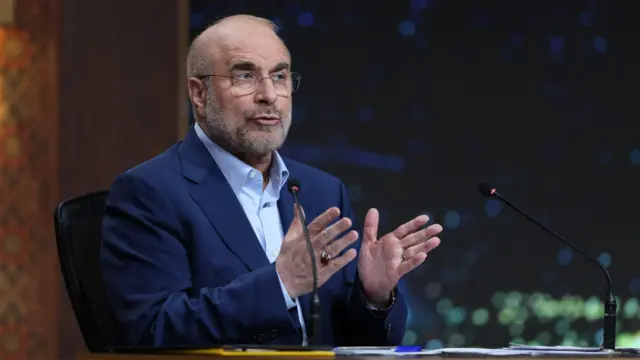
    Mohammad Ghalibaf gestures as he speaks in front of a microphoneImage source, Rex/Shutterstock

    Iran's parliamentary speaker and chief negotiator Mohammad Ghalibaf has accused the US of committing "major" violations of the memorandum of understanding signed between the two countries.

    He says the US has violated "Iranian adjustments in the strait", continually threatened to attack Iran and reinstated oil sanctions.

    Ghalibaf also says there have been further attacks on southern Iran and continued "aggression" by Israel in southern Lebanon.

    "The era of bullying and extortion is over. It leads nowhere. We don't fold," he says in a post on X.

  4. Bahrain activates alarm siren as Iranian military says it is striking US sitespublished at 07:29 BST

    There are reports of alarms sounding in Bahrain this morning, as Iran's military says it is targeting US sites in the Gulf state.

    "The naval and aerospace forces of the Islamic Revolutionary Guard Corps, in a joint missile and drone operation, struck 85 key American military installations at Salman Port, the US Fifth Fleet area in Bahrain," the IRGC says in a statement.

    The Iranian military also says it has targeted Ali Al Salem Air Base in Kuwait.

    It says this follows US military strikes launched against a "number of coastal bases coastal bases and civilian facilities along the coasts of Hormozgan Province and Mahshahr".

    Amid the attacks, Bahrain's interior ministry has been sounding an alarm siren.

  5. US says strikes are response to attacks on vessels in Strait of Hormuzpublished at 07:25 BST

    Smoke rises at an unknown location following what US Central Command says is a new wave of strikes against IranImage source, Reuters
    Image caption,

    Smoke rises at an unknown location following what U.S. Central Command says is a new wave of strikes against Iran

    Last night, the US launched strikes on Iran in response to attacks on three oil tankers in the Strait of Hormuz.

    Iranian state media says US strikes hit Qeshm island, Bandar Abbas and Sirik.

    The US says its strikes were in response to attacks by Iran on commercial vessels moving through the strait in recent days. Tehran has not directly claimed responsibility for those attacks.

    UK Marine Trade Operations had said a tanker travelling through the strait had reported a fire after an unknown projectile hit an engine room on Monday.

    In two separate incidents on Tuesday, a tanker reported being hit as it exited the strait but was able to proceed to its next port of call, while another tanker reported sustaining minor structural damage after being struck, the organisation said.

  6. The Strait of Hormuz - why is it significant?published at 07:16 BST

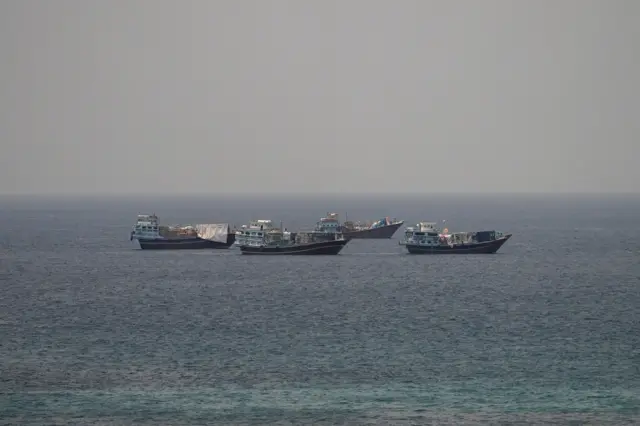
    Vessels at the Strait of Hormuz, as seen from Musandam, OmanImage source, Reuters

    The waterway has been a key focus in the conflict.

    Bounded to the north by Iran and to the south by Oman and the United Arab Emirates (UAE), the strait - only about 50km (31 miles) wide at its entrance and exit, and about 33km wide at its narrowest point - connects the Gulf with the Arabian Sea.

    About 20% of the world's oil and liquefied natural gas (LNG) usually passes through the strait, with oil coming not only from Iran but also from other Gulf states such as Iraq, Kuwait, Qatar, Saudi Arabia and the UAE.

    Before the war, about 3,000 ships usually sailed through the strait each month, but this dramatically decreased after Iran threatened to attack tankers and other ships.

    Since the memorandum of understanding was signed on 17 June, shipping traffic has begun to recover but still remains below the pre-war peak.

    This Flourish post cannot be displayed in your browser. Please enable Javascript or try a different browser.

  7. Foreign secretary: UK recognises US concerns over Iran hijacking Strait of Hormuzpublished at 07:08 BST

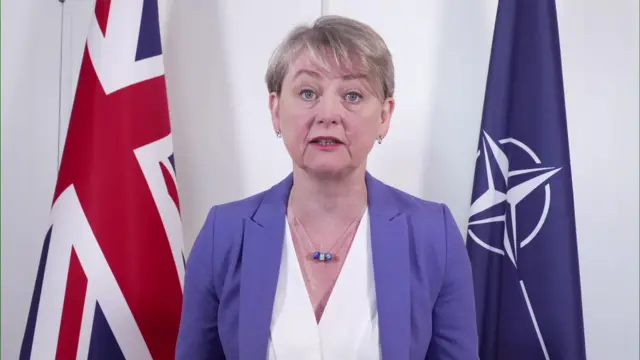
    Yvette Cooper in a blue jacket in front of UK and Nato flags

    UK Foreign Secretary Yvette Cooper has accused Iran of trying to "hijack the global economy" following attacks in the Strait of Hormuz.

    Speaking to BBC Breakfast from the Nato summit in Turkey, Cooper calls on Iran to "respect the terms of the memorandum that they committed to".

    As a reminder, the US and Iran signed an initial peace deal - known as a memorandum of understanding - on 17 June. Among its terms was a pledge to reopen the Strait of Hormuz, in return for the US lifting sanctions on Iran.

    She stresses the UK wasn't involved in the US strikes overnight but says "I do recognise their concerns about Iran trying to continue to hijack the strait and violating the terms of the ceasefire".

  8. What is the memorandum of understanding between the US and Iran?published at 07:00 BST

    On June 17, the presidents of the US and Iran signed an initial deal - known as a memorandum of understanding (MoU) - extending the ceasefire between the two nations.

    The agreement includes reopening the Strait of Hormuz, a $300bn (£224bn) plan for Iran's "reconstruction", and the US terminating "all types of sanctions" on Iran.

    But it does not deal with the thorny issue of Iran's nuclear programme - one of the reasons stated by the US for launching the war.

    As a result, further negotiations have been taking place the two sides in recent weeks.

    Earlier this morning, Iran's parliamentary speaker and chief negotiator Mohammad Ghalibaf accused the US of breaking the MoU by "violating Iranian adjustments in the strait".

    During the conflict Iran sought to assert its sovereignty over the strait, including by establishing the "Persian Gulf Strait Authority" which it said would manage "safe passage permits".

    But the agreement notes that Iran will "make arrangements using its best efforts" to allow safe passage of commercial vessels through the strait - with no charge - for at least 60 days.

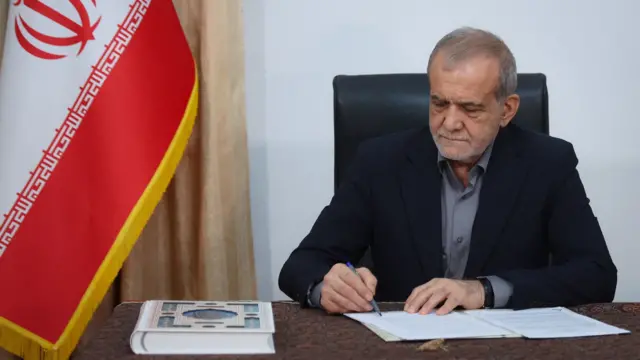
    Iranian President Masoud Pezeshkian signs the document of memorandum of understanding in TehranImage source, Reuters
    Image caption,

    Iranian President Masoud Pezeshkian signing the memorandum of understanding

  9. Nato chief says US strikes were 'absolutely necessary'published at 06:48 BST

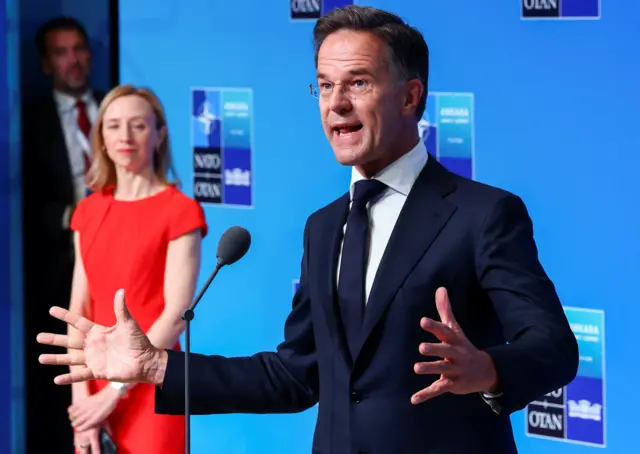
    NATO Secretary-General Mark Rutte's hands are stretched out wide as he speaks to the media at the summit in Ankara, TurkeyImage source, Reuters
    Image caption,

    The Nato summit in Ankara got under way yesterday

    The latest round of US strikes against Iran have taken place against the backdrop of the Nato summit, which began in the Turkish capital Ankara yesterday.

    This morning, Nato Secretary-General Mark Rutte was asked about the overnight strikes.

    He says they were "absolutely necessary" as he accused Iran of violating the ceasefire agreement. "I think it is totally crucial that the US forcefully reacts," he adds.

  10. Tensions ramp up in Middle East as Trump meets allies at Nato summitpublished at 06:42 BST

    Donald TrumpImage source, EPA/Shutterstock
    Image caption,

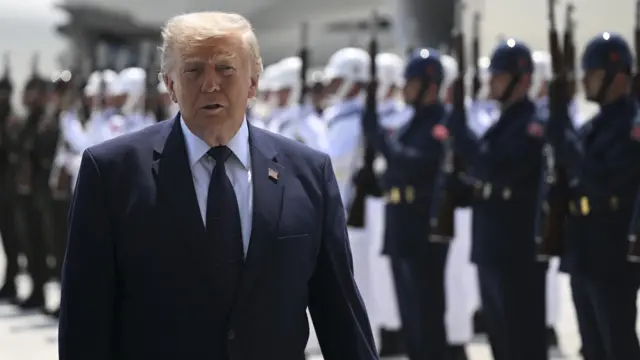
    Trump arrived in Ankara on Tuesday for the Nato summit

    The US and Iran have traded strikes overnight after tensions escalated in the Strait of Hormuz, as Donald Trump is in Turkey for the Nato summit.

    US Central Command (Centcom) said on Tuesday it had hit over 80 targets, including more than 60 Islamic Revolutionary Guard Corps (IRGC) small boats in the strait.

    The IRGC said it had responded with retaliatory attacks on US military sites in Bahrain and Kuwait in the early hours of Wednesday morning.

    Centcom says the US strikes are in response to Iran “targeting and attacking commercial shipping” in the strait, after several reports of tankers being targeted on Tuesday.

    Iran, on the other hand, has accused the US of breaching a memorandum of understanding signed between the countries last month.

    It comes as the US president will meet with allies at Nato’s Ankara summit - we’ll bring you up to speed with the situation in the Middle East and keep across what is happening in Turkey.