Summary

  • Donald Trump threatens to attack Iran "hard" tonight, hours after saying he thinks the US-Iran ceasefire is "over"

  • Trump earlier said of the Iranian leadership: "I don't want to deal with them anymore, they're scum. They're sick people, they're led by sick people" - here are his remarks in full

  • Trump added that negotiators on both sides could continue to talk, but "I think they're wasting their time"

  • In response, Iran's foreign minister says: "We do not answer vulgarity with vulgarity, but with action: fearlessly and with great valour"

  • Something seems to have shifted in Trump, writes our White House reporter Bernd Debusmann Jr

  • Trump's comments follow both countries exchanging attacks. Late on Tuesday, the US said it had fired at more than 80 Iranian targets - BBC Verify has looked at one set of strikes

  • In response, Iran said it was targeting US military sites in Bahrain and Kuwait. The US strikes on Tuesday followed attacks on three tankers in the Strait of Hormuz

  1. Analysis

    We've been here before - exchange of words and bombs another test of fragile ceasefirepublished at 19:32 BST

    Nick Johnson
    Reporting from Washington DC
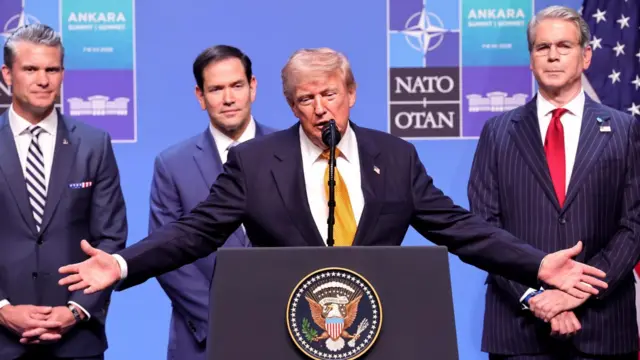
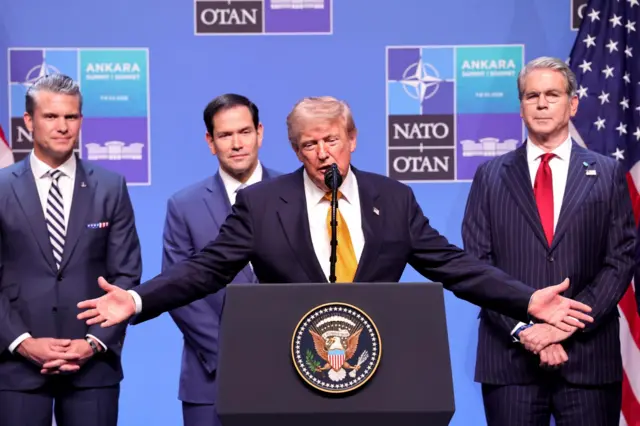
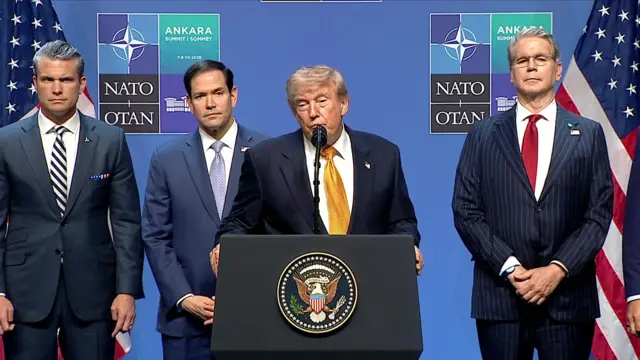
    Trump speaking on stage alongside Pete Hegseth, Marco Rubio, and Scott BessentImage source, EPA

    Speaking from the Nato summit in Turkey, President Trump made it clear his patience with Iran was running thin.

    Shortly after describing the leadership in Tehran as “scum” - he said the US would "probably" strike Iran “very hard” again tonight.

    On Tuesday, the US attacked sites in Iran which it claims were used to launch strikes upon commercial vessels in the Strait of Hormuz. Tehran replied by targeting US interests in Bahrain and Kuwait.

    But, we’ve been here before.

    Only last week, ceasefire talks resumed following another tit-for-tat exchange of fire between Iran and the US. And despite the president’s rhetoric, it’s not clear if the ceasefire has yet run its course.

    The duration and intensity of any subsequent US strikes on Iran should provide a clearer picture.

    While Donald Trump did not rule out a continuation of the ongoing peace talks, this latest exchange of words and bombs is yet another test of a ceasefire which looks increasingly fragile.

    We're ending our live coverage now. You can read more in our news story.

  2. BBC Verify

    How many ships have been attacked since the ceasefire?published at 19:18 BST

    By Joshua Cheetham

    The US says it carried out its latest round of strikes in response to attacks on three commercial vessels which it has blamed on Iran.

    But these aren’t the only ships to come under attack recently in the Strait of Hormuz.

    In total, at least five vessels have been targeted since the US and Iran signed a deal to end the war on 17 June.

    The first, on 25 June, was a Singaporean-flagged container ship called Ever Lovely.

    The others were three oil tankers and an LPG carrier, tied to owners in Saudi Arabia, Qatar, Greece and South Korea.

    All were hit near the coast of Oman, along shipping routes that the UN’s International Maritime Organization, the US and its regional allies have said ships should use to transit the strait.

    Iran has previously warned ships to only use a corridor further to the north of the strait which has been approved by Tehran.

  3. BBC Verify

    Iran has been trying to assert control over the Strait of Hormuz - how have ships been getting through?published at 19:10 BST

    By Thomas Copeland

    As a reminder, Tuesday's US strikes on Iran followed attacks by Iran on three tankers in the Strait of Hormuz.

    Iran has been trying to assert control over the Strait of Hormuz and has demanded that ships take a government-approved route.

    Since a deal to end the war with the US was signed on 17 June, Iran has been blamed for five strikes on ships using other routes instead.

    This includes a route recommended by the US through Omani waters and also an International Maritime Organization lane through the middle of the strait.

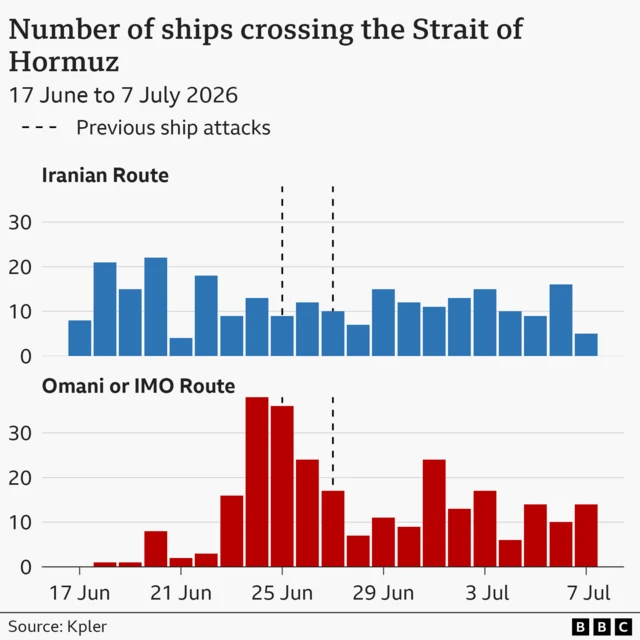
    The numbers of ships carrying cargo, oil or gas through these non-Iranian routes steadily grew to a peak of 38 on 24 June, according to data from maritime intelligence firm Kpler.

    Then Iran attacked two ships and traffic through the non-Iranian routes slumped.

    But these transits have continued at a lower level, despite Iran’s threats, averaging about 13 a day between 30 June and 7 July.

    We’ll be keeping a close eye on the data to see what impact yesterday’s three ship attacks will have.

    Bar chart titled “Number of ships crossing the Strait of Hormuz, 17 June to 7 July 2026.” Two panels compare daily ship crossings on the Iranian route (blue bars) and the Omani/IMO route (red bars). Dashed vertical lines mark previous ship attacks around 25–27 June. Iranian-route traffic is relatively steady throughout the period, generally between about 7 and 22 ships per day, with little change after the attacks. Omani/IMO-route traffic is very low before 23 June, then rises sharply, peaking at about 38 ships on 24 June and remaining elevated, mostly between 6 and 24 ships per day, through early July. The chart suggests traffic shifted from the Iranian route to the Omani/IMO route around the time of the attacks. Source: Kpler.
  4. Return of full-scale hostilities would have 'catastrophic consequences', says UN secretary-generalpublished at 18:42 BST

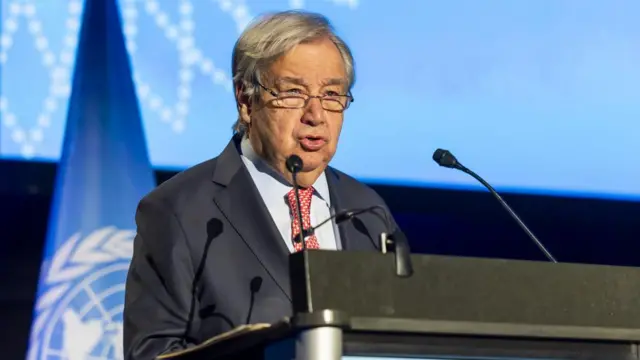
    Antonio Guterres speaks while standing behind a podium. He is wearing a dark suit and the symbol of the UN is visible behind him.Image source, EPA/Shutterstock

    The UN secretary-general has urged Iran and the US to "urgently resume negotiations".

    Antonio Guterres says in a statement that a return to full-scale hostilities between the two countries would have "catastrophic consequences" - on the people of the region, international peace and security, as well as the global economy.

    He calls on all parties to take immediate steps to de-escalate.

  5. Iran accuses US of violating memorandum of understandingpublished at 18:37 BST

    Iran's foreign ministry has also just released a statement accusing the US of violations of the memorandum of understanding (MOU) - an agreement between Iran and the US to work towards ending the conflict.

    The ministry highlights what it describes as "repeated illegal attacks against Iran, along with the decision last night by the US Treasury to revoke the license to sell Iranian oil" among the violations.

    The US is responsible for the "dangerous consequences" of this escalation, it warns.

  6. 'We do not answer vulgarity with vulgarity, but with action' - Iran's foreign ministerpublished at 18:27 BST
    Breaking

    In a post on X, Iran's Foreign Minister Abbas Araghchi says: "Addressing the civilised and courageous nation of Iran with derogatory language does not diminish its greatness.

    "Iranians are known for their civility, culture, and strong moral values.

    "We do not answer vulgarity with vulgarity, but with action: fearlessly and with great valour."

  7. Mediators Pakistan urge restraintpublished at 18:07 BST

    Pakistan has expressed its "deep concern" at the escalation in tensions in the Middle East.

    The country was one of the key mediators in getting the memorandum of understanding (MoU) signed between the US and Iran last month, having hosted high-level talks in April.

    A spokesperson from the Ministry of Foreign Affairs said "a renewed conflict is in no one’s interest", calling on "on all parties to exercise restraint" and uphold their commitments to the MoU.

    "There is no alternative to continued engagement, dialogue, and diplomacy," the statement says.

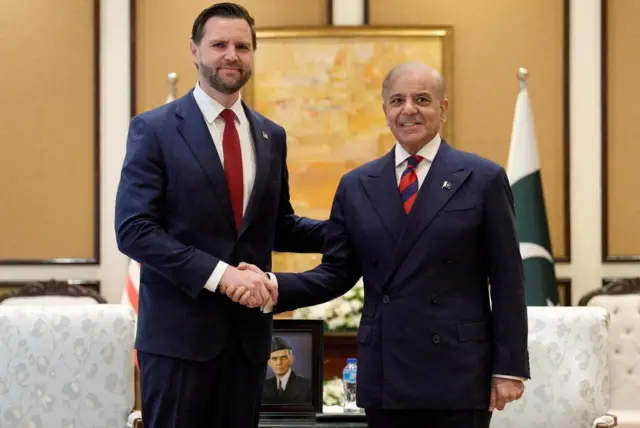
    US Vice-President JD Vance with Pakistan's Prime Minister Shehbaz Sharif at the Islamabad talks in AprilImage source, Reuters
    Image caption,

    US Vice-President JD Vance with Pakistan's Prime Minister Shehbaz Sharif at the Islamabad talks in April

  8. Analysis

    With midterms approaching, Trump brushes off oil price fearspublished at 18:03 BST

    Bernd Debusmann Jr
    White House reporter

    Over the last few weeks, President Trump has repeatedly praised Iran's leadership as one he believes is more rational and easier to deal with than those that were killed at the height of Operation Epic Fury earlier this year.

    But at the summit in Ankara, he has repeatedly referred to them as "scum" - and leaving an open question on whether he believes negotiations can continue, even if he believes further US strikes are necessary.

    "We can play games. But I'm not sure I want to make a deal," he told reporters. "Let's just finish the job."

    Notably, he has also brushed off questions about the price of oil - an important domestic consideration for Americans who grew increasingly antsy about rising petrol prices at US pumps.

    Trump has repeatedly expressed optimism that oil prices are dropping, and that any price increases would end quickly.

    It is unclear, however, how that can be the case if military strikes continue or Iran takes steps to impose further controls over the Strait of Hormuz.

    "I've been right about everything," Trump said. "I have been for a long time."

    But with the November midterms just a few months away, many Republicans will be hearing from concerned constituents - for whom Trump's argument that high oil prices are a worthwhile price to pay may ring hollow.

    • A benchmark oil price was up 5% today to hit $80 a barrel - read our earlier post here
  9. Trump: I don't think war will start again with Iranpublished at 17:59 BST

    Trump is asked if it seems like the war might start again.

    "I don't think it's going to start again," he says.

    "I think it's going to go very quickly, they hit a couple of ships and so we hit them much harder."

    He adds that he had been asked earlier if he planned to hit Iran again, "I said we might, yeah we might."

    "But when they hit, we hit," he says. "We use their language and we speak their language."

    The news conference has now finished.

  10. Trump says US will eventually 'take' Iranian nuclear materialpublished at 17:50 BST

    Trump is asked about his comments last month that Iranian people were nice and rational to deal with - compared to him calling them "scum" today.

    He responds by saying he "got to know them", adding that the country's leaders are not doing a service to their people "based on their actions over the last week or two".

    Trump then says he does not think a full-scale conflict is going to start again, adding: "Anything that happens is going to be over very quickly."

    The president reiterates earlier comments that the US "might" strike Iran tonight.

    He adds that anybody who goes near the country's underground nuclear material will "get blown up" and that the US will eventually "take it".

  11. Trump says he is Iran's 'number one target'published at 17:41 BST

    Hegseth, Trump, Rubio, and BessentImage source, Reuters

    Trump insists the war with Iran has been a "tremendous military success" and says it has prevented Tehran from acquiring a nuclear weapon.

    He says Iran's negotiators are "a little loco, they're a little crazy", and goes on to say: "In one day, all of their anti-aircraft is gone... everything is gone. Their leaders are gone."

    He adds: "They have another set of leaders, they may be gone. Who knows?"

    Repeating his remarks about Iranian leaders being "scum", Trump says: "I may be gone too, because I'm their number one target."

    In 2024, Trump's campaign said it had been briefed by US intelligence on Iranian assassination plots against him. The Iranian government did not comment at the time.

  12. Trump praises 'tremendously successful' Nato summitpublished at 17:29 BST

    Trump is still speaking at the Nato summit, flanked by some of his closest advisers - Pete Hegseth, Marco Rubio and Scott Bessent.

    His remarks are wide-ranging and have touched on Iran, Ukraine, and more.

    Trump says there was "tremendous love" and "unity" in the room when Nato leaders met earlier, describing the summit as "tremendously successful" - in contrast to some criticism of allies earlier in the day.

    On Iran, Trump says its air force is "totally decimated", their leaders are "gone" and its combat capability is "pretty low".

    He says other nations "respect us as a country again", and that two years ago "Nato laughed at us... they don't laugh anymore".

  13. Frank Gardner: The black cloud over the Nato summitpublished at 17:22 BST

    Donald Trump is still speaking at the Nato summit - we'll bring you any news if there is a significant update from him there.

    In the mean time, our security correspondent Frank Gardner has been giving his assessment of events in the Turkish capital.

    Media caption,

    Frank Gardner on the 'black cloud' over Nato summit

  14. Trump speaking at Nato news conferencepublished at 17:08 BST

    Donald Trump stands at a microphone wearing a dark suit and gold coloured tie. Officials including Pete Hegseth and Marco Rubio can be seen behind him.

    After making a series of comments to reporters during meetings throughout the Nato summit, Donald Trump is now speaking at his official news conference.

    We'll bring you any key lines from his speech or you can watch live above.

  15. Eight Iranian soldiers killed in US attacks, Iran's military sayspublished at 17:06 BST

    Eight Iranian soldiers were killed in the attacks launched by the US overnight, according to a statement attributed to the Iranian military.

    The soldiers were serving in the air force and the navy, says a statement shared by several Iranian media outlets.

    It says the soldiers were stationed in Bandar Abbas and Bushehr.

  16. Oil price rises to $80 a barrel as US-Iran tensions worry marketspublished at 16:58 BST

    Michael Race
    Business and economics reporter

    Oil prices have surged in response to Trump declaring the ceasefire between the US and Iran "over". Brent crude, the global benchmark, has shot up 7% today to hit $80 a barrel.

    Prices remain well below the peak seen in May but the fresh spike is clearly dampening appetite among investors, with stocks markets in the US and across Europe down on trading.

    Earlier today, the International Monetary Fund (IMF) released an update to its economic outlook, but some of its projections could already be upended due to today's events.

    The report will have been written prior to today's news. In it, the IMF says it assumed the key Strait of Hormuz waterway, for example, would be reopened in "mid-July, with conditions broadly returning to the prewar state of affairs by March 2027".

    That looks very unlikely to happen now.

    The influential body, which seeks to encourage the global trade and economic growth, warned conflict in the Middle East was the "most imminent risk" to its forecast for the global economy.

    An escalation between the US and Iran increases risks to inflation due to supply constraints causing rising oil and food prices.

    With oil prices surging today, those risks are already beginning to become reality.

  17. Iranian media reacts to Trump declaring ceasefire 'over'published at 16:51 BST

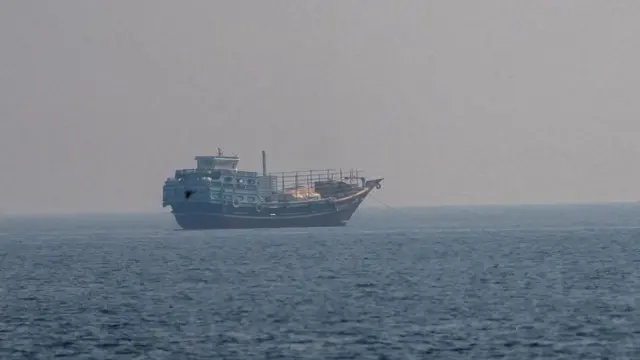
    A ship seen floating in the sea. The sky above looks grey and cloudy.Image source, Reuters
    Image caption,

    A vessel seen in the Strait of Hormuz on Wednesday

    Press TV, the English language channel for Iran's state-controlled IRIB outlet, cites a security source as saying Iran will close the Strait of Hormuz to all maritime traffic in the case of any strike made against the country.

    It reports the source as saying the country will also strike at least two targets for every Iranian target that is hit, adding: "Iran does not distinguish between the United States and its partners in the region."

    Separately, the Tasnim news agency - affiliated with Iran's Islamic Revolutionary Guard Corps - says the "death" of the Islamabad ceasefire agreement had been "officially announced" by Trump.

    The outlet added that Iran now has a "clearer mandate" to confront the US, Israel and their proxies in the region and the world.

    Earlier, a senior adviser to the Iranian supreme leader warned of "fire" in the Middle East region following Trump's comments.

  18. Trump in freewheeling, domestic mode on international stagepublished at 16:37 BST

    Bernd Debusmann Jr
    White House reporter

    With conflict again brewing in the Middle East and a full-blown war in Ukraine, one might think that Trump would be laser-focused on the main topics at hand in Ankara.

    But his remarks today have been largely familiar ones to those of us who listen to him regularly, with the same freewheeling, slightly chaotic energy that has been the hallmark of his sessions with reporters in the Oval Office or on Air Force One.

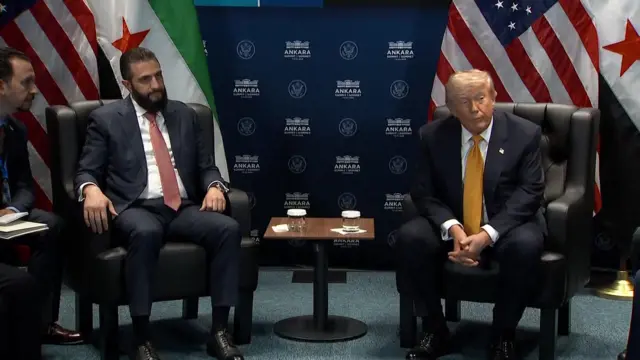
    Just a few minutes ago, for example, Trump briefly appeared alongside Syrian President Ahmed al-Sharaa, a controversial figure who leads a country in what Trump often describes as a "tough" part of the world.

    Even there, Trump - often unprompted - repeatedly pivoted back and forth between topics, both domestic and global. He even took a moment to insult his predecessor Joe Biden.

    At one point, he abruptly brought up his administration's efforts to fight crime in Washington DC, where last year he deployed the National Guard in a bid to combat what the administration described as out-of-control crime.

    He even joked that al-Sharaa, who came up through the ranks of Al Qaeda-affiliated jihadist groups in Syria and fought against US forces in Iraq, may not have been frightened of Washington's criminals.

    That's a frequent talking point of his back home, but for many of his detractors it will be somewhat jarring to hear them with a foreign leader alongside him.

  19. Trump says Iran's nuclear material 'so far underground' it can't be reachedpublished at 16:26 BST

    Donald Trump and Syrian President Ahmed al-Sharaa sit next to each other in large leather armchairs during a bilateral meeting at the Nato summit. Al-Sharaa has short black hair and a bushy beard and is wearing a navy suit with a white shirt and red tie. Trump is also wearing a navy suit and white shirt but with a yellow tie.

    Donald Trump has just been speaking to journalists during another meeting at the Nato summit, this time with Syrian President Ahmed al-Sharaa.

    Trump is asked how the US plans to get the nuclear material still inside Iran, as well as the assurances he wants to see from its leaders after saying negotiations with them are a "waste of time".

    Trump says the US has effectively already secured the nuclear material "because it is so far underground nobody is going to be able to get it except us" - a reference to the June 2025 strikes on Iranian nuclear facilities.

    He goes on: "[The nuclear material] is so far down underneath a mountain that it would take massive machinery that we have, that no other country has."

    Asked whether the US will consider putting boots on the ground in Iran, he adds: "Why would I go in there? I go in when they are completely either eliminated or an agreement is made."

  20. Funeral processions for Iran's former supreme leader continuepublished at 16:21 BST

    Ghoncheh Habibiazad
    Senior reporter, BBC Persian

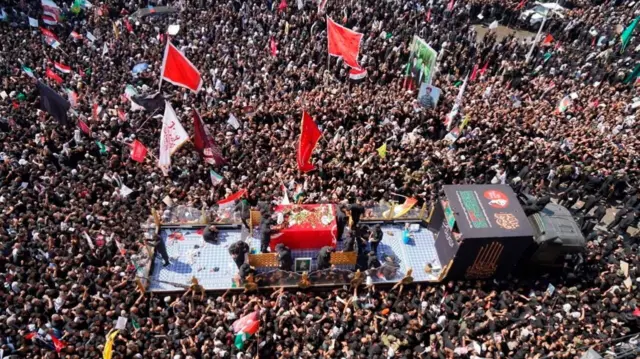
    People attend a funeral procession for Iran's late Supreme Leader Ayatollah Ali Khamenei, who was killed on February 28 in Israeli and U.S. airstrikes, in Najaf, Iraq, July 8,Image source, Reuters
    Image caption,

    Huge crowds attended the funeral procession in Iraq

    Last week, US President Donald Trump claimed talks with Iran had been paused for the funeral of Iran's former Supreme Leader Ayatollah Ali Khamenei.

    "We gave them [Iran] a week off for a funeral because we're nice," Trump told a crowd gathered at Mount Rushmore for his address on the eve of 4 July celebrations.

    Iran has not confirmed what Trump said, though the country is still holding funeral processions for Khamenei over several days, with one in Iraq today.

    Iran’s late supreme leader was killed on the first day of the war on 28 February, when the US and Israel attacked Iran. He is expected to be buried tomorrow in his birthplace, Mashhad, a holy city for Shia Muslims in north-eastern Iran.

    Iranian President Masoud Pezeshkian, who travelled to Iraq for the funeral processions today, has already returned to Tehran.

    It is not known whether his return is related to the renewed tensions between Iran and the US.

    The figure of interest who has not been seen during the funeral procession for Ali Khamenei, which began in Tehran on 4 July, is his son and Iran’s third Supreme Leader Mojtaba Khamenei.

    He has not been seen since succeeding his father in early March, with written statements attributed to him and released via Iranian media his only communication.