Summary

  1. We're not the only ones making for the waterpublished at 19:48 BST

    Esme Stallard
    Science reporter

    A one horned rhino has it's mouth slightly ajar and moves through muddy water from left to rightImage source, Chester Zoo
    Image caption,

    Asha the one-horned rhino takes a dip in one of Chester Zoo's mud pools

    While we've been sharing tips on coping with the heat, the animals at Chester Zoo have their own techniques.

    "Eastern black rhinos and capybaras will cool off by submerging themselves in mud wallows," says Nick Davis, mammals general manager at the zoo.

    "Big cats such as Sumatran tigers and jaguars, and other species like Asian elephants and Humboldt penguins, might beat the heat by taking a dip in their pools."

    Keepers are also trying to help by making special deliveries of fruit and vegetable ice lollies to their chimps and red pandas.

  2. How to stay safe while swimming outdoorspublished at 19:28 BST

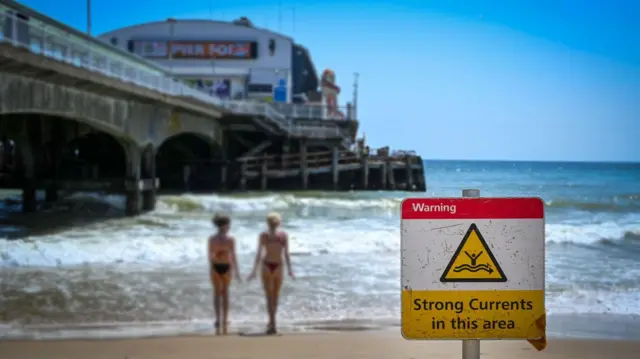
    Two young women are at the edge of the sea, the pier is in the background and on the sand is a red sign that says "Strong currents in this area"Image source, Getty Images

    Water safety experts have shared some simple tips with BBC News on staying safe when swimming in open water. Here’s what they told us:

    Choose a spot with a lifeguard: The best place to swim is somewhere supervised. You can find a list of UK beaches with lifeguards on the RNLI website, external.

    Watch videos of rip currents: A rip current can quickly pull you away from shore and out of your depth. They can be difficult to spot, RNLI says, but watching videos can help you identify them.

    Think about your swimming ability: Swimming in the sea, lakes and rivers is very different from a swimming pool, so people should think carefully before getting in.

    Keep someone on shore: Someone from your group should always stay on shore to keep an eye on those in the water and can call for help if needed.

    Avoid inflatables: If the wind changes when you’re in an inflatable, you can be blown out to sea. It’s advised to avoid them altogether.

    Get in the water slowly: Getting into cold water too quickly can cause cold water shock, which restricts your ability to move and affects your breathing. You should get in slowly and allow your body to acclimatise.

  3. 'Even the fittest person can get into difficulties in the water'published at 19:17 BST

    Gabriela Pomeroy
    Live reporter

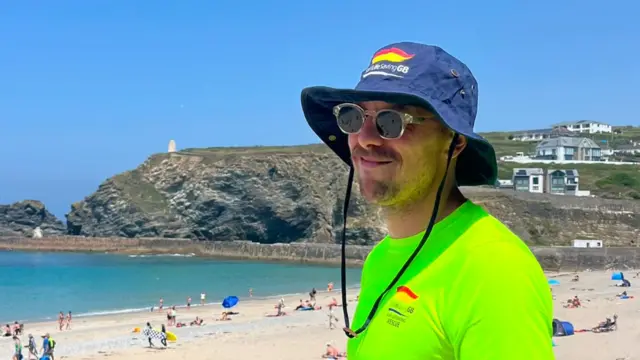
    George on patrol in Cornwall todayImage source, George Haynes

    George is a lifeguard on patrol today at Portreath beach in Cornwall.

    He’s part of the volunteer beach lifesavers charity Surf Life Saving GB, which says the government has asked it to help provide extra volunteer lifeguards for Wednesday and Thursday.

    At least 17 people died in water-related incidents during the UK heatwave in May and June, and some 40 people have drowned in France since the start of this heatwave.

    There’s a “really nice vibe” on the beach, George says, but "even the fittest person can get into difficulties in the water".

    One of the risks is cold water shock, he says.

    "People tend not to realise that no matter how hot it feels, the water is still very cold.

    "A lot of people want to jump in the water to cool off but they need to acclimatise before running and diving in. It can cause a gasp reflex taking in seawater which is horrible if you are gasping it quickly," he says.

  4. Headteacher raises concerns about keeping children healthy in extreme heatpublished at 19:05 BST

    Anthea Lee and Hayley Clarke
    Education reporters

    lulu stainer-martin

    At Ridgeway School in Bedford, a specialist school for children with special educational needs and disabilities, head of school Lulu Stanier-Martin says her biggest concern in the heat is keeping children cool, engaged with their learning, and staying healthy - especially those with medical needs.

    The school has some portable air conditioning units, she says, but it also uses fans and cool towels. That isn’t as effective as having whole-class air conditioning, she adds.

    Stanier-Martin hopes the government will support schools to install air conditioning throughout their buildings, and work with unions on guidance to help schools deal with extreme heat.

  5. How to exercise safely in hot weatherpublished at 18:45 BST

    Melissa Hogenboom
    Senior health correspondent

    Woman in running gear drinking from water bottleImage source, Getty Images

    Staying active in hot weather can be challenging. It's one reason why players at the World Cup 2026 in the US, Canada and Mexico are being given additional, but controversial hydration breaks 22 minutes into each half.

    And with record temperatures on their way this summer thanks to a powerful El Niño weather pattern, it's likely to be a tough time to exercise.

    Some methods you can use to keep yourself safe are: exercising when it's cooler, avoiding humid conditions, reducing the intensity of the workout or learning new methods of cooling down.

  6. Tips to help you prepare ahead of tomorrow's red warningpublished at 18:35 BST

    This Flourish post cannot be displayed in your browser. Please enable Javascript or try a different browser.

  7. More rail operators tell passengers to travel only if absolutely necessarypublished at 18:26 BST

    We reported earlier that Greater Thameslink Railway has warned passengers not to travel on Wednesday and Thursday unless it’s absolutely essential.

    Several other operators have now issued the same advice. They include Great Western Railway, CrossCountry, West Midlands Railway, Southeastern, South Western Railway, LNER, Greater Anglia and Chiltern Railways.

    "Due to a rare red warning of extreme heat, customers are being warned of essential travel only on Wednesday and Thursday," a warning on the Great Western Railway website reads.

    It also urges passengers to check its website, external for the latest service information.

  8. Shades, water, umbrellas - a hot day in picturespublished at 18:23 BST

    It’s been a hot day, with temperatures peaking at about 34C in the UK so far and climbing into the 40s elsewhere in Europe.

    That hasn’t stopped people going about their business, as the pictures below show:

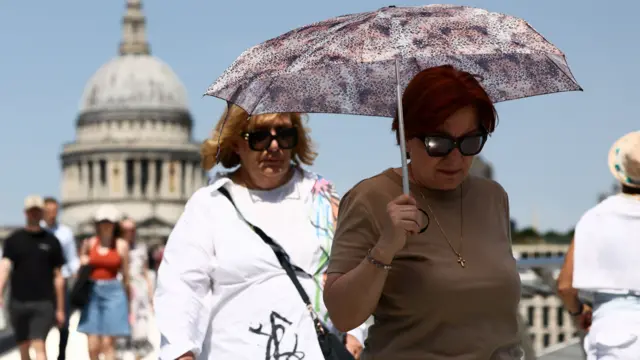
    A woman wearing sunglasses walks with an umbrella along the Millennium Bridge in London. Another woman, also wearing sunglasses, is walking close behind herImage source, Reuters
    Image caption,

    It may not be raining but on the Millennium Bridge in London, plenty of people are using umbrellas for shade

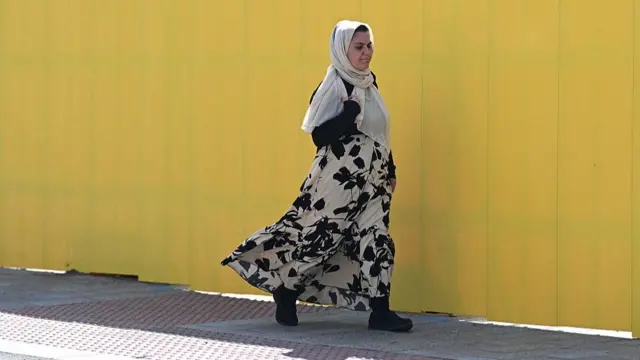
    A woman in a white headscarf walks along a paved sidewalk in front of a bright yellow wall. She is walking in the shade, away from the sunImage source, Getty Images
    Image caption,

    A woman sticks to the shady side of the road as she walks in Huddersfield, northern England

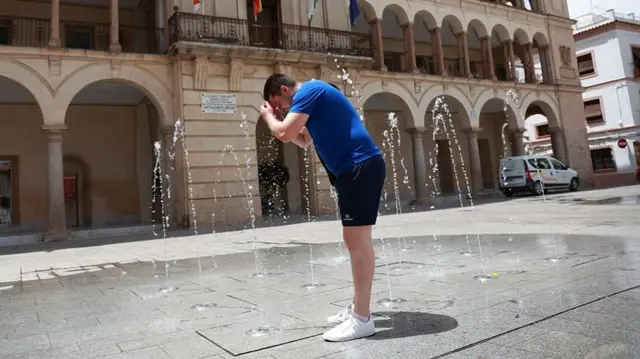
    A man wearing a blue top, black shorts and white trainers is standing in a public square, cooling himself off with water that is spraying from the groundImage source, Getty Images
    Image caption,

    A man cools himself down in the town of Andujar in Cordoba, Spain, where temperatures are above 40C today

    Commuters use a hand fan and an umbrella to cool down as they wait for a tramway in BordeauxImage source, AFP via Getty Images
    Image caption,

    Commuters sweat it out under the sun in south-western France

  9. Wales also records highest minimum June temperaturepublished at 18:05 BST

    Wales has provisionally recorded its highest minimum temperature for June after the mercury didn’t fall below 20.3C in St Athan, South Glamorgan, according to the Met Office.

    The forecaster has warned more areas in England and Wales will stay around 20C "leading to an uncomfortable night’s sleep".

  10. Maximum temperatures across the UK today are inpublished at 17:52 BST
    Breaking

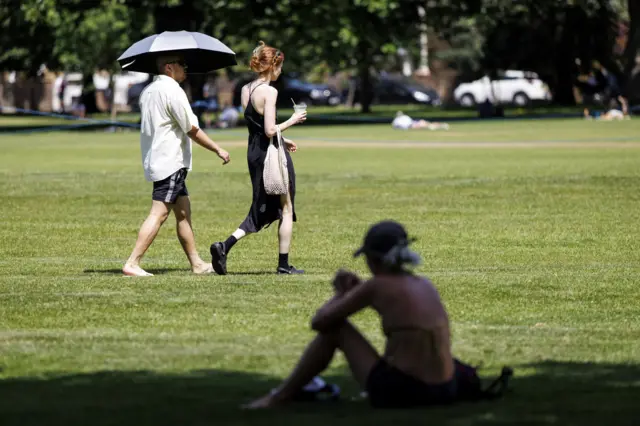
    A person sunbathes at a park as the UKImage source, EPA

    We’ve just had the confirmed maximum temperatures for today from our BBC Weather colleagues.

    • England: 34.6C at Wisley, Surrey
    • Scotland: 29.0C at Dyce, Aberdeen
    • Wales: 32.2C at Cardiff Bute Park
    • Northern Ireland: 28.1C at Katesbridge, County Down

    As we reported in an earlier post, overnight storms meant the temperature in England wasn’t as hot as predicted.

    Meanwhile, Scotland and Northern Ireland recorded their hottest days of the year so far.

  11. Some train services to be affected by hot weather, National Rail warnspublished at 17:45 BST

    Intercity Express Train (or Azuma) built by Hitachi for Great Western RailwayImage source, PA Media

    National Rail has warned train passengers that several rail operators will be affected by the hot weather in the coming days.

    LNER, Avanti West Coast and Great Western Railway could all be hit, with passengers advised to check their routes before travelling.

    London Northwestern Railway, West Midlands Railway, c2c and Northern services are also set to be affected.

    Greater Thameslink Railway (GTR) also warned passengers earlier today not to travel tomorrow or Thursday unless it’s absolutely necessary.

  12. Brace for tomorrow’s red extreme heat warning - a recappublished at 17:28 BST

    A man walks alongside a woman with an umbrella to shelter from the heat at London FieldsImage source, EPA

    Temperatures

    • We won’t know today’s maximum temperature until after 18:00, but in England the heat hasn’t been quite as fierce as predicted, with temperatures peaking so far at 33.7Cin Surrey
    • Scotland and Northern Ireland, however, have both had their hottest days of the year so far, with temperatures reaching 28.8C in Aberdeenshire and 26.4C in County Down

    Warnings

    • An amber warning for extreme heat remains in effect across parts of England and Wales
    • The Met Office has also issued a rare red extreme heat warning, set to last from 09:00 on Wednesday to 21:00 on Thursday

    Disruptions

    • UK’s largest train operator is warning passengers not to travel tomorrow and Thursday unless necessary
    • At least 312 schools will be at least partially closing this week due to the heat

    Meanwhile, in France

    • France has recorded its hottest day on a national scale, with the average temperature from 30 stations across the country reaching 29.8C
  13. Eastern European countries brace for baking weekendpublished at 16:59 BST

    Nick Thorpe
    Central Europe correspondent in Budapest

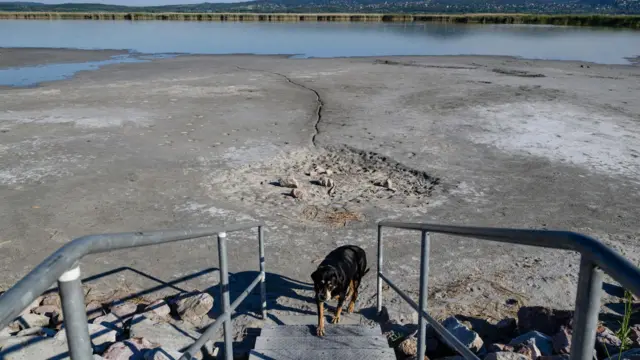
    A dog leaves behind the almost dried-up lakebed at Pisztrang Street Beach at Lake Velence in Gardony, Hungary, 23 June 2026Image source, EPA
    Image caption,

    One expert says Hungary's Lake Velence, a popular holiday spot, could shrink to a muddy puddle before the end of summer

    The heatwave now over Spain, France and Italy is moving eastwards, and eastern European countries are bracing for a baking weekend, with temperatures expected to touch 39C on Sunday on the Great Hungarian Plain.

    One early casualty is Lake Velence, an 11km-long (6.8 miles), 3km-wide lake south of Budapest, which is a popular holiday resort.

    Water levels are now down to a record low of 52cm, down from the former average water level of 1.5m.

    By the end of summer, the lake may be reduced to a muddy puddle at 30cm, according to Zsombor Boromisza, professor of landscape conservation.

    The lake is slowly splitting into several smaller basins, with fish die-offs and disaster tourism.

    About 200,000 to 300,000 people visit the lake each summer, though numbers are hard to verify as many are day-trippers.

  14. France records its hottest day on a national scalepublished at 16:44 BST
    Breaking

    France has seen its hottest day on a national scale since records began, according to the country’s weather agency.

    Météo-France says the national temperature indicator, an average from 30 stations across the country, reached 29.8C (85.6F) at 17:00 local time, beating the previous record of 29.4C.

    That's not the same as the hottest temperature ever recorded in France, which happened in June 2019, when the mercury reached 46C in Vérargues.

    On Tuesday, temperatures reached 44.3C in Pissos in south-western France, while other areas also hit unprecedented highs, including 42.1C in Bordeaux, Météo-France said in a post on X.

    It comes after the agency said earlier that last night was the hottest night on record.

  15. Big puddles after overnight storms may stop today being the hottest of the yearpublished at 16:30 BST

    Simon King
    Lead weather presenter

    The maximum temperature today (we won’t know the final figure until after 18:00) looks to have peaked at about 33.7C at Wisley in Surrey.

    That’s not as hot as the predicted 35C or 36C, and it could be because of the storms overnight.

    Intense rainfall and flash flooding in some locations meant there were lots of big puddles around and the ground was saturated.

    As the sun rose this morning, lots of energy was used to evaporate the moisture instead of directly heating the ground, which then heats the air above it.

    That could be why temperatures ended up about 2C or 3C lower than expected in south-east England.

  16. What happened when we put the thermometer in the sunpublished at 16:23 BST

    Ben Rich
    Lead Weather presenter, reporting from Oxford Botanic Garden

    I’m at Oxford Botanic Garden, finding out what impact the heatwave is having here.

    They say they’re watering the plants early in the morning and late at night, making sure they get a real drenching in those cooler hours. That means staff don’t have to work outdoors in the middle of the day, at the peak of the heat.

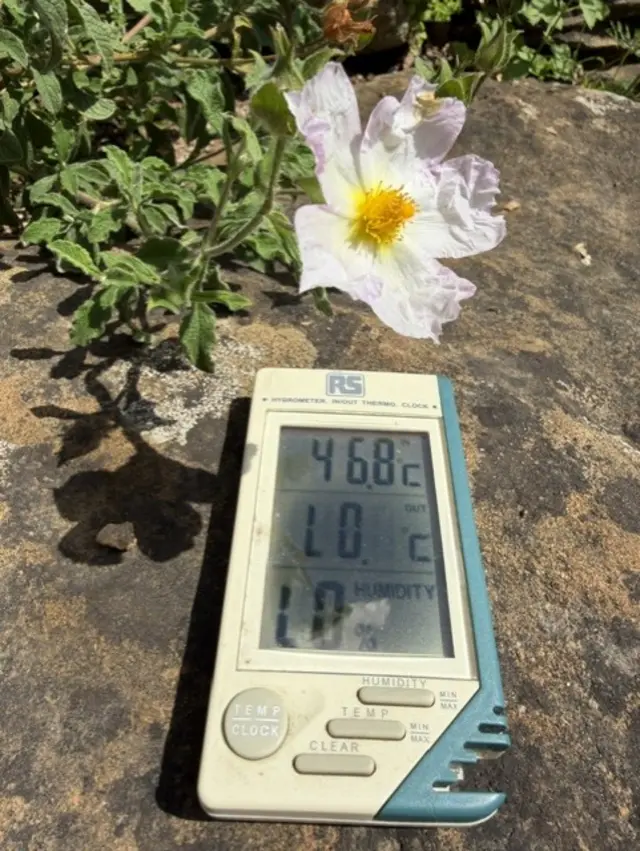
    We’ve put this thermometer in the sun and recorded a temperature of 46.8C. It’s not at all scientific, because official temperature records are taken in the shade to make sure weather and climate records remain consistent.

    A thermometer in the sun

    But, of course, if you’re standing in direct sunlight, you’ll be experiencing temperatures in the 40s or above, regardless of what the official shade temperatures are.

    That’s why the advice is to stay out of the sun in the hottest part of the day, especially in areas covered by the Met Office extreme heat warnings.

  17. Temperatures in Surrey hit 33.7Cpublished at 16:11 BST
    Breaking

    In an earlier post, we reported the temperature in Wisley reached 32.6C - we’ve now had an update from BBC Weather with a revised reading of 33.7C, taken at 14:00.

    The current June all-time record is 35.6C, set in 1976, while the hottest day of the year so far was on 26 May, when the mercury reached 35.1C.

  18. What caused last night's intense thunderstorms?published at 16:00 BST

    Last night brought intense thunderstorms and lightning across parts of England.

    Press play to find out more about why this happens.

  19. What is a red weather warning - and how rare is it?published at 15:43 BST

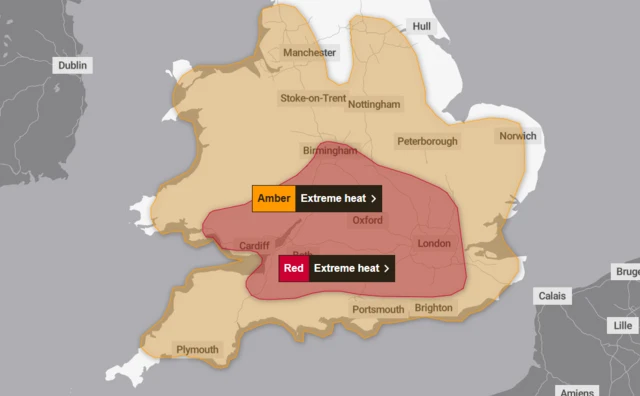
    As we’ve reported earlier, the Met Office has issued a rare red extreme heat warning from 09:00 on Wednesday to 21:00 on Thursday.

    It covers parts of southern England, as well as the Midlands and south Wales. It’s the first time Wales has been covered by a red extreme heat warning and only the second time one has been issued by the Met Office.

    A red warning is the most severe level of alert. It means dangerous weather is expected, with a high likelihood of risk to life.

    It could also lead to failures of critical national infrastructure, such as power cuts or roads and rail lines being closed.

    When a red warning is issued, the Met Office advises people to avoid travelling where possible and to follow the advice of the emergency services and local authorities.

    UK weather warningsImage source, Met Office
  20. Temperatures in Northern Ireland and the Republic of Ireland approaching all-time highs this weekpublished at 15:35 BST

    Barra Best
    NI weather presenter

    Northern Ireland will avoid the extreme heat seen in other parts of the UK, but temperatures are expected to climb close to the all-time record this week.

    The current record of 31.3C was set in Castlederg, County Tyrone, in July 2021. Thermometers are likely to climb close to that on Thursday.

    It’s a similar story in the Republic of Ireland, where an almost 140-year-old record could be threatened.

    33.3C was recorded at Kilkenny Castle, County Kilkenny, on 26 June 1887 - almost exactly 139 years ago to the day.

    The Irish weather service, Met Éireann, has issued a yellow heat warning from noon on Tuesday until 09:00 on Friday.

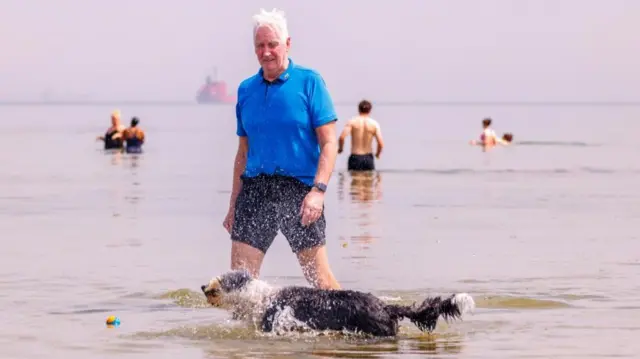
    Darren and his bearded collie Alfie enjoying the water at Helen's Bay Beach in Crawfordsburn Country Park, County DownImage source, PA Media
    Image caption,

    Darren and his bearded collie Alfie enjoy the water at Helen's Bay beach in Crawfordsburn Country Park, County Down