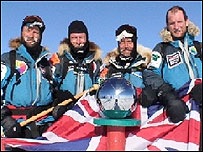
A four man team of Royal Marines from Lympstone in Devon have become the first British military personnel to reach the South Pole for nearly 100 years. The Polar Quest team are in high spirits after they reached the geographical South Pole at 0218 on 27 December 2006. The Marines retraced the steps of Scott of the Antarctic, who led an ill-fated expedition to the South Pole in 1912. 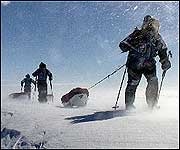 | | Hauling sledges across the ice |
Just like their illustrious predecessor, the four servicemen hauled sledges across the frozen wastelands of Antarctica. Departing from an area known as Patriot Hills in Antarctica in early November, each man pulled a sledge weighing more than 20 stone (127kg), which contained everything they needed to survive. On reaching the pole they flew the UK, Royal Navy and Royal Marines flags and a replica of Captain Scott's flag. Expedition leader Captain Sean Chapple said his team, made up of three Royal Marines and a Royal Navy sailor, was "totally exhausted". He said they had all lost a lot of body weight and suffered some frost damage to their faces and hands.  | | Team leader Capt Paul Chapple |
"When we arrived at the South Pole there was a total mixture of feelings and emotions," said Capt Chapple. "As I stood at the South Pole I was unable to contain the overwhelming feeling of relief and my eyes filled with tears. "I had reached the end of the most physically and mentally demanding journey of my life and it was as if my body had given up after 45 days of relentless exertion. "It was on one part elation that we'd achieved our goal, another part relief that we wouldn't have to get up in the morning at half seven and haul that sledge again." The other team members are Major Paul Mattin and Surgeon Lt Cdr Andy Brown from Devon and marine Craig Hunter from Kilmarnock, Scotland.  | | Climbing the ice plateau |
During their stay at the South Pole the team held a remembrance service for all those who have lost their lives in the exploration of the North and South Poles, including all five members of Scott's ill-fated 1912 expedition to Antarctica. Captain Scott's uncompleted venture was the last time service personnel from Britain were involved in a trip to the South Pole. After a brief stop-over to regain their strength, the four men turned around to complete their 1,450 mile (2,334 km) return journey to the Patriot Hills with the aid of giant kites. The kites harnessed the power of the wind and reduced the overall length of the return trip to just 71 days. The team successfully completed the longest Antarctic journey in British military history on 21 January. However the return journey proved to be far more challenging than expected after the marines encountered erratic variable winds. "Arriving back at Patriot Hills was a moving occasion, a real sense of achievement at completing our 1,400 nautical mile journey," said Captain Sean Chapple. "The return journey has been far more demanding than anticipated, due to winds this January being particularly erratic, bodies run down from the haul into the Pole and minor injuries. "However, through exceptional teamwork we have achieved our objective and I hope shared with you our trials and tribulations along the way. "Thank you for the messages of support throughout our journey which have been great to receive and provided real inspiration and encouragement." The expedition was unsupported by dogs or vehicles. |