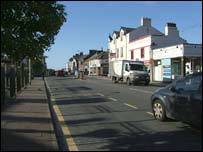
As you pass through Cleator Moor when travelling from Cockermouth to Egremont, you won't see much more than a row of houses on either side of the road.
However, take a sneaky right turn halfway along and you'll come into the heart of the community which seems to ooze with history and stories just waiting to be told. 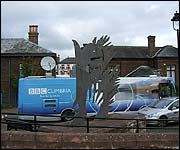 | | BBC bus in Cleator Moor |
The BBC Bus team managed to station itself right in the centre and unearth some stories from the people that live here, and get them involved in producing their own community breakfast programme for BBC Radio Cumbria. Little IrelandCleator Moor saw the arrival of many Irish immigrants hoping to rebuild their lives during the 1845 – 1850 potato famine in Ireland. As a result, Cleator Moor was often referred to as 'Little Ireland'. IndustryDuring the Industrial Revolution in the 19th Century, the Cleator Moor Ironworks was built to manufacture high grade iron-ore. The surrounding area was a hive of activity as raw materials for the ironworks were mined and trains transported the goods to meet the growing demands of the industrial boom. Disasters in HistoryCleator Moor has been witness to a few disasters over the years. In 1948 there was an explosion at Whinney Hill mine which killed 30 miners. In 1857 six residents of Bowthorn Road were overcome by gas in their homes. The gas was found to be sulphurated hydrogen gas which was generated from the slag under their homes, and from the heaps of slag behind the houses. In 1863 an accident occurred at Number Two Pit whilst trying to link it with Hope Pit situated 700 yards away. Three brothers and one of their sons were suffocated by gas in the accident. Keekle ViaductIn 1877, work began on the Keekle Viaduct which was part of the Cleator and Workington Junction Railway. It was an impressive seven-arched viaduct which was built to span the river Keekle. The use of the viaduct for regular passenger travel came to an end in 1931, then it was closed to freight trains by 1963. The viaduct has now fallen into a sorry state and is overgrown with weeds. Sculptures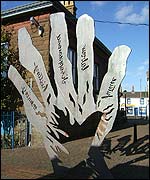 | | The Hand |
The Market Square contains three sculptures by Conrad Atkinson, who was born in Cleator Moor in 1940. The sculptures are of the Miner, the Phoenix and the Hand. The Miner represents the mining heritage of Cleator Moor. The Hand is meant to be the "hand of friendship" as well as the hand of the miner. The Phoenix appears in a few places around Cleator Moor. Before the Phoenix Centre existed, the building was in a state of disrepair, so the renovation of it was linked to the mythical creature - the pheonix rising from the ashes. The name of 'phoenix' for the Phoenix Centre was selected as the winning name in a competition. Local Poets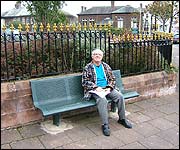 | | James Garnett |
There must be something about Cleator Moor that brings out the poet in the residents. James Garnett and Susan Taylor were keen to show us their work on the BBC Bus. You can also find a wealth of information about the history of Cleator Moor on the website created by Tom Duffy. The link to it can be found on the right hand side of this page. If you have anything you would like to tell us about Cleator Moor, send it along with your name and any photos, to cumbriabus@bbc.co.uk. |