

A global solution needed
- 10 Oct 08, 02:55 PM
In the past 50 years, there haven't been many - if any - meetings of the world's seven richest developed nations as important as today's.
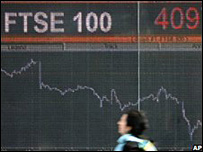 Markets are in meltdown. Investors are dumping almost any asset that can be sold for cash - and never mind the price.
It's a vicious downward spiral.
When the prices of assets fall sharply, that triggers margin calls for other investors, a hideous, insidious form of feedback that triggers another round of asset liquidations.
Which in turn undermines the capital of banks - which forces them to dump yet more assets and call in more loans.
It's a terrifying process, the precursor to a "Minsky Moment" - called such after the economist who described a breakdown of the entire financial system caused by a panicked mass liquidation of assets.
To ward off the Minsky Moment - which would have devastating economic consequences - a circuit breaker has to be found. And only taxpayers can provide that circuit breaker, by - inter alia - underwriting the banking system so that lenders to banks regain confidence that they'll get their money back
I don't mean just British taxpayers. We've been doing our bit. I mean the taxpayers of the developed world (because this is the developed world's mess, our mess, whether we like it or not).
The problem is global so the solution has to be global.
National initiatives - such as the UK's £400bn bank rescue plan and the US Treasury's scheme of equivalent size to remove toxins from banks - are useful.
But they can't be a complete cure, because they treat only parts of the ailing body, not the entire sick global corpus.
What would an effective medicine look like? Well it might be a global version of the British Treasury's recently announced £250bn guarantee for lending between banks - which is designed to demonstrate to institutional lenders that they are safe when lending to banks.
This could restore the flow of money between the banks and financial institutions; it could unblock the pipes that underpin our very way of life.
But for reasons that aren't at all clear, the US and French governments have dismissed that kind of initiative.
Maybe there's another cunning plan available to ward off the Minsky Moment.
If the leaders of rich Europe, Japan and North Amierica fail to find such a plan today or over the weekend, the painful consequences could scar a generation.
Day of reckoning
- 10 Oct 08, 07:35 AM
The sharp and nerve-straining falls in share price on Wall Street last night and in Tokyo today are damaging to the wealth of many, especially those saving for a pension.
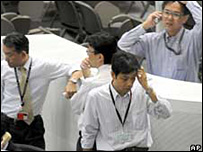 But it's as well to remember that they are the symptom of the disease, not the disease itself.
The underlying illness remains in the financial system, as manifested in the record amounts banks were charging each other yesterday for lending to each other for three months.
One serious anxiety concerns the auction today to settle liabilities on insurance - or credit default swaps - on debt of the collapsed investment bank, Lehman Brothers.
As I noted a couple of weeks ago, there are estimates that claims under insurance contracts will total $400bn. Sandy Chen of Panmure was one of the first to highlight the scale of this looming problem.
If demands for payment are as big as $400bn, there will be pain for banks, insurers, hedge funds and other financial institutions.
Here's why.
For every winner in a claim, there is a loser, the underwriter who has to divvy up. And if the underwriter lacks the resources to pay - which may turn out to be the case in this under-regulated market - that creates two losers: viz the bust underwriter and the claimant which doesn't get the money on which it was counting.
And if that claimant had been calculating its own financial strength on the basis that it had insurance against its Lehman debt, well then failure to receive payment could shatter the integrity of its balance sheet. Which in turn would create potential losers among its creditors.
So this day of reckoning on Lehman credit default swaps is momentous - and it could not come at a worse time for fragile bank shares.
The fall in Morgan Stanley's share price yesterday was a remarkable 26%, on the back of various nebulous rumours and as Moody's said it was reviewing Morgan Stanley's credit rating for possible downgrade.
There was also a doubling in the credit-default-swap price for insuring Morgan Stanley's debt: there was contagion from this opaque market to the more transparent stock market.
As soon as regulators have time for breath, they surely must as a matter of urgency bring some light, order and proper regulatory oversight into the credit-default-swaps market
But probably more urgent is for the US Treasury Secretary to decide how and whether he will inject US taxpayers' money into banks to recapitalise and strengthen them, along the lines of what the British Treasury is proposing to do.
But he "only" has $700bn to play with, which no longer looks that enormous in the context of the $400bn claims that may be enforced in just the next, anxiety-inducing few hours.
The BBC is not responsible for the content of external internet sites
I'm Robert Peston, the BBC's business editor. This blog is my regular take on the business stories and issues that matter.
Click here for all the business news
The New Capitalism: Download a PDF [37Kb] with my thoughts on how the global crisis occurred and what the re-made economy will look like


Archives
« October 2008 »
| Sun | Mon | Tue | Wed | Thu | Fri | Sat |
|---|---|---|---|---|---|---|
| 1 | 2 | 3 | 4 | |||
| 5 | 6 | 7 | 8 | 9 | 10 | 11 |
| 12 | 13 | 14 | 15 | 16 | 17 | 18 |
| 19 | 20 | 21 | 22 | 23 | 24 | 25 |
| 26 | 27 | 28 | 29 | 30 | 31 |
Being Discussed Now
- Will Thiam survive at Pru?(50)
- BP's financial pain is America's pain(407)
- Government cuts private pensions(137)
- Peston Picks is moving(46)
- HSBC banks on UK(61)
- What price a Greek haircut?(91)
- The big PPI lesson for banks(85)
- RBS opposes internal firewalls(97)
- Lloyds to settle PPI claims(136)
- Lloyds: back in the red?(27)
Websites linking here
- "Robert Peston at the BBC [gets blogging's] deepest utility: an essential intellectual tool as well as a means for distributing stories"
Website: Slugger O'Toole - "Peston, Murdoch and Marr sounds like a firm of dodgy solicitors, but they are, of course, the names of important prognosticators of our media future"
Website: Nick Baines - "Politicians really should be stepping up to make these arguments, but in their absence BBC reporter Robert Peston does a pretty good job of summing up"
Website: SqueezeBox - "I outline how blogging went from being an activity by a handful of journalists to being adopted by some of the BBC's biggest names, such as Business Editor Robert Peston, despite at times vehement opposition from within the corporation"
Website: Reportr
Robert's TV/Radio reports
- Rock criticised over risk taking
Broadcast: 20 March 2009 - Row over Sir Fred pension advance
Broadcast: 17 March 2009 - Testing times for China's economy
Broadcast: 12 March 2009 - Chinalco president on Rio Tinto deal
Broadcast: 06 March 2009 - China's factories 'in trouble'
Broadcast: 06 March 2009

Latest from BBC News blogs
Nick Robinson: |  |
Douglas Fraser: |  |
Brian Taylor: |  |
 |
Richard Black: |  |
Jonathan Amos: |  |
- News Editors
- Sport Editors
- Journalism Labs
- BBC Internet Blog
- Radio 4 Blog
- Peston's Picks
- Nick Robinson's Newslog
- Stephanomics
- Mark Easton's UK
- Mark Mardell's America
- Nick Bryant's Australia
- Andrew Harding on Africa
- Gavin Hewitt's Europe
- Soutik Biswas' India
- dot.Rory
- Science: Jonathan Amos
- Richard Black on environment
- Today: Tom Feilden
- Fergus Walsh's medical files
- Newsnight: Paul Mason
- Newsnight: Mark Urban
- Torin Douglas
- Will Gompertz's arts
- Phil Coomes on photojournalism
- Magazine Monitor
- Mark D'Arcy in Westminster
- NI: Mark Devenport
- Scotland: Brian Taylor
- Scotland: Douglas Fraser
- Wales: Betsan Powys
- Martin Rosenbaum on FOI
- 5 Live Breakfast
- Newsnight
- PM programme (iPM)
- World Tonight: Robin Lustig
