

RBS takes silver medal
- 8 Aug 08, 08:06 AM
It was only a year ago that Royal Bank of Scotland was the proudest, most confident bank in the UK.
 The owner of NatWest had just pulled off the biggest banking deal in Europe, the takeover of ABN of the Netherlands, in partnership with a couple of other banks.
Now, on the anniversary of the onset of the credit crunch, it has suffered the indignity of the second worst loss ever in British banking history - a pre-tax loss of £691m.
Only Lloyds has recorded a bigger loss, of £715m, back in 1989, when it was forced to write off colossal bad loans to Latin America (although till I told Royal Bank this morning about the Lloyds debacle, it thought it had taken the British gold medal for worst ever loss).
Royal Bank's undoing has been that it piled into all those toxic securities linked to the dire US subprime housing market - and that it increased its exposure to the poison through the ABN takeover.
Its so-called credit market write-downs were a staggering £5.9bn - an almost incomprehensibly big figure.
What is particularly galling for the bank is that the rest of its business isn't doing too badly.
Its US operations have been hurt by a widespread banking downturn over there - with profits down a painful 42% - but in the UK it seems to be performing better than many of its peers.
Royal Bank's charge for the impairment of British personal loans and mortgages has fallen. However this may be the last time there's a fall in that charge, if the UK economy continues on its current decelerating path.
In fact if you want to see why the economy is slowing down, you only have to look at Royal Bank's consolidated balance sheet, which shows that in just the last six months it has shrunk the amount that it lends to customers and other banks while massively increasing its holdings of risk-free liquid assets (Treasury bills, and cash deposited at central banks, inter alia).
Like most banks, Royal Bank is deleveraging, or lending less than it was, in the spirit of these more risk-averse times. That's what its shareholders would want, though there's a serious price for most of us in the form of slower economic growth.
Also good for shareholders is that Royal Bank's profit margins on lending are improving a bit, which reflects the massive reduction in lending capacity in many banking markets. Or to put it another way, most of us are paying more for whatever finance we can raise from our cash-strapped banks.
And after its eyewateringly large £12bn rights issue, its balance sheet is in much better shape - though it still needs to sell a few more assets in order to lift its capital-to-assets ratio up to best-in-class levels.
In fact the scale of Royal Bank's humiliation is that it had to be shouted at (metaphorically) by the Financial Services Authority before agreeing to issue all those new shares to compensate for the subprime losses and prepare for the chill economic climate we're all experiencing.
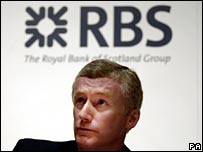 Its chief executive, Sir Fred Goodwin, tries to put a brave face on the humiliation. He says of the subprime and credit-market calamity: "It has been a chastening experience and reporting a pre-tax loss of £691m is something I and my colleagues regret very much."
He says that he and his team are "acutely aware that we drew heavily on our shareholders for financial support and we recognise that we must now deliver a level of performance that meets their expectation for the company and restores value to our shares."
That's as close as you'll ever hear to a chief executive saying that he's living on borrowed time. He is under unambiguous instruction from the bank's owners and its non-executives to fix the business and pronto, or he'll be out the door quicker than it takes to say "ABN was the wrong deal, at the wrong price, at the wrong time".
The BBC is not responsible for the content of external internet sites
I'm Robert Peston, the BBC's business editor. This blog is my regular take on the business stories and issues that matter.
Click here for all the business news
The New Capitalism: Download a PDF [37Kb] with my thoughts on how the global crisis occurred and what the re-made economy will look like


Archives
« August 2008 »
| Sun | Mon | Tue | Wed | Thu | Fri | Sat |
|---|---|---|---|---|---|---|
| 1 | 2 | |||||
| 3 | 4 | 5 | 6 | 7 | 8 | 9 |
| 10 | 11 | 12 | 13 | 14 | 15 | 16 |
| 17 | 18 | 19 | 20 | 21 | 22 | 23 |
| 24 | 25 | 26 | 27 | 28 | 29 | 30 |
| 31 |
Being Discussed Now
- Will Thiam survive at Pru?(50)
- BP's financial pain is America's pain(407)
- Government cuts private pensions(137)
- Peston Picks is moving(46)
- HSBC banks on UK(61)
- What price a Greek haircut?(91)
- The big PPI lesson for banks(85)
- RBS opposes internal firewalls(97)
- Lloyds to settle PPI claims(136)
- Lloyds: back in the red?(27)
Websites linking here
- "Robert Peston at the BBC [gets blogging's] deepest utility: an essential intellectual tool as well as a means for distributing stories"
Website: Slugger O'Toole - "Peston, Murdoch and Marr sounds like a firm of dodgy solicitors, but they are, of course, the names of important prognosticators of our media future"
Website: Nick Baines - "Politicians really should be stepping up to make these arguments, but in their absence BBC reporter Robert Peston does a pretty good job of summing up"
Website: SqueezeBox - "I outline how blogging went from being an activity by a handful of journalists to being adopted by some of the BBC's biggest names, such as Business Editor Robert Peston, despite at times vehement opposition from within the corporation"
Website: Reportr
Robert's TV/Radio reports
- Rock criticised over risk taking
Broadcast: 20 March 2009 - Row over Sir Fred pension advance
Broadcast: 17 March 2009 - Testing times for China's economy
Broadcast: 12 March 2009 - Chinalco president on Rio Tinto deal
Broadcast: 06 March 2009 - China's factories 'in trouble'
Broadcast: 06 March 2009

Latest from BBC News blogs
Nick Robinson: |  |
Douglas Fraser: |  |
Brian Taylor: |  |
 |
Richard Black: |  |
Jonathan Amos: |  |
- News Editors
- Sport Editors
- Journalism Labs
- BBC Internet Blog
- Radio 4 Blog
- Peston's Picks
- Nick Robinson's Newslog
- Stephanomics
- Mark Easton's UK
- Mark Mardell's America
- Nick Bryant's Australia
- Andrew Harding on Africa
- Gavin Hewitt's Europe
- Soutik Biswas' India
- dot.Rory
- Science: Jonathan Amos
- Richard Black on environment
- Today: Tom Feilden
- Fergus Walsh's medical files
- Newsnight: Paul Mason
- Newsnight: Mark Urban
- Torin Douglas
- Will Gompertz's arts
- Phil Coomes on photojournalism
- Magazine Monitor
- Mark D'Arcy in Westminster
- NI: Mark Devenport
- Scotland: Brian Taylor
- Scotland: Douglas Fraser
- Wales: Betsan Powys
- Martin Rosenbaum on FOI
- 5 Live Breakfast
- Newsnight
- PM programme (iPM)
- World Tonight: Robin Lustig
