

Cerberus for EU financial hell?
- 25 Feb 09, 03:09 PM
Why have one new institution when you can have three? Or indeed four. The De Larosiere report has backed off creating a single brand new watchdog to oversee financial institutions in the European Union.
The grand old man of European finance said that "we might have been accused of being unrealistic". He said his aim was not to pile rule upon rule, but to come up with a new system that was "ambitious but not unrealistic." Given the gloom I wrote about earlier it is quite appropriate that his system resembles Cerberus, the guardian of the gates of Hades, a three-headed watchdog.
There would be separate new authorities to look after insurance, banking and securities. He also said it was clear that, although there were warnings before the crisis, the alarm bells were not ringing loud enough. So he also proposes another new body, called the "European Systemic Council", made up of the governors of the various national banks. He stressed the governor of the Bank of England would play a very important role.
The European Commission President, Jose Manuel Barroso, said they would make their official response a week today, but gave the report a very warm welcome, saying: "We are determined not to miss the chance to restore confidence in European and global financial systems. The citizens of Europe expect us to change the rules of the game."
Not everyone agrees: listen to the reaction on Radio 4's World at One. The chap at the end of the item may not be reassured that the president of the Socialists in the European Parliament has welcomed the report. PES president Poul Nyrup Rasmussen said: "The De Larosiere group's proposals represent an essential step forward. They are ambitious but practical. The spotlight is now on the European Commission. It is a test of Barroso's courage and conviction. Today should be an important day in the history of international financial markets - but we shall see if the current conservative European Commission is capable of taking the recommended steps." What do you think?
Sarkozy U-turn on French jobs?
- 25 Feb 09, 12:43 PM
The day in Brussels started bright, sunny and warm. I woke to birdsong for the first time this year. But the first day of spring is not warmed by any rays of economic sunshine.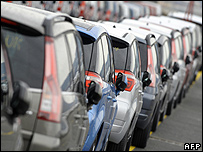
One senior diplomat gloomily told me he could scarcely believe people were still walking around carrying on with their normal lives when the prospects looked so bleak, and none of the levers so energetically pulled by world leaders seemed to be working. I am not quite sure what he thought they should be doing instead.
Industry Commissioner Guenter Verheugen, a German, spoke of the "dark cloud" hanging over Europe. In the car industry alone he said 400,000 jobs were at stake. But the commission is warning the way forward is not to throw out the single market or free trade.
He said they would do all in their power to fight protectionism or what he called "pernicious economic nationalism".
The commission is poring over plans by six countries (Britain, Germany, France, Italy, Spain and Sweden) to help their car industries, to see if they do break the rules. There is a suggestion that the French may do a U-turn on their plan to link their billions of euros' worth of aid to keeping plants open in France. But the competition commissioner Neelie Kroes said "there should be a solution by the end of the day: but it takes two to tango". I'll be watching to see if Mr Sarkozy's dance card is full.
It is one of the trials of reporting the EU that the commission likes to announce various different proposals all on the same day. So more on the suggested EU financial watchdog this afternoon.
EU watchdog for City?
- 25 Feb 09, 07:43 AM
"City may be ruled by Brussels" reads one headline in advance of today's report into regulation of Europe's financial institutions.
It is enough to make the UK government blanch, but the devil will be in the detail of the report by the former IMF director and head of the French Central Bank, Jacques de Larosiere.
As I write, so are the wise men of the committee. This up-to-the wire performance means diplomats and members of the Commission aren't exactly sure what will be in it. But many do expect it to suggest an overarching EU-wide watchdog, a new institution to act as an early warning system. It could be modelled on, or even under the authority of, the European Central Bank.
Fans of the proposal think that national watchdogs like Britain's Financial Services Authority no longer make sense: so many banks operate across too many borders with countries' banking sectors often having bigger assets than their nation's GDP.
Few think the current system works well, but opponents think the solution should be at a global rather than European level. Gordon Brown has recently dropped his opposition to tighter regulation, but we will have to wait and see what he's prepared to swallow.
The BBC is not responsible for the content of external internet sites
Description
Archive
« February 2009
| Sun | Mon | Tue | Wed | Thu | Fri | Sat |
|---|---|---|---|---|---|---|
| 1 | 2 | 3 | 4 | 5 | 6 | 7 |
| 8 | 9 | 10 | 11 | 12 | 13 | 14 |
| 15 | 16 | 17 | 18 | 19 | 20 | 21 |
| 22 | 23 | 24 | 25 | 26 | 27 | 28 |
Being Discussed Now

Latest from BBC News blogs
Nick Robinson: |  |
Douglas Fraser: |  |
Brian Taylor: |  |
 |
Richard Black: |  |
Jonathan Amos: |  |
- News Editors
- Sport Editors
- Journalism Labs
- BBC Internet Blog
- Radio 4 Blog
- Peston's Picks
- Nick Robinson's Newslog
- Stephanomics
- Mark Easton's UK
- Mark Mardell's America
- Nick Bryant's Australia
- Andrew Harding on Africa
- Gavin Hewitt's Europe
- Soutik Biswas' India
- dot.Rory
- Science: Jonathan Amos
- Richard Black on environment
- Today: Tom Feilden
- Fergus Walsh's medical files
- Newsnight: Paul Mason
- Newsnight: Mark Urban
- Torin Douglas
- Will Gompertz's arts
- Phil Coomes on photojournalism
- Magazine Monitor
- Mark D'Arcy in Westminster
- NI: Mark Devenport
- Scotland: Brian Taylor
- Scotland: Douglas Fraser
- Wales: Betsan Powys
- Martin Rosenbaum on FOI
- 5 Live Breakfast
- Newsnight
- PM programme (iPM)
- World Tonight: Robin Lustig
