Religion and life
In this article, learn about how Muslims view the origins of the universe as well as some of life's big questions.
Key points
The The sacred book in Islam. It is believed that the Qur'an contains the word of God, dictated by Angel Jibril and written in Arabic. teaches Muslims that Allah created the world and continues to oversee and organise the universe.
Most Muslims accept that the world has value and that human beings have a responsibility of stewardship, known as The Arabic word for steward. The belief that everyone is a guardian of the world., to look after both nature and animals.
According to the Qur’an, Allah created male and female from clay, but opinions differ as to whether the scientific theories of evolution and Refers to organisms possessing physical or behavioral features known as adaptations, that improve their survival and reproduction in their specific habitats. can be accepted.
The Qur’an teaches that human life is sacred.
Muslims may differ in their views on abortion and euthanasia.
Muslims believe that there is life after death and that everyone will spend eternity in heaven or hell.
Video
Watch the video below to compare Hindu, Muslim, and Christian attitudes towards whether religious creation stories contradict the Big Bang Theory.
Christian presenter: Do religious creation stories…
Hindu presenter: contradict…
Muslim presenter: the Big Bang theory?
Christian presenter: Hello, I'm Christian
Hindu presenter: I'm Hindu
Muslim presenter: and I'm Muslim
Christian presenter: We all believe that God created the world.
Hindu presenter: And there are ancient stories in our holy books that describe how it happened.
Muslim presenter: But science can now explain how the universe began.
Christian presenter: In the 1920s, a Russian mathematician called Alexander Friedmann and a Belgian physicist called George Henri Lemaitre, who was also a Roman Catholic priest, explained the origins of the universe with what became known as the Big Bang Theory.
Hindu presenter: It says that about 13.8 billion years ago, all of time and space was concentrated into one tiny spot smaller than an atom. And then it exploded outwards and the universe began. And it's still expanding.
Muslim presenter: The earth was formed about 4.6 billion years ago, and life developed because the conditions just happened to be right.
Christian presenter: People who believe that God made the world in exactly the way it's described in their holy books are called creationists.
Hindu presenter: And they are troubled by the Big Bang Theory
Muslim presenter: because it suggests that the universe might have appeared by chance, but
Hindu presenter: do religious creation stories contradict the Big Bang Theory?
Christian presenter: The first book of the Bible is called Genesis, and it describes how God made the world in six days, starting with light and finishing with the first man, Adam, who was created from dust.
Hindu presenter: Our scriptures tell us that before there was anything, there was Brahman, the one unseen spirit, and the sound of Brahman's energy, Aum. “In one version of the creation story, the god Vishnu appeared, and from his belly button a lotus flower grew, which floated away on a dark, empty ocean. Sitting in the flower was the god Brahma, who used the petals to create the heavens, the sky, and the earth.” Then Brahma created the beautiful goddess Saraswati, and together they had a son called Manu, the first man.
Muslim presenter: Creation is mentioned in several surahs, or chapters, of the Qur’an. They teach us that Allah made the heavens and earth in six days. He made the animals and plants and then the angels to serve him. Finally, Allah created the first man, Adam, from Clay.
Christian presenter: The religious creation stories are very different to the scientific explanation.
Hindu presenter: So despite the evidence, some religious people reject the Big Bang theory
Muslim presenter: because they believe it contradicts their holy books.
Christian presenter: Some say the world is just too complex, too perfect to have appeared by chance.
Hindu presenter: Some say it doesn't make sense for everything to be the result of a big explosion.
Muslim presenter: But it's difficult to ignore the science.
Christian presenter: From a literal reading of the Bible, strict creationists have decided that the world is only about 7000 years old, which goes against strong scientific evidence.
Hindu presenter: So maybe our religious stories were never meant to be read as factual accounts. What if they are more like poetry, which we reinterpret in a different way?
Muslim presenter: The Qur’an is a book of guidance, not a science textbook. It teaches us that Allah created the earth, not exactly how he did it.
Christian presenter: Professor John Polkinghorne was an Anglican priest and a scientist. He said “Genesis is not there to give short technical answers about how the universe began. It gives us the big answer that things exist because of God's will. One can perfectly well believe in the Big Bang but believe in it as the will of God the creator.” In other words, he thought that the Big Bang could be what happened when God created the universe. Remember George Henri Lemaitre, one of the scientists who developed the Big Bang Theory, was also a priest.
Hindu presenter: Some Hindus believe that life goes in repeated cycles, that people are born, live, die, and then are reborn, over and over again. And the same goes for the universe. This isn't the first and it won't be the last. Who knows? The Big Bang could be how the latest universe began.
Muslim presenter: Some Muslims believe that the Big Bang theory is in line with what it says in the Qur’an. There's a verse that says “the heavens and the earth were joined together as one unit, before we clove them asunder,” which could be a poetic description of the first massive explosion.
Christian presenter: I used to think that science threatened my beliefs, but now I think of it as humans discovering God's actions. I believe it's absolutely possible that the Big Bang is the way in which God created the universe. I interpret the story of Genesis as a poem that describes God's creation of a beautiful world.
Hindu presenter: So you don't have to choose between our holy books and The Big Bang Theory
Muslim presenter: although it depends on how you interpret the religious stories.
Christian presenter: Are they poetry or a literal description of what happened?
Hindu presenter: Is there really a contradiction?
Muslim presenter: That's for you to decide.
Click here for a helpful tip!
There are a variety of Muslim teachings and beliefs on ethical issues, such as caring for the environment (khalifah), the treatment of animals, and questions around abortion and euthanasia.
Matters of life and death scripture
The origins of the universe
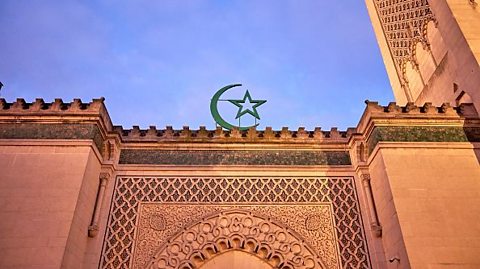
Islam teaches that Allah made the world in six stages. The The sacred book in Islam. It is believed that the Qur'an contains the word of God, dictated by Angel Jibril and written in Arabic. says “six days”, but many Muslims think these “days” were actually long periods of time, not just 24 hours.
The Qur’an doesn’t give a list of what was made on each day, but it describes how Allah created everything with great power and wisdom.
Islam also teaches that Allah is still in control of the world today, especially in creation such as helping plants grow and new life begin.
The The scientific theory that describes the early development of the Universe. in science states that the universe emerged in one moment from an event known as the Big Bang.
Some Muslims see the Big Bang as proof of Allah’s creation and accept it as scientific truth- but because it does not mention a designer or creator, it is incomplete, as it only explains the process Allah used to create it.
“The heavens and earth were once one mass then We split them apart”
Qur’an 21:30
Exam-style question
Which one of the following describes the idea that believers have a duty to look after the environment on behalf of Allah?
a) Responsibility b) Environment c) Stewardship (khalifah) d) Dominion
Sample answer
C) Stewardship (khalifah)
The value of the world

Islam teaches that Allah has created the world and everything in it, the sky, sea, land, animals, and people and that his creations reflect his glory.
Muslims believe that Allah made human beings Someone who guides another or takes responsibility for, and care, of others - in this case God's creation. of the Earth, with a responsibility for caring for the created world. This means that while the world belongs to Allah, people have been given the duty to look after it on His behalf. This is known as stewardship or The Arabic word for steward. The belief that everyone is a guardian of the world..
Most Muslims believe that they will be held accountable for their actions affecting the planet on the The day when Allah will decide about individual deeds, and reward or punishment..
“Wherever you turn, there is the Face of Allah.”
Qur’an 2:115
Exam-style question
Give one religious belief about the universe.
Sample answer
Many Muslims believe the universe was created by Allah and they have a duty to look after it.
The treatment of animals and the environment
Video
Watch the video below to compare Muslim, Jewish, and Sikh attitudes towards whether humans have the right to use the planet however they want.
Muslim presenter: Should humans have the right…
Jewish presenter: to use the planet…
Sikh presenter: however they want?
Muslim presenter: Hello, I'm Muslim,
Jewish presenter: I'm Jewish,
Sikh presenter: and I'm Sikh
Muslim presenter: And our religions all teach that God created the world for us to live in and care for.
Jewish presenter: But does that give us the right to do whatever we want with it?
Sikh presenter: Especially if that means damaging the environment for future generations?
All: Our planet is home to over 8 billion people and counting, and we're quickly using up its resources.
Forests have been destroyed and the seas are polluted.
The summers are getting hotter and the winters are getting wetter.
Muslim presenter: Climate change is real and it's caused by humans.
Jewish presenter: It puts the planet and us all at risk.
Sikh presenter: So what do our religions say about this?
Jewish presenter: Should humans have the right to use the planet however they want?
Muslim presenter: Muslims are taught that Allah created the world to provide us with everything that we need and to be a place of worship. It's our job to be khalifahs or stewards, which means that we have a responsibility to look after the earth. Muslims believe that we'll be judged by Allah on how well we've lived up to his trust.
Jewish presenter: Judaism also teaches that the earth belongs to God and we're his stewards. And not only that, the Torah says that the world was given to humans to rule over. But it comes with responsibilities because we must work the land and take care of it. An important Jewish principle is bal tashchit, ‘don't waste’ or ‘don't destroy’, which means we should care for the Earth's resources and avoid harming the environment.
Sikh presenter: The Guru Granth Sahib ji is the sixth Scripture and our eternal guru. The first words are ‘Ik Onkar’, which means everything is one. We're taught that God created the world and the world is part of God. All things are part of this oneness. Everything is connected, the worlds, the animals, and plants, us. So if we harm the planet, we harm the oneness we are part of. Sikhs follow the principle of Seva, which means selfless service. So to serve humanity, we need to protect the world we all share.
Muslim presenter: As Muslims, we believe that we should care for even the smallest of animals, the Prophet Muhammad, peace be upon him, said “whoever kills anything bigger than a sparrow, without just cause, will be accountable to Allah”, which means animals should only be killed for food.
Jewish presenter: A Jewish rabbi called Moses Maimonides once wrote, “it is forbidden to cause pain to any animal, although we are allowed to eat meat too.”
Sikh presenter: Guru Nanak Dev ji, the founder of Sikhi, wrote, Air is the guru, Water the Father, Earth the Great Mother. Nature provides everything we need and deserves respect. Many Sikhs do this by living simply and making choices that reduce harm to the environment, like being vegetarian.
Every Sikh temple, called a Gurudwara, has a free community kitchen called Langar. The food is always vegetarian, so that people of any background can share the same meal as equals.
Muslim presenter: But it's not always easy to know where our food has come from or how it was produced.
Jewish presenter: And have you ever wondered how your clothes are made?
Fast fashion and food choices can also have an impact on the environment.
Muslim presenter: Pesticides, deforestation, cheap labour.
Sikh presenter: However, it can be more expensive to buy food and clothing that have been ethically produced.
Jewish presenter: But our religions teach us that we should try and make the right choices.
Muslim presenter: So we could decide to save up, do without, or eat less meat, for example.
Sikh presenter: One of our most important principles is Kirat Karna, earning an honest living. That means we should never take advantage of people or damage the environment to make a profit.
Jewish presenter: A Jewish principle that's relevant here is Tikkun olam, which means repairing the world. We believe that we're partners with God in making the planet a better place.
Muslim presenter: I've actually been really anxious about climate change recently. I think lots of people are. It's when you realise that the damage we've done to the planet might be irreversible, and that humanity has got to wake up. My faith reminds me that I have a responsibility to change my habits and do something about it.
Jewish presenter: All of our religions teach that this planet is special
Sikh presenter: and we can't do whatever we want with it,
Muslim presenter: so we need to look after our planet, our home, and each other.
The environment
The Qur'an teaches that Allah has given Muslims the special role of being a The Arabic word for steward. The belief that everyone is a guardian of the world.. Most Muslims may believe that while Allah gave natural resources these resources should be used to help humans. They should not be exploited, since Humanity's God-given authority to rule over the Earth's resources and life. belongs to Allah. Misusing natural resources, for example by causing pollution, affects others in a negative way, which will harm the The worldwide, and local, community of Muslims bound together by ties of religion. as well as Allah's creation.
“Corruption has spread on land and sea as a result of what people’s hands have done.”
Qur’an 30:41
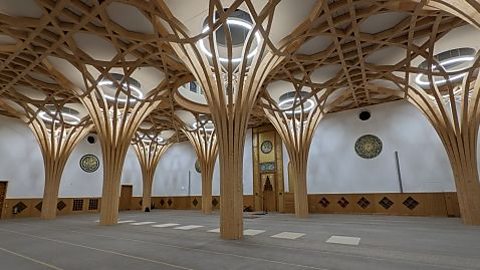
Many Muslims respond to environmental concerns in different ways. For example, during The month of fasting and prayer in Islam; the ninth month of the Islamic calendar., many mosques encourage worshippers to bring their own mugs rather than using plastic cups.
Muslims are also encouraged not use excessive water when performing Ritual washing before Salah or Salat (prayer). before prayer, only the amount that is necessary, which is something taught by Prophet Muhammad. Furthermore, the organisers of The annual pilgrimage to Mecca that every Muslim should make at least once in their lifetime according to the Five Pillars of Islam. have put in place teams to help prevent litter and encourage plastic water bottles to be recycled whilst performing the pilgrimage. In 2019, an eco-friendly mosque was opened in the UK, Cambridge Central Mosque. The mosque incorporates eco-friendly design features that help lower energy use and reduce its carbon footprint.
Global warming is the dramatic increase in the Earth’s average surface temperature, caused by greenhouse gases such as carbon dioxide and methane being released into the atmosphere known as emissions. Many Muslims see this as a moral issue because they see it as harming God’s creation and threatening future generations.
Animal rights
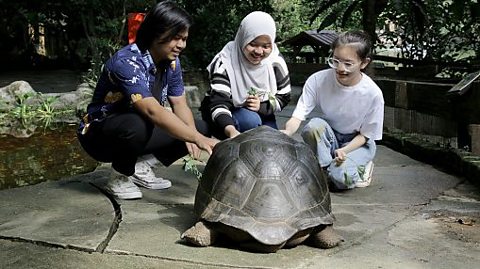
Many Muslims believe that animals were created by Allah to benefit humans.
“It is Allah who provided for you all manner of livestock, that you may ride on some of them and from some you may derive your food. And other uses in them for you to satisfy your heart's desires. It is on them, as on ships, that you make your journeys.”
Qur'an 40:79-80
But although some believe animals have been made for the use of humanity, they must be treated with kindness and respect.
In general, Muslims try to follow the food laws of Sharia sets out the moral and religious rules that Muslims must follow. It puts into practice the principles set out by the Qur’an, the Sunnah and the Hadith. which gives guidance on which foods, including animals, can be eaten and which can’t. Most Muslims believe that only certain animals can be used for food. For these animals to be Arabic for permissible or lawful. Halal food is food that is prepared according to Islamic law. to eat, they must be slaughtered in a certain way with many conditions.
Actions are judged on their intent in Islam so animal testing for non-medical purposes are not acceptable to most Muslims due to the responsibility of being a The Arabic word for steward. The belief that everyone is a guardian of the world. as well as Muslim teachings of kindness and compassion.
Many Muslims disagree with animal testing if other methods can be found. However, as humans are seen as more important, it can be seen as acceptable under certain circumstances.
Exam-style question
Explain two different Islamic beliefs about the treatment of animals.
Sample answer
Many Muslims oppose animal testing when alternative methods are available. Still, because human life is regarded as having greater significance, some consider it permissible in certain situations.
Another belief is that animals can be used for food as long as they are halal. This is because Islam teaches that animals were made for humans to survive.
Muslims follow Muhammad’s example of kindness and compassion towards animals. Many Muslims believe that meat should only be eaten if it is halal (permissible), meaning that the animal has been slaughtered according to the Sharia.
The origins of human life
The Qur'an teaches that Allah is the origin of human life. After creating the universe, Allah tells the angels:
“I am going to create a human being from clay. So when I have made him complete and breathed My Spirit into him, fall down and prostrate.”
Qur’an 26:36
Islam teaches that humans are above any other species and Allah made humans in the form that they are. Many Muslims believe all humans descend from Adam and Hawwa, Eve.
In the 19th century, Charles Darwin proposed the Theory of Evolution, supported by evidence that is now widely accepted, including by many Muslims, as an explanation of how human life developed.
So believing in A theory put forward by Charles Darwin that all living creatures that exist today, including human beings, have evolved over a period of millions of years from more primitive life forms. would mean that humans are just another kind of animal, which reduces the value of a human being.
However, some Muslim's believe it is possible for evolution and Islam to be compatible. through interpreting the Qur'an symbolically rather than literally.
Exam-style question
Explain two beliefs about the origins of human life. Refer to sacred writings or another source of religious belief and teaching in your answer.
Sample answer
A belief held by some Muslims is that humans were made by Allah and descended from Adam and Hawwa. They may reject evolution because Allah gave humans a soul. The Qur'an says that Allah “breathed His Spirit” into humans. Some Muslims may believe this shows that humans cannot be related to other species.
A different belief held by some Muslims may be that Allah created humans in stages. For some this belief may be compatible with ideas of evolution, as long as Allah is still the origin.
Abortion
An abortion is a way of ending a pregnancy. Abortion is legal in the UK in specific circumstances, which are set out in law.
Beliefs about the value and The concept that life is holy, sacred and precious and belongs to God. strongly influence Muslim views on abortion, because human life is seen as sacred and belonging to Allah. The Qur’an states that no one can die without Allah’s permission. This belief strongly influences Muslim attitudes to abortion, as taking life is seen as interfering with Allah’s will.
Islam also teaches that life begins at conception and therefore, that abortion should not be allowed. An exception to this view might be if the woman’s life is in danger since the mother’s life takes priority. According to some scholars, abortion may be permissible in such circumstances, however, situations should be assessed on individual circumstances.
However, for other Muslims abortion may be acceptable before the In Islam, the point at which an unborn child is given a soul. of the An unborn child. takes place. Many Muslims, particularly within the Hanafi, Shafi'i, and some Shi'a schools of thought, believe abortion is permissible before "ensoulment." Therefore for Muslims it is important to understand when life begins and when ensoulment happens. Some believe ensoulment happens 40 days after conception whereas others believe it is at 120 days. This means that the value and sanctity of life may be understood differently, leading to different views on whether abortion is morally acceptable at early stages of pregnancy.
Euthanasia
Euthanasia is the act of deliberately ending a person's life to relieve suffering. Euthanasia or assisted dying is currently illegal in the UK (March 2026).
Due to the belief in the The concept that life is holy, sacred and precious and belongs to God. principle, most Muslims believe that only Allah has the right to take away life at a time of his choosing.
Most Muslims believe in The belief that everything that happens has been decided already by Allah. and that what happens is all under the control of Allah, including the time of death which should not be hastened by human intervention.
Some Muslims may accept 'passive euthanasia', when any form of treatment to extend a person’s life is withdrawn. In such cases, some may accept this as not interfering with Allah’s will.
Exam-style question
‘Sanctity of Life means that a religious person should never take away a human life.’
Evaluate this statement. In your answer, you:
Should give reasoned arguments to support this statement
Should give reasoned arguments to support a different point of view
Should refer to religious arguments
May refer to non-religious arguments
Should reach a justified conclusion.
Sample answer
Many Muslims argue that life [should] never be taken by humans, due to the sanctity of life. The Qur’an teaches, “Do not take life, which Allah has made sacred”, teaching that human life is a sacred gift from Allah. Most Muslims believe only Allah can give or take life, and that humans should not interfere with this divine power.
Furthermore, the Qur’an also states: “Whoever kills a person… it is as if he has killed all of mankind." This highlights the seriousness of taking a life unjustly. This further supports the argument that life can never be taken, since life is too valuable. This teaching means man Muslims oppose abortion and euthanasia in many circumstances.
However some Muslims may disagree and argue that abortion may be allowed if the mother's life is in danger or it the abortion takes place before ensoulment.
In conclusion, Muslims agree that human life is sacred and must be protected. However, for some there are also cases where abortion may be accepted, which may depend on when a person believes life begins, and the circumstanes of the situation.
Death and the afterlife
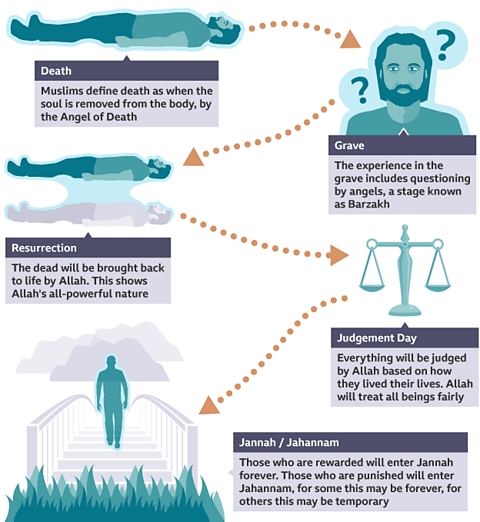
Islam teaches that there is a life after death, called Akhirah, and that once a person dies they will be judged by Allah on The day when Allah will decide about individual deeds, and reward or punishment..
On Judgement Day, a record of all the good and bad actions in a person’s life are brought to Allah, who will weigh these and decide whether the person will spend eternity in heaven (Jannah) or hell (Jahannam). This will include being judged on how they valued human life and took care of the universe.
Muslims believe that the The spiritual part of a human being. It is believed by many that the soul is eternal. is eternal but that there is a physical body after death in paradise; this is a new resurrected body.
There are various understandings of what heaven (Jannah) might be like, and it is described in the Qur’an in many ways, for example, heaven as a beautiful garden, with magnificent mansions and everything that is needed for those who are there.
Hell (Jahannam) is described in the Qur’an as being a place of physical and spiritual torment and where Satan and his followers are.
Test your knowledge
More on Islam
Find out more by working through a topic
- count2 of 3