Challenge 6 - Knotted net
Challenge 6 is all about joining dots, or knots.
Maths teacher Chris Smith and pupils from Grange Academy are here to explain.
The Maths Week Scotland Daily Challenges have been set by the Scottish Mathematical Council.
Mr Smith: This problem is all about joining dots, or knots.
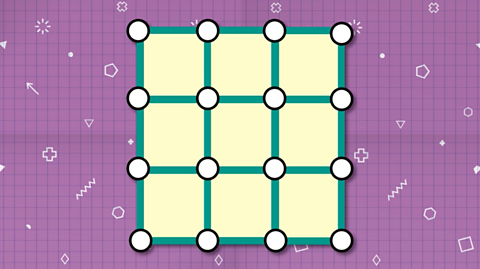
The diagram represents a rectangular net.
The net is made from string knotted together at the points shown.
The strings are cut a number of times.
Each cut severs one section of string between two adjacent knots.
What is the maximum number of cuts that can be made without splitting the net into two separate pieces?
Explain your answer.
Pupil: A drawing or a model might help you work this out.
Pupil: Think about the relation between knots and strings.
Pupil: Remember the question is about the number of cuts not the number of strings left.
Pupil: Good luck!
So here's the challenge:
This problem is all about joining dots, or knots.
The diagram represents a rectangular net.
The net is made from string knotted together at the points shown.
The strings are cut a number of times; each cut severs one section of string between two adjacent knots.
What is the maximum number of cuts that can be made without splitting the net into two separate pieces?

Need a hint?
A drawing or a model might help you work this out.
Think about the relation between knots and strings.
Remember the question is about the number of cuts not the number of strings left.
Solution
Worked out the answer? Here's how you can do it.
Did you work out the maximum number of cuts that can be made to the net without splitting it into two separate pieces?
Let’s look at how we got our answer.
To work out the maximum number of cuts, it helps to work out the minimum number of strings we need.
If we just had two knots, we need at least one string to connect them.
If we had three knots, we'd need at least two strings.
For four knots we'd need three strings, and so on.
The minimum number of strings is always one less than the number of dots.
Looking at our net, across the rows there are 6 × 5 = 30 knots.
If you need 1string to connect 2 knots, and 2 strings .to connect 3 knots and so on, to connect 30 knots requires a minimum of 29 strings.
But the question was what was the maximum number of cuts to be made.
The original net had five rows of five horizontal strings.
5 x 5 =25
And six columns of four strings.
6 x 4 = 24
That's 49 strings in total.
49 subtract the number of strings left, 29, equals 20.
So the maximum number of cuts we can make is 20.
Well done if you pieced this one together!

Step 1
To work out the maximum number of cuts, it helps to work out the minimum number of strings we need.
If we just had two knots, we need at least one string to connect them.
If we had three knots, we'd need at least two strings.
For four knots we'd need three strings, and so on.
The minimum number of strings is always one less than the number of dots.

Step 2
Looking at our net, across the rows there are 6 × 5 = 30 knots.
To connect 30 knots requires one less string:
30 - 1 = 29
A minimum of 29 strings is needed to connect 30 knots.
We can use this to find the maximum number of cuts to be made.
Step 3
The original net had five rows of five horizontal strings.
5 x 5 = 25
And six columns of four strings.
6 x 4 = 24
That's 49 strings in total.


1 of 2

Step 4
To find the maximum number of cuts that can be made, we take the total strings, and subtract the minimum number of strings:
49 - 29 = 20
So the maximum number of cuts we can make is 20.
Maths problem solving. collection
Try out Maths Week Scotland challenges from previous years.
Maths Week Scotland. External Link
Find more maths challenges and activities at the Maths Week Scotland website.
More on Problems solving - Maths Week Scotland challenges
Find out more by working through a topic
- count8 of 43

- count9 of 43
- count10 of 43
- count11 of 43