Where did the Vikings explore?
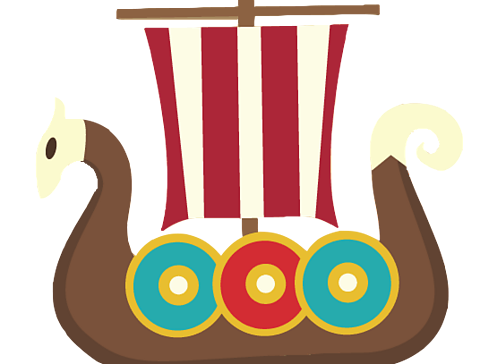
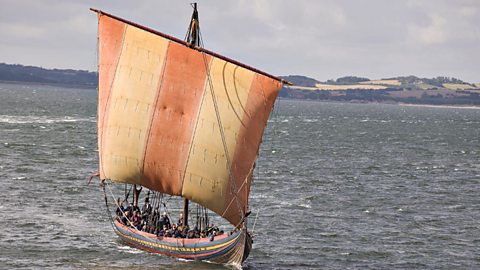
The Vikings were great explorers and travellers. Most of the explorers came from Norway because their land was crowded and there was not much farmland. In search of new land, the Viking ships reached Britain,France, Spain, Italy and North Africa.
Archaeologists know about longships from their excavations on farms in Norway.
Traders made long journeys overland through Russia, reaching as far south as Constantinople in modern-day Turkey. The Vikings also travelled inland along the Volga River in Russia to the Caspian Sea between Europe and Asia. Some merchants traveled further east to Baghdad in Iraq.
A few daring explorers made voyages to Iceland and beyond, travelling across the Atlantic Ocean to North America.
Explorer Leif Erikson travelled to Newfoundland in modern-day Canada.Eric the Red travelled to Greenland.
Important words for the Vikings
| Keyword | Definition |
|---|---|
| Explorer | A person who travels to new places. |
| Voyage | A long journey, usually by ships. |
| Trade | The buying and selling of goods. |
| Longships | Long, narrow ships designed for speed. |
| Rely | Using someone or something for support. |
| Archaeologist | People who dig up and uncover artefacts to help understand the past. |
| Excavation | The digging of the earth to study the remains of the past. |
| Parliament | People who make the laws for the country. |
What did the Vikings trade?
The Vikings were great traders who traded all over Europe and as far east as Central Asia. The Vikings traded because some goods and materials (silver, silk and glass) were unavailable in their homeland.
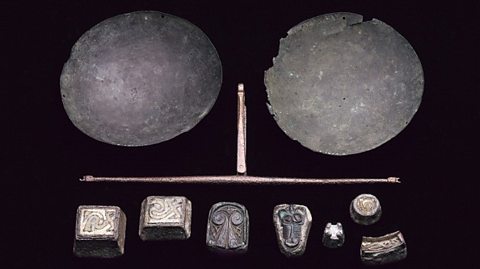
The Vikings began to use coins in the late 9th century. They used scales to weigh coins and get a fair deal.
They bought goods and materials such as silver, silk, spices, wine, jewellery, glass and pottery.
In return, they sold items like honey, tin, wheat, wool, wood, iron, fur, leather, fish and walrus ivory.
Everywhere they went, the Vikings bought and sold enslaved people too.
In markets, the Vikings competed with sellers over the price of spices and silks. Viking traders carried a set of folding scales which they used to weigh coins to make sure they got a fair deal.
How did they find their way?
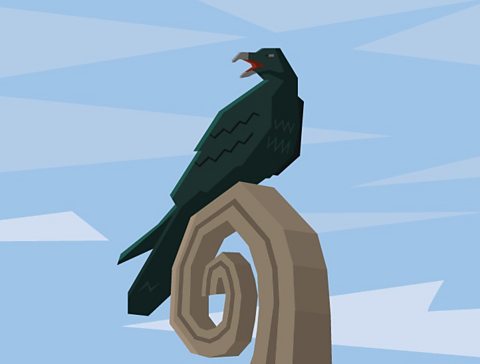
The Vikings did not use maps. Vikings sailed close to the coast whenever possible, watching for landmarks.
Out of sight of land, they looked for the sun: west (towards the sunset) meant they were headed for England; east (towards the sunrise) meant home to Denmark or Norway.
The Vikings invented a kind of sun-shadow board or sundial to help find their way. At night they watched the skies and could use the position of the stars to determine which direction they were heading.
Seamen knew a lot about winds and sea currents. By studying the habits of birds and fish, an experienced sailor could tell when land was close.
How do we know about longships?
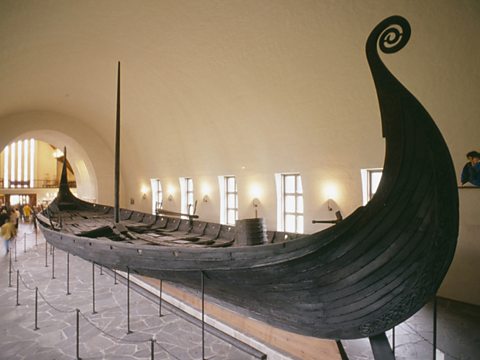
Wood rots and metal rusts away after a thousand years or more in the ground, but some remains show what Viking ships were like.
- Two Viking ships were found by archaeologists on farms in Norway.
- The Gokstad ship was dug up in 1880. The Oseberg ship was found in 1904.
- Both ships were buried in Viking funerals between AD800 and 900.
- The Gokstad ship is 23 metres long, the largest Viking ship ever found. It was big enough for 32 oarsmen and had 16 oars on each side.
- These ships are now in a museum in Oslo, Norway.
Think like a historian

Have a look at the thinking points below and think about your answer to each question. You could even write them down on a piece of paper or discuss them with somebody else if you want to.
- Why did the Vikings explore new lands?
- What might have happened if the Vikings did not trade?
- How do archaeologists know about longships in the past?
The Vikings explored new lands because their homeland was crowded and there was not much farmland.
If the Vikings did not trade, they would not have any coins. They would not be able to obtain goods that were unavailable in their homeland.
Archaeologists know how longships were built because of their excavations on farms in Norway. The Gokstad ship was found in 1880 and the Oseberg ship was found in 1904.
Activities
Activity 1: Viking explorers
Click on each of the Vikings to find out how far they travelled and what they discovered.
Activity 2: Quiz – Viking traders and explorers
Grown-ups Corner
Are you a parent, carer or teacher? Take a look at some of the links below on KS2 History which are packed full of knowledge, videos, quizzes and activities.
Viking clothing
Bitesize for Teachers
Anglo-Saxons travel around Britain
Bitesize for Teachers
Explorers - KS2
Primary Topic Packs
Horrible Histories: Raid and Trade game! game
Play Horrible Histories: Raid and Trade KS2 History
More on Vikings
Find out more by working through a topic
- count1 of 5
- count2 of 5
- count3 of 5