What did the Ancient Egyptians do for leisure?
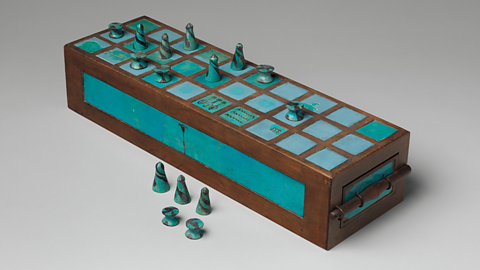
During the Ancient Egyptian times, it wasn’t all work and no play.
Ancient Egyptians enjoyed playing with games and toys, particularly board games.
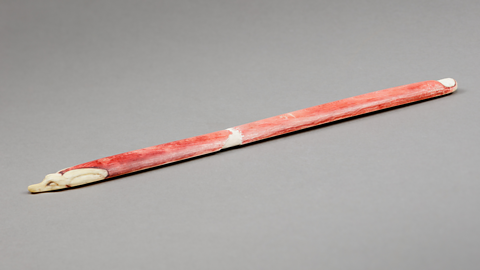
Board games were often played with throw sticks (sticks with a rounded side and a flat side, which would be thrown in the air) or knuckle bones (from sheep and used as a dice).
This was because they were games of chance.
For the Ancient Egyptians, the elements of chance symbolised that their fate was in the hands of the gods.
Important words
Important words on games the Ancient Egyptians played.
| Keyword | Definition |
|---|---|
| Deity | (or God) is considered worthy of worship because they have responsibility over parts of the universe or life. |
| Knuckle bones | Sheep knuckle bones used as an Ancient Egyptian dice. |
| Mehen | An ancient Egyptian board game named after a snake god. |
| Throw sticks | Sticks with a rounded side and a flat side, which would be thrown in the air. The number of flat sides that landed determined how many spaces a player could move. |
Watch: What Ancient Egyptian board games were there?
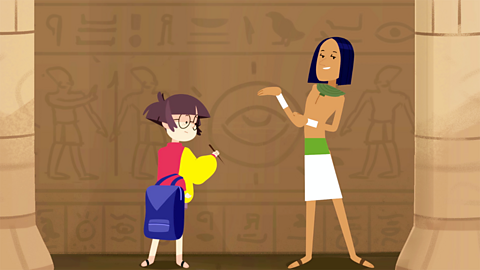
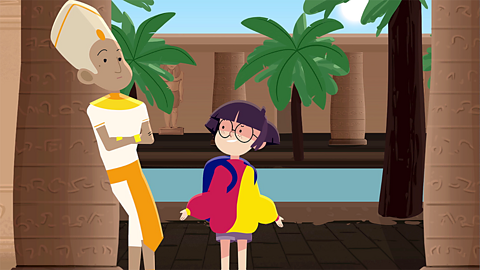
Child: Life looked tough in Ancient Egypt.
It doesn’t look like they had much time for fun.
What’s this?
‘Senet’, a board game dating from around 3000BC.
Ancient Egyptian person: Can I help you?
Child: Oh, hello!
Ancient Egyptian person: Do you play?
Child: Play? Oh no, I’ve never tried.
Ancient Egyptian person: Shame, it’s good.
I hear the last pharaoh was even buried with his favourite Senet boards!
It’s not surprising really.
The game shows the journey into the afterlife.
Child: What about this snake one?
Ancient Egyptian person: You mean ‘Mehen’? It’s named after a god in the form of a snake.
Oh yes! That’s very popular.
Though I’m not keen on snakes myself.
Child: I like this one.
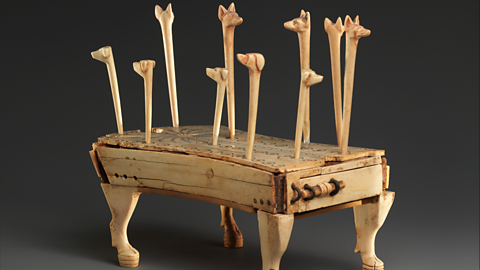
Ancient Egyptian person: ‘Hounds and Jackals’! Do you know, I always forget the rules to that one!
Child: Hmmm…
Ancient Egyptian person: We have toys too, like this cute little horse, and this doll!
Child: I’m too old for dolls!
Ancient Egyptian person: Maybe you’re after something a bit more physical?
I’ve got juggling balls, a hand ball, and even bows and arrows!
Child: Hmm… I think I’d like to play this one.
Ancient Egyptian person: Ahh, ‘Aseb’! Yes, this is my favourite.
I can show you how to play if you like.
I should warn you, I am one of the best players around.
Child: Ok then. I’ll give it a go.
Ancient Egyptian person: Well, you need to throw this dice and you need a four…
Child: Yay! I win!
Ancient Egyptian person: Ok… Ok… best of three!
What was Mehen?
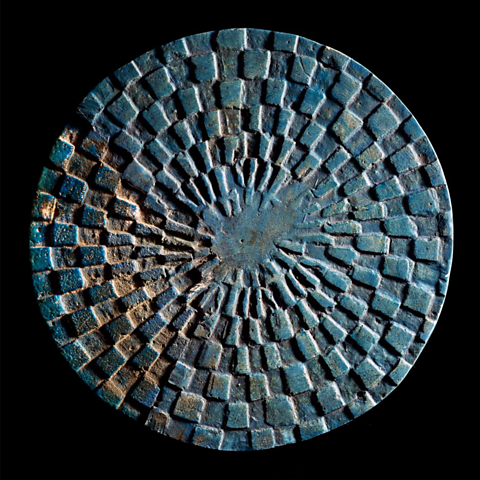
Mehen was a snake deity (god) in Ancient Egyptian religion.
The gameboard showed a coiled snake whose body is divided into rectangular spaces.
The game was played with lion or lioness shaped pieces with three to six sets and small marbles or balls.
No rules for Mehen have ever been found but its thought the aim was to race to the end moving space by space.
Slideshow: Ancient Egyptian games
Click through the slideshow to learn more about Ancient Egyptian games.
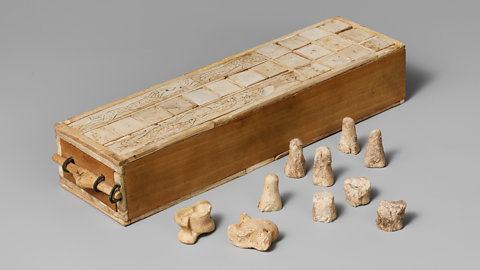
Image caption, The Ancient Egyptians played Aseb on one side of this box and Senet on the other side. Look closely at the picture and you can see some knuckle bones. The ancient Egyptians would use these as dice.
1 of 3
Think like a historian
Have a look at the thinking points below and think about your answer to the questions. You could even write it down on a piece of paper or discuss it with somebody else if you want to.
Why is it difficult for historians to know exactly how Mehen was played?
How is the way children played in ancient Egypt different from the way children play today?
You might have wondered how the game Mehen was played a very long time ago. This means that not everything people made or wrote at the time has lasted till today. We don’t know the exact rules of Mehen because no instructions were written down, or if they were, they didn’t survive.
Did you think about how children in ancient Egypt played for fun, just like we do today? They played with their friends and family and used toys or game pieces in their games. However, their toys were made from clay, wood, or stone while today most toys are made from plastic or electronics. Some games in Ancient Egypt were board games like Mehen or Senet, whereas children now might play video games, board games or take part in sports.
Activities
Activity 1: Explore Ancient Egyptian games
Click on the market stall to learn about four Ancient Egyptian games.
Games included ‘Senet’, ‘Hounds and Jackals’ ‘Aseb’ and ‘Mehen’.
Activity 2: Name the game
Solve the riddle and type the correct game name.
Activity 3: Quiz – Ancient Egyptian games
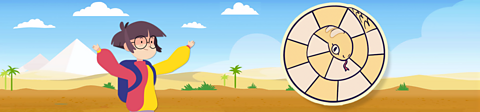
Activity 4: Make your own Mehen board
Make your own Mehen board. document
Download our ancient Egyptian Mehen board game and play the game yourself!
Activity 5: History Explorer game
Play this game to test your knowledge and learn even more facts about Ancient Egypt.
History Explorer: Secrets through time
History Explorer: Secrets through time: KS2 History
Grown-ups corner
Are you a parent, carer or teacher?
Take a look at some of the links below on KS2 History which are packed full of knowledge, videos, quizzes and activities.
KS2 History: Ancient Egypt
BBC Bitesize for Teachers
KS2 History: Ancient Egypt - Society and culture
BBC Bitesize for Teachers
KS2 History: Ancient Egypt - Rames - The Engineer
BBC Bitesize for Teachers
Horrible Histories: Raid and Trade game! game
Play Horrible Histories: Raid and Trade KS2 History
More on Ancient Egypt
Find out more by working through a topic
- count7 of 9
- count8 of 9
- count9 of 9
- count1 of 9