What are nitrates?
Nitrogen gas makes up 78% of Earth’s atmosphere and is an essential element in amino acids and proteins.
However, plants and animals cannot use nitrogen gas directly.
Plants can only absorb nitrogen in the form of The chemical absorbed from the soil by plants to produce their protein..
Minerals
Root hair cells, which are specially adapted, take in water and essential minerals from the soil, including nitrates for making amino acids and proteins
Root hair cells have a long extension that provides a large surface area for absorbing water and minerals.
Nitrates are absorbed by active transport, moving from a low concentration in the soil to a high concentration in the plant root, against the concentration gradient. This process requires energy from Respiration that requires oxygen., meaning it occurs only in the presence of oxygen.
What is the Nitrogen cycle?
Nitrogen is essential to life on Earth.
The nitrogen cycle continuously recycles nitrogen, changing it into different forms that plants and animals can use.
There are four key processes in the cycle: nitrogen fixation, nitrification, denitrification and decomposition.
In all these processes, microorganisms, like bacteria and fungi, play a vital role.
First comes nitrogen fixation.
Nitrogen gas makes up around 78% of the Earth’s atmosphere, but plants and animals can’t use it in this form.
So, nitrogen-fixing bacteria living in the soil, or in legume plants, convert the nitrogen from the atmosphere into ammonia or ammonium, which some plants can use for growth.
The second process is nitrification.
Here, nitrifying bacteria add oxygen to the ammonium, converting it into nitrites and then into nitrates – a form of nitrogen that plants can absorb more efficiently, helping them to grow.
Nitrifying bacteria are aerobic, which means they need oxygen to function.
The third process is denitrification.
Denitrifying bacteria take nitrates out of the soil, converting them back into nitrogen gas, which is released into the atmosphere.
This reduces the nitrogen in the soil, making it harder for plants to grow.
Denitrification takes place in low-oxygen environments, like waterlogged soil. These are known as anaerobic environments.
To increase levels of nitrifying bacteria in the soil that support plant growth, farmers drain and plough it, increasing the oxygen levels.
The final process is decomposition.
When plants and animals die, decomposers like bacteria break down their remains, converting proteins into ammonia or ammonium, and raising the nitrogen levels in the soil.
Understanding how the nitrogen cycle works is important to help us look after our ecosystems.
Nitrogen is transferred between living organisms and their environment.
Bacteria carry out the following processes in the nitrogen cycle:
Nitrogen fixation
Nitrogen-fixing bacteria convert nitrogen gas into nitrates.
These bacteria can be found "free" in the soil or in nodules on the roots of plants like peas, beans and clover.
Nitrogen-fixing bacteria need oxygen, as they are aerobic.
Decomposition
- Bacteria/fungi break down protein found in dead plants and animals, urine and Waste matter from the bowels. into ammonia.
Nitrification
Ammonia is converted into nitrates by nitrifying bacteria.
Nitrifying bacteria need oxygen as they are aerobic.
Denitrification
Nitrates are converted into nitrogen gas by denitrifying bacteria.
These bacteria thrive in waterlogged soil as they are Respiration in the absence of oxygen. and do not need oxygen.
Denitrification reduces soil fertility and plant growth.
Ploughing soil and improving drainage reduces the number of denitrifying bacteria.
What is eutrophication?
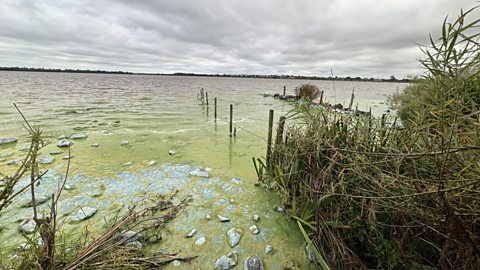
Eutrophication is caused when sewage or fertilisers get leached (washed off soil by rain) into rivers and lakes.
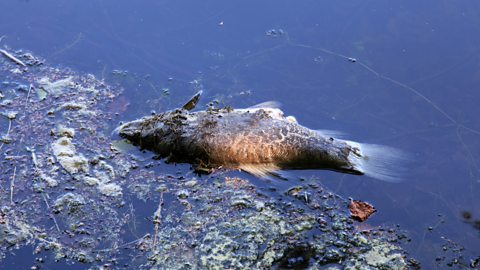
Eutrophication process
- Increase nitrate levels
- Sewage disposal and fertiliser run-off increase nitrates level in rivers.
- Nitrates cause increased growth of aquatic plants and algae – known as an algal bloom.
- Plants die
- Algae and plants become overcrowded, shading each other and blocking light for photosynthesis, causing them to die.
- Decomposition
- Aerobic bacteria break down dead plants and algae.
- Oxygen Depletion
- Bacteria use up oxygen for respiration.
- Fish and other organisms die from a lack of oxygen.
Controlling the use of fertiliser and storing manure and slurry more securely can reduce eutrophication.
Watch: A closer look at minerals and eutrophication
To grow and be healthy, plants need to absorb minerals.
They do this through specialised cells called root hair cells. This have an extended shape, which gives them a large surface area for more efficient absorption.
The minerals they absorb include nitrates, to make proteins for growth, calcium to create strong cell walls, and magnesium, a component of chlorophyll, which supports the absorption of light during photosynthesis.
Mineral ions are absorbed by the root hair cells through a process called active transport. This is how it works: respiration provides the energy to transport minerals against a concentration gradient, so they travel from a region of low concentration in the soil to a region of higher concentration in the root hair cell.
To help plants grow, farmers can increase the mineral levels of soil by adding slurry, manure, or artificial fertilisers. However, when fertilisers get leached or washed out of the soil into rivers or lakes, they cause eutrophication.
This means that the excess nitrates from the fertiliser initially causes rapid growth of aquatic plants and algae. This is known as an algal bloom. But then the plants die, due to the nitrate depletion and shading.
Next, aerobic microorganisms break down the dead plants, which consumes a lot of oxygen. This depletion of oxygen affects aquatic life, leading to the death of fish and other organisms that need oxygen to survive.
It's important we understand how mineral absorption in plants works, and the consequences of eutrophication, so we can maintain healthy ecosystems.
Test your knowledge
More on Biodiversity
Find out more by working through a topic
- count1 of 5
- count2 of 5

- count3 of 5