What are the key learning points about quantitative chemistry (1)?
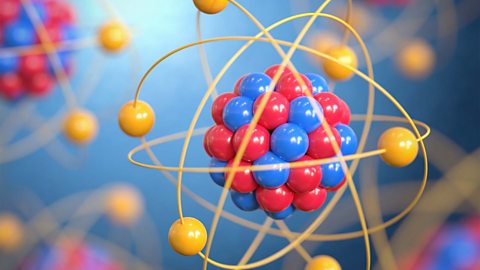
The smallest particle of an element. We often think of atoms as tiny spheres, but in fact they are made from smaller particles called protons, neutrons and electrons. are very light, so chemists measure their mass relatively, which means they are compared to the mass of a carbon-12 atom.
A mole is a measurement of a ‘batch’ of particles. It is easier to describe the number of moles of a substance rather than the number of atoms as atoms are very small.
What are relative masses?
Relative atomic mass
Atoms have a very small mass, so they are difficult to measure accurately.
Instead, chemists use a scale.
On this scale, the mass of a 12C atom is exactly 12.
This scale is convenient as the mass of the atom is the same as the The total number of protons and neutrons found in the nucleus of an atom. of the atom.
For example:
- 24Mg has a relative mass of 24 – it is twice as heavy as a 12C atom.
- 1H has a relative mass of 1 – it is 12 times lighter than a 12C atom.
These masses are called relative atomic masses.
They use the symbol Ar or RAM.
The relative atomic mass is the mass of an atom compared with that of the 12C Atoms which have the same number of protons (so they are atoms of the same element and have the same atomic number) but they have a different number of neutrons (so they have a different mass number)., which has a mass of exactly 12.
Relative atomic mass is the weighted mean mass of the isotopes of an element.
For example, chlorine has two isotopes (35Cl and 37Cl) and the relative atomic mass of chlorine is 35.5.
Relative atomic masses do not have units.
Relative formula mass
The relative formula mass of a substance is the sum of the The mass of the atom compared with that of the carbon-12 isotope, which has a mass of exactly 12. These masses use the symbol Ar or RAM. of the atoms in the formula.
Relative formula mass has the symbol, Mr or RFM.
Like Ar values, Mr values also have no units.
To calculate Mr for a substance:
- work out how many atoms of each element are in the chemical formula
- add together the Ar values for all the atoms of each element
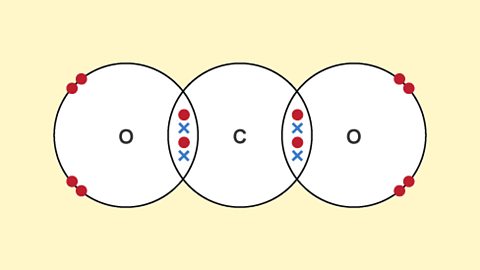
For example, the formula for carbon dioxide is CO2.
It contains one carbon atom and two oxygen atoms.
Using the mass numbers from the periodic table, the Ar of carbon is 12, and the Ar of oxygen is 16.
Mr of CO2 = 12 + 16 + 16 = 44
Question
Calculate the relative formula mass, Mr, of calcium hydroxide, Ca(OH)2.
(Ar of Ca = 40, Arof O = 16, Arof H = 1)
Answer
Ca(OH)2 contains: 1 x Ca, 2 x O, 2 x H.
Mr = 40 + (2 × 16) + (2 × 1)
= 40 + 32 + 2
= 74
How to find the percentage of an element in a compound by mass
To find what percentage of the mass of a compound comes from a particular element, you must first calculate the The sum of the relative atomic masses of the atoms in a formula. Relative formula mass has the symbol, Mr or RFM. (Mr) of the compound.
Then, use the following equation:
\({\%~of~an~element} = \frac{mass~of~an~element~in~the~compound}{relative~formula~mass~M_r} \times 100\)
Example
Calculate the percentage by mass of hydrogen in ethanol C2H5OH.
(Ar of C = 12, Ar of H = 1, Ar of O = 16)
Answer
Mr of C2H5OH = (2 × 12) + (5 × 1) + 16 + 1 = 46
There are six atoms of hydrogen in the compound, so the mass of hydrogen is 6 × 1 = 6.
\({\%~of~hydrogen} = \frac{mass~of~hydrogen}{relative~formula~mass~M_r} \times 100 = \frac{6}{46} \times 100 = 13\% \)
Question
Calculate the percentage by mass of oxygen in sodium carbonate, Na2CO3.
(Ar of Na = 23, Ar of C = 12, Ar of O = 16)
Answer
Mr of Na2CO3 = (2 × 23) + 12 + (3 × 16) = 106
There are three atoms of oxygen in the compound, so the mass of oxygen is 3 × 16 = 48.
\({\%~of~oxygen} = \frac{mass~of~hydrogen}{relative~formula~mass~M_r} \times 100 = \frac{48}{106} \times 100 = 45\%\)
What is a mole?
Atoms and molecules are too small to count individually.
Instead, chemists use a quantity called amount of substance, measured in a unit called the mole (mol).
A mole is like a ‘batch’ of atoms, and they are easier to count than individual atoms.
The mass of one mole of any substance is numerically equal to its relative formula mass or relative atomic mass.
For example, the relative atomic mass of carbon is 12.
If you weighed out 12 g of carbon, you would have one mole of carbon atoms.
What is the relationship between moles and masses?
Moles, mass and relative formula mass are closely related.
\(moles = \frac{mass~(g)}{M_r}\)
You can imagine these properties of a substance in a triangle.
You can reconfigure the triangle to calculate a substance’s mass, moles or Mr.
Cover the value you want to find and perform the operation between the remaining two values
How to calculate amounts in moles
Example
Calculate the number of moles in 36 g of water (Mr of water = 18).
\(moles = \frac{mass~(g)}{M_r}\)
\(moles = \frac{36}{18}\)
= 2 mol
How to calculate mass
Example
Calculate the mass of 0.25 mol of carbon dioxide molecules (Mr of CO2 = 44).
Mass = mol × Mr
= 0.25 × 44
= 11 g
How to calculate amounts in moles.
We're going to talk about the chemist's old friend, the mole.
Not the furry kind.
In chemistry, a mole is the unit of measurement for expressing the number of particles.
So that's atoms, molecules or ions in a certain substance.
It's not exactly easy to measure numbers of atoms, because atoms are so tiny.
So tiny in fact, if you take just one grain of sand it's actually composed of more atoms than there are grains of sand on an entire beach.
With this in mind, particle numbers get ridiculously big.
So there needs to be a really simple way to count them, and that's moles.
The same way that a "pair of socks" means 2 socks or a "dozen eggs" means 12 eggs, "one mole" of a substance contains a fixed number of atoms, molecules or ions: 6.02 × 10²³ particles.
Yes, it's a scarily huge number — six, zero, two followed by twenty one zeros.
Do you see why we need to simplify things?
This number is called the Avogadro constant.
It doesn't have anything to do with avocados.
It's Avo-ga-dro.
It's based on the number of atoms found in 12 grams of carbon 12, but it's used for measurements of all substances.
A mole of particles is always the same number of actual particles no matter what kind of particle they are.
So how do we know how many moles in a substance?
First, you need to know its relative formula mass, which you can work out by adding up the relative atomic masses — the AR values — of all the atoms in your formula.
AR values are easy to find because they're right there on the periodic table.
Then you need to know the mass of a substance — simple — and then you divide the mass by the relative formula mass.
So let's work out how many moles there are in, say, 37 grams of calcium hydroxide.
We know the mass: 37.
Next, we need to work out the relative formula mass.
There are three types of atoms present here, so add up their relative atomic masses: calcium is 40, oxygen is 16 and hydrogen is 1.
But the formula shows there are two hydrogen atoms and two oxygen atoms present for every calcium atom, which means the values for the hydrogen and oxygen have to be doubled.
So that's a total of 74 for the relative formula mass.
Now divide the mass by the relative formula mass: 37 ÷ 74 = 0.5 moles.
So, there are 0.5 moles in 37 grams of calcium hydroxide.
That turns a mountain of a calculation into a molehill.
Question
Calculate the missing values in the table below:
| Substance | Mr | Mass (g) | Moles |
|---|---|---|---|
| NH3 | 17 | 68 | |
| CaCO3 | 100 | 2.5 | |
| MgO | 40 | 120 | |
| CuSO4 | 160 | 0.5 |
Answer
| Substance | Mr | Mass (g) | Moles |
|---|---|---|---|
| NH3 | 17 | 68 | \(\frac{68}{17}=4\) |
| CaCO3 | 100 | 2.5 × 100 = 250 | 2.5 |
| MgO | 40 | 120 | \(\frac{120}{4}=3\) |
| CuSO4 | 160 | 0.5 × 160 = 80 | 0.5 |
What is a molar ratio in an equation?
A ratio is a way to show the relationship between the amount of one substance compared to another.
In balanced equations, the number in front of each A formula is made up of the symbols for one or more element and a subscripted number to show how many atoms of each element are bonded together. shows the ratio of the The chemical present at the start of a reaction. Reactants appear on the left of a chemical equation, before the arrow →. and A chemical which is made in a chemical reaction. Products are written on the right of a chemical equation, after the arrow (→). .
It tells us how many moles of each chemical we need to react to make the products.
If there is no number, the amount is one mole.
Example:
Zn + 2HCl → ZnCl2 + H2
The molar ratio is:
1 mol Zn : 2 mol HCl : 1 mol ZnCl2 : 1 mol H2.
In other words, one mole of Zn will react with two moles of HCl. This will produce 1 mole of ZnCl2 and one mole of H2.
How to calculate masses from equations
A chemical equation written using the symbols and formulae of the reactants and products, so that the number of units of each element present is the same on both sides of the arrow. and The sum of the relative atomic masses of the atoms in a formula. Relative formula mass has the symbol, Mr or RFM. can be used to calculate the mass of product made from a given mass of reactant, and vice versa (higher tier only).
Example:
N2 + O2 → 2NO
What mass of nitrogen is needed to make 120 g of nitrogen monoxide?
(Mr of NO = 30, Mr of N2 = 28)
A table layout can be helpful to work out the answer:
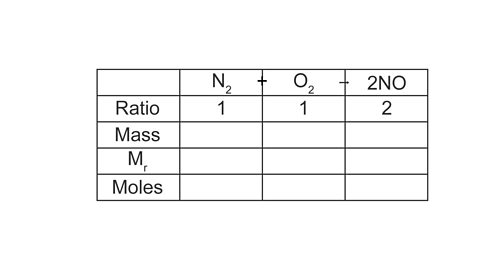
Image caption, 1. Give each substance its own column in the table, and record the ratio using the balancing numbers in the equation.
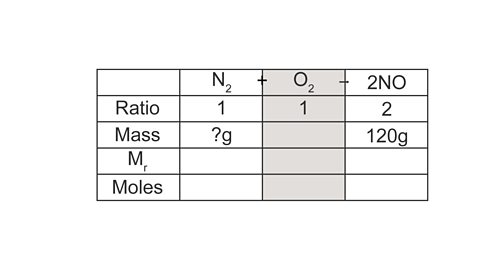
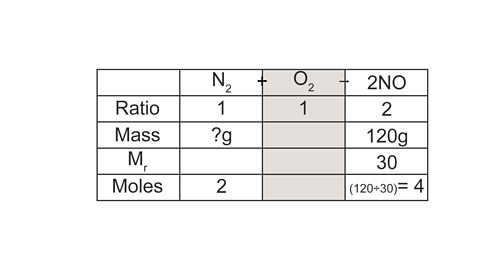
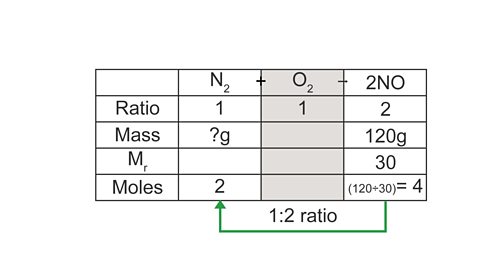
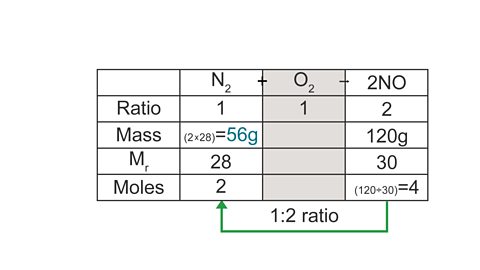
1 of 5
Question
2Mg + O2 → 2MgO
Calculate the mass of magnesium oxide that could be produced from 48 g of magnesium.
(Ar of Mg = 24, Mr of MgO = 40)
Answer
Mass of magnesium oxide = 80 g
What are limiting reactants? (Higher tier only)
A reaction finishes when one of the The chemical present at the start of a reaction. Reactants appear on the left of a chemical equation, before the arrow →. is all used up.
The other reactant has nothing left to react with, so some of it is left over:
- the reactant that is all used up is called the limiting reactant - it sets a limit on how much A chemical which is made in a chemical reaction. Products are written on the right of a chemical equation, after the arrow (→). can form.
- the reactant that is left over is described as being in excess.
The mass of product formed in a reaction depends upon the mass of the limiting reactant.
This is because no more product can form when the limiting reactant is all used up.
Example
2K + S → K2S
What mass of potassium sulfide is formed when 58.5 g of potassium is reacted with 32 g of sulfur?
Again, a table can be useful to structure this calculation:
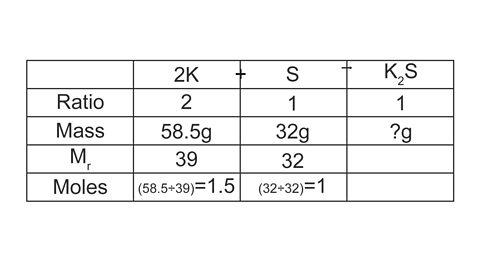
Image caption, 1. Start by calculating the number of moles of each reactant.
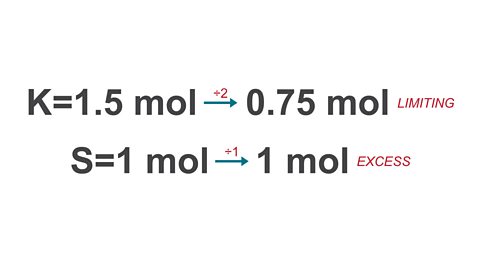
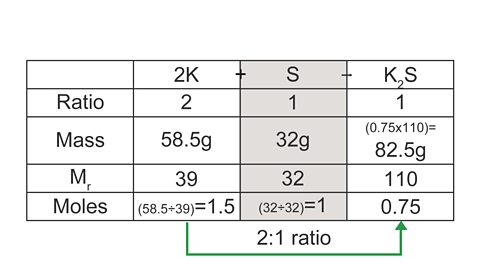
1 of 3
What is theoretical, actual and percentage yield? (Higher tier only)
Yield describes the amount of a product that is made in a chemical reaction.
There are three types of yield in chemistry:
Theoretical yield: the maximum possible mass of a product that a chemical reaction can make. It is calculated using The mass of one mole of a substance. The molar mass is the same as the relative formula mass in grams, or the relative atomic mass in grams.A ratio is a way to show the relationship between amounts of one substance compared to another. It is usually written in the form a:b..
Actual yield: the mass of a product that a chemical reaction makes in real life. It is usually less than the theoretical yield, for a number of reasons:
- some of the product may be lost when the products are removed from the reaction mixture.
- there might be side reactions – unwanted reactions that compete with the desired one.
- the reactions may be reversible and may not go to completion.
Percentage yield: a comparison between actual yield and theoretical yield.
\({percentage~yield} = \frac{actual~yield}{theoretical~yield} \times 100\)
The percentage yield can vary from 100% (no product lost) to 0% (no product made).
Example
12.4 g of copper(II) carbonate are heated and it decomposes.
6 g of copper(II) oxide is formed.
Calculate the percentage yield.
CuCO3 → CuO + CO2
Calculate the theoretical yield, using the same steps as a reacting mass calculation.
The maximum possible mass of a product that a chemical reaction can make. It is calculated using molar ratios. of copper(II) oxide = 8 g
The amount of a product made in a chemical reaction. of copper(II) oxide = 6 g
\({Percentage~yield} = \frac{actual~yield}{theoretical~yield} \times 100 = \frac{6}{8} \times 100 = 75\%\)
How much do you know about quantitative chemistry (1)
More on Structures, trends, chemical reactions, quantitative chemistry and analysis
Find out more by working through a topic
- count8 of 9
- count9 of 9
- count1 of 9
- count2 of 9