What are the key learning points about energy resources?
Renewable energy is defined as energy that is collected from resources that will never run out or which are naturally replenished within a human lifetime.
Examples of renewable energy include sunlight, wind, hydroelectricity, tidal, waves, wood and geothermal.
Using renewable energy resources can affect the environment, for example causing habitat destruction or visual pollution.
A non-renewable energy resource is one that has a finite (limited) supply and it will run out some time.
Fossil fuels such as oil, natural gas and coal are considered non-renewable because they cannot be replaced within a human lifetime.
Nuclear energy based on The splitting of a large nucleus to produce two smaller ones. Two or three neutrons are also released in the process. The energy from the neutrons powers a nuclear reactor. is also non-renewable since supplies of uranium ore will not last forever.
Using non-renewable energy resources can affect the environment, for example causing acid rain or global warming.
What are energy resources?
Energy resources are the different ways of supplying an energy form.
For example:
Chemical energy is an energy form.
- Food, oil, coal, gas, petrol, turf and wood are some of the resources which supply chemical energy.
The energy an object possesses by being in motion. is an energy form.
- Waves, tides, wind and falling water are some of the resources which supply kinetic energy.
There are many different energy resources.
They can be split into A renewable resource will never run out or replaced by nature in less than a human lifetime. and A resource that will run out, e.g. oil, natural gas, coal. These sources cannot be replaced by nature in less than a human lifetime. resources.
What are renewable energy resources?
Key facts
Renewable energy is defined as energy that is collected from resources that will never run out or which are replaced by nature in less than a human lifetime.
Non-renewable energy is defined as energy collected from resources that cannot be replaced when they are used up, such as oil, natural gas or coal.
How is wind energy generated?
Wind is produced as a result of giant The motion of a liquid or gas caused by heating some part of that liquid or gas. in the Earth's atmosphere, which are driven by heat energy from the Sun.
This means that wind is a renewable energy resource providing kinetic energy - as long as the Sun exists, the wind will too.
Wind Revolving machine with blades that are turned by wind, water or steam. Turbines in a power station turn the generators. use the wind to drive turbines directly.
They have huge blades mounted on a tall tower.
The blades are connected to a The part at the top of the tower of a wind turbine. The blades of the turbine are joined to the nacelle, which contains gears linked to a generator., or housing, which contains gears linked to a generator.
As the wind blows, it transfers some of its The energy an object possesses by being in motion. to the blades, which turn and drive the generator.
Several wind turbines may be grouped together to form a wind farm.
What are the advantages of wind energy?
- It is a renewable energy resource.
- There are no fuel costs.
- No harmful polluting gases are produced.
What are the disadvantages of wind energy?
- Wind farms are noisy and may spoil the view for people living near them.
- The amount of electricity generated depends on the strength of the wind; if there is no wind, there is no electricity.
- They can be a danger to birds or low-flying aircraft.
What are wave, tide and falling water energy resources?
Wave
Sea waves moving up and down can be used to drive turbines directly to generate electricity.
Energy which an object possesses by being in motion. of the waves → electrical energy.
WATCH: How wave power works and its impact
Find out how the power of waves can be used to generate electricity for our homes.
Scotland has over six thousand miles of coastline, so we have a lot of wave energy that can be turned into electricity.
Waves are created when the wind blows air across the surface of water.
The moving air creates friction that pulls the water along, piling it up into waves.
The more wind, the bigger the waves, and the bigger the waves, the more energy they have.
This is kinetic energy - movement energy that can be used to generate electrical energy.
There are different ways of doing this.
One way is to string together long lines of turbines that rely on the rise and fall of the wave.
The turbines have a chamber that fills with water when a wave hits it.
Water rushes in and pushes air out of the chamber, through a turbine.
This turns the turbine blades which powers a generator and it is this that generates the electricity.
The North and west coast of Scotland is perfect for developing wave power.
Strong winds blow across the Atlantic Ocean and could create big, powerful waves that reach all the way to our coastlines.
Wave energy still has a long way to go, compared to other renewable energies like wind or hydro.
So, for the moment, we do not generate a lot of electricity from our waves, but the potential for wave energy is huge.
Wave power doesn't need fuel.
All that's needed is wind and water.
There is no pollution generated and, once set up, the costs are low.
But, there are a few drawbacks before we line our coasts with wave power stations.
The first is in the building process.
That is difficult and expensive.
Imagine trying to build a turbine with high winds, giant waves, and the dangers of being dragged out to sea.
Building wave turbines can damage local marine ecosystems, as well as obstructing shipping, and being an eyesore.
Even if we find a brilliant, efficient way to capture energy from waves, we will only get energy out if there is energy going in.
So, on a calm day, no waves means no electricity.
So, with wave power still in its early days and currently only accounting for less than one percent of Scotland’s renewable energy, do you think this will be the future of renewable energy.
Tides
Huge amounts of water move in and out of river mouths each day because of the tides.
The moving water has kinetic energy.
A tidal barrage is a barrier built over a river mouth to make use of the kinetic energy in the moving water.
The barrage contains electricity generators, which are driven by the water rushing through tubes in the barrage.
Kinetic energy of the moving water → electrical energy.
WATCH: How tidal power works and its impact
Find out how the tides of the sea can be used to generate electricity.
The tide and high seas are moved by the gravitational pull of the moon and the sun, too.
Just like gravity pulls objects down to the Earth, the moon's gravity pulls things towards it, too, including the Earth.
Where there is sea facing the moon, this gets pulled even more causing a high tide.
On the other side of the Earth, the sea is pulled a bit less, causing another high tide.
As the moon moves around the Earth, these tides move, too.
That's why the tide will come in and go out again from the coast twice a day.
The movement of all this water involves a lot of energy - energy that could be used to generate electricity.
For tidal power to work, you need a really strong flow of water.
This is easier to capture when you’ve got water flowing through a narrow channel, such as an estuary, or between two parts of land.
It works like this: giant turbines are fixed to the sea floor.
The kinetic energy of the water flowing back and forward with the tide is used to turn the blades of the turbines.
This powers generators that convert the kinetic energy into electrical energy that can be transported back to land through undersea cables.
Unlike solar and wind energy, tidal movements are reliably constant.
Every day there are two high tides and two low tides that can be used to generate electricity.
It's also a renewable, sustainable source of energy.
It needs no fuel, and produces no by-products or pollution.
So, what's the catch?
Well, the technology is still at an early research stage, and, worldwide, tidal power doesn't generate much electricity yet.
Also, the cost of engineering and constructing machines to work on the seabed is high at the start of the project.
And, because tidal turbines work best in narrow channels, the places that they can be sited are limited, and these might not be near where the electricity is needed.
And that requires miles and miles of electricity lines.
There is also the potential damage to the marine environment and turbines installed in large numbers.
Tidal energy is still at the experimental stage with research still being carried out.
How important do you think it will be in the future?
Hydroelectric power
Like tidal barrages, hydroelectric power (HEP) stations use the kinetic energy in moving water.
Often, the water comes from behind a dam built across a river valley.
The water high up behind the dam contains The energy an object possesses due to its position above the ground..
This is transferred to kinetic energy as the water rushes down through tubes inside the dam.
The moving water drives electrical generators, which may be built inside the dam.
Gravitational potential energy of the water → kinetic energy.
Kinetic energy of the falling water → electrical energy.
WATCH: How hydroelectric power works and its impact
Find out how water can be used to generate electricity.
Scotland gets a lot of rain.
An awful lot of rain.
If only there was a way to turn all of this into clean energy.
Hydroelectric power does just that – and even better, it’s a renewable source of energy.
For hydro power to work you need a couple of things.
Lots of water, somewhere to store it all, and some way of using it to generate electricity.
The good news is that Scotland has all of these.
It has lots of lochs and rivers thanks to all that rain, it has steep valleys that are perfect for building dams to store it all, and it has clever engineers who know how to use them properly.
The idea is simple.
Water is stored high up in valleys behind a dam.
At this point, the energy stored there is called ‘potential energy’.
When the water is released, gravity makes it fall down through pipes in the dam.
All the potential energy changes to a huge amount of ‘kinetic energy’.
Down at the bottom are enormous turbines.
The kinetic energy of the falling water turns the blades of the turbines.
This turns electromagnets in a generator which changes this kinetic energy into ‘electrical energy’.
Once it’s done its job of turning turbines and generating electricity, the water flows out of the power station and downstream.
But in some power stations the water is stored in a lower reservoir and can be pumped back uphill to the dam so it can be used again and again.
There’s no pollution from waste products, or greenhouse gases, no fuel costs, and it’s cheap to run once it’s set up.
Plus with dams we can regulate the creation of electricity, only producing when we need to.
So, what’s the catch.
Well, they’re very expensive to build.
A lot of concrete is needed to build dams and making that concrete creates a lot of CO2.
There can also be environmental problems, too.
When a valley is dammed, large areas of land are flooded.
Ian Molnar, Hydrogeology Lecturer, University of Edinburgh: When you look at a map of where all the big hydroelectric power plants are in the world, hydroelectric power is mostly used in the wettest countries.
The four biggest producers in the world are some of the wettest countries in the world.
So, China, Brazil, Canada, and the US make up roughly half of all hydro power generated in the world.
We know we need to stop relying on non-renewable fuels, and hydro is a good example of a renewable energy source.
So, what do you think?
Is it worth flooding a valley to produce clean and cheap energy?
What is geothermal energy?
Hot water and steam from deep underground can be used to drive turbines: this is called Energy from the heat of the Earth. energy.
Geothermal and nuclear energy are the only energy resources that do not come from the Sun.
Geothermal power stations are located in places such as Iceland, California and Italy.
Hot rocks
In some places, the rocks are hot, but no hot water or steam rises to the surface.
In this situation, deep wells can be drilled down to the hot rocks and cold water pumped down.
The water runs through fractures in the rocks and is heated up.
It returns to the surface as hot water and steam, where its energy can be used to drive turbines and electricity generators.
The diagram below shows how this works.
What are the advantages of geothermal energy?
- Geothermal energy is a renewable energy resource and there are no fuel costs.
- No harmful polluting gases are produced.
What are the disadvantages of geothermal energy?
- Most parts of the world do not have suitable areas where geothermal energy can be exploited.
How is solar energy generated?
Solar energy is used to generate electricity and to produce hot water.
Solar energy is energy released by A type of nuclear reaction in which two lighter atoms are joined to make a heavier atom, releasing a large amount of energy in the process. in the Sun.
Solar cells
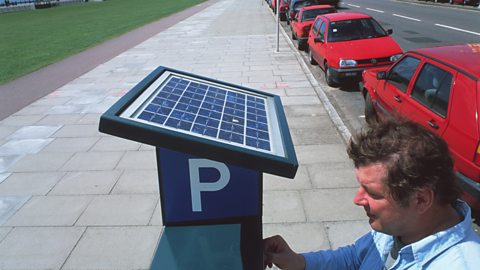
Solar cells are devices that convert light energy directly into electrical energy.
Small solar cells are used in calculators.
Larger arrays of solar cells are used to power road signs in remote areas, and even larger arrays are used to power satellites in orbit around Earth.
What are the advantages of solar energy?
- Solar energy is a renewable energy resource and there are no fuel costs.
- No harmful polluting gases are produced.
What are the disadvantages of solar energy?
- Space is needed for installing solar cells.
- Solar cells do not work at night.
Solar panels
Solar panels do not generate electricity, but rather they heat up water.
They are often located on the roofs of buildings where they can receive heat energy from the Sun.
The diagram outlines how they work:
- Cold water is pumped up to the solar panel, it heats up and is transferred to a storage tank.
- A pump pushes cold water from the storage tank through pipes in the solar panel. The water is heated by heat energy from the Sun and returns to the tank. In some systems, a conventional boiler may be used to increase the temperature of the water.
Advantages
- Solar energy is a renewable energy resource and there are no fuel costs.
- No harmful polluting gases are produced.
Disadvantages
- Solar panels may only produce very hot water in very sunny climates, and in cooler areas may need to be supplemented with a conventional boiler.
- Although warm water can be produced even on cloudy days, solar panels do not work at night.
What are non-renewable energy resources?
Fossil fuels
Fossil fuels include coal, oil and natural gas.
They were formed from the remains of living organisms (plants and animals) millions of years ago.
They have A type of stored energy. It is taken in when chemical bonds break, and given out when chemical bonds are made. stored within them and are non-renewable because they cannot be replaced within a human lifetime.
As of 2026, around 30-35% of the electricity generated in the UK comes from power stations fuelled by fossil fuels – this is almost always gas.
This diagram shows an energy transfer diagram for the generation of electricity from a fossil fuel such as gas.
What are the advantages of using fossil fuels?
- At the moment, fossil fuels are relatively cheap and easy to obtain. This may not always be the case.
- Much of our The basic structures needed for an area to function, for example roads and communications. is designed to run using fossil fuels.
What are the disadvantages of using fossil fuels?
- Fossil fuels are non-renewable energy resources. Their supply is limited and they will eventually run out.
- Coal and oil release sulphur dioxide gas when they burn, which causes breathing problems for living creatures and contributes to acid rain.
- Fossil fuels release carbon dioxide when they burn, which adds to the The retention of heat in the atmosphere caused by the build-up of greenhouse gases. and increases global warming. Of the three fossil fuels, for a given amount of energy released, coal produces the most carbon dioxide and natural gas produces the least.
Key facts
A non-renewable energy resource is one that has a Something that has a limited number of uses before it is depleted. For example, oil is a finite resource. supply and it will run out at some stage. They are used faster than they can be replaced.
Fossil fuels such as oil, natural gas and coal are considered non-renewable because they cannot be replaced within a human lifetime.
How is nuclear energy generated?
The main nuclear fuels are uranium and plutonium.
In a nuclear power station, nuclear fuel undergoes a controlled chain reaction in the A piece of equipment in which nuclear fission or fusion takes place. to produce heat - nuclear energy is converted to heat energy:
Heat is used to change water into steam in the boiler.
The steam drives the A turbine is a machine that turns the movement of liquid or gas into energy that can be used. In a simple turbine water or air push against turbine blades and spin them round. The spinning blades turn a long pole called a shaft. The shaft can then turn other pieces of machinery, such as a generator that is used to produce electricity. (heat to The energy an object possesses by being in motion.)
This drives the generator to produce electricity - kinetic to electrical energy.
Nuclear and geothermal energy are the only energy resources that do not come from the Sun.
What are the advantages of nuclear energy?
- Unlike fossil fuels, nuclear fuels do not emitThe gases responsible for global warming - carbon dioxide, methane, nitrous oxide and CFCs (chlorofluorocarbons). such as carbon dioxide.
- Nuclear fuels do not emit gasses such as sulphur dioxide which cause Rain that contains dissolved acidic gases such as nitrogen oxides and sulfur dioxide..
- 1 kg of nuclear fuel produces fuel (such as uranium) produces 1 million times more energy than 1 kg of coal.
What are the disadvantages of nuclear energy?
- Like fossil fuels, nuclear fuels used for The splitting of a large nucleus to produce two smaller ones. Two or three neutrons are also released in the process. The energy from the neutrons powers a nuclear reactor., such as uranium ore, are non-renewable energy resources since supplies will not last forever.
- Although modern reactor designs are extremely safe, if there is an accident, large amounts of radioactive material could be released into the environment. Such an incident occurred at Chernobyl in Ukraine in 1986.
- Nuclear waste remains radioactive and is hazardous to health for thousands of years, so it must be stored safely.
- To deactivate or remove in a safe manner. a nuclear power plant is extremely expensive.
What are the different energy resources used today?
The table below shows the main features of the most common energy resources used today.
What are the environmental effects of air pollution?
Global warming and acid rain are often confused as they are both caused by air pollution from the combustion of fossil fuels and biofuels.
Global warming
Global warming is caused by the release of carbon dioxide (CO₂) from the burning of all fossil fuels (and biomass fuels as well).
This extra CO₂ and other greenhouse gases (such as methane) in the atmosphere, traps infra-red radiation (heat) resulting in an increase in the Earth’s temperature (the greenhouse effect) which causes melting of ice caps, flooding of low-lying land and extreme weather patterns known as climate change.
Acid rain
Rain that contains dissolved acidic gases such as nitrogen oxides and sulfur dioxide. is caused by the release of sulfur dioxide (SO₂) and nitrogen oxides (NOx) from the burning of coal and oil.
This sulfur dioxide and nitrogen oxides react with rainwater in clouds forming sulfuric acid and nitric acid which falls as acid rain.
This causes rivers and waterways to become acidic which can kill aquatic plants and animals.
It can cause defoliation of young trees and can also corrode buildings.
| Energy | Energy store | Renewable or non-renewable | Uses | Power output | Impact on environment |
|---|---|---|---|---|---|
| Fossil fuels (oil, coal and natural gases) | Chemical | Non-renewable | Transport, heating, electricity generation | High | Releases CO₂ (causes global warming) |
| Nuclear fuels | Nuclear | Non-renewable | Electricity generation | Very high | Radioactive waste (needs to be disposed of safely) |
| Biofuel | Chemical | Renewable | Transport, heating, electricity generation | Medium | Carbon-neutral so low impact |
| Wind | Kinetic | Renewable | Electricity generation | Very low | Take up large areas that could be used for farming, people say windmills spoil their view |
| Hydroelectricity | Gravitational potential | Renewable | Electricity generation | Medium | Local habitats are affected by the large areas that need to be flooded to build dams |
| Geothermal | Internal | Renewable | Electricity generation, heating | Medium | Very low |
| Tides | Kinetic | Renewable | Electricity generation | Potentially very high but hard to harness | Tidal barrages can block sewage which needs to go out to sea |
| Sun | Nuclear | Renewable | Electricity generation | Potentially very high, but hard to harness | Very little |
| Water waves | Kinetic | Renewable | Electricity generation | Low | Very low |
How do the different energy resources compare?
Power stations that use fossil fuels or nuclear fuel are very reliable sources of energy.
These two types of stations provide much of the UK’s electricity.
They operate almost continuously.
When additional power is needed, gas power stations are usually used because they will come on very quickly and start generating electricity almost immediately.
The fuel for nuclear power stations is relatively cheap, but the power stations themselves are expensive to build.
It is also very expensive to dismantle, or decommission, old nuclear power stations at the end of their useful life.
The highly radioactive waste needs to be stored for millions of years before the natural activity will reduce to a safe level.
Water power eg tidal and hydroelectricity are reliable and predictable because of the Moon causing the tides and rainfall filling reservoirs.
These two types can also be used to supply additional demand.
But many of the renewable sources are unreliable, including wind and solar energy, and cannot respond to increased demand - sunny and windy weather cannot be guaranteed.
Renewable resources have no fuel costs, but the equipment used is expensive to build.
How much do you know about energy resources?
More on Unit 1: Energy
Find out more by working through a topic
- count3 of 5

- count5 of 5
- count1 of 5