Matters of life and death
In this article, learn about Christian views on the origins of the universe as well as some of life's big questions.
Key points
- The Bible teaches Christians that God created the world but opinions about how this happened differ between denominations
- Most Christians believe the world and animals are valuable, and that humans should care for them through stewardship and Humanity's God-given authority to rule over the Earth's resources and life.
- Christianity teaches that life is sacred, but there are various views on abortion and euthanasia within Christianity
- Many Christians believe that there is life after death and that everyone will spend eternity in either heaven or hell
Video
Watch the video below to compare Hindu, Muslim, and Christian attitudes towards whether religious creation stories contradict the Big Bang Theory.
Christian presenter: Do religious creation stories…
Hindu presenter: contradict…
Muslim presenter: the Big Bang theory?
Christian presenter: Hello, I'm Christian
Hindu presenter: I'm Hindu
Muslim presenter: and I'm Muslim
Christian presenter: We all believe that God created the world.
Hindu presenter: And there are ancient stories in our holy books that describe how it happened.
Muslim presenter: But science can now explain how the universe began.
Christian presenter: In the 1920s, a Russian mathematician called Alexander Friedmann and a Belgian physicist called George Henri Lemaitre, who was also a Roman Catholic priest, explained the origins of the universe with what became known as the Big Bang Theory.
Hindu presenter: It says that about 13.8 billion years ago, all of time and space was concentrated into one tiny spot smaller than an atom. And then it exploded outwards and the universe began. And it's still expanding.
Muslim presenter: The earth was formed about 4.6 billion years ago, and life developed because the conditions just happened to be right.
Christian presenter: People who believe that God made the world in exactly the way it's described in their holy books are called creationists.
Hindu presenter: And they are troubled by the Big Bang Theory
Muslim presenter: because it suggests that the universe might have appeared by chance, but
Hindu presenter: do religious creation stories contradict the Big Bang Theory?
Christian presenter: The first book of the Bible is called Genesis, and it describes how God made the world in six days, starting with light and finishing with the first man, Adam, who was created from dust.
Hindu presenter: Our scriptures tell us that before there was anything, there was Brahman, the one unseen spirit, and the sound of Brahman's energy, Aum. “In one version of the creation story, the god Vishnu appeared, and from his belly button a lotus flower grew, which floated away on a dark, empty ocean. Sitting in the flower was the god Brahma, who used the petals to create the heavens, the sky, and the earth.” Then Brahma created the beautiful goddess Saraswati, and together they had a son called Manu, the first man.
Muslim presenter: Creation is mentioned in several surahs, or chapters, of the Qur’an. They teach us that Allah made the heavens and earth in six days. He made the animals and plants and then the angels to serve him. Finally, Allah created the first man, Adam, from Clay.
Christian presenter: The religious creation stories are very different to the scientific explanation.
Hindu presenter: So despite the evidence, some religious people reject the Big Bang theory
Muslim presenter: because they believe it contradicts their holy books.
Christian presenter: Some say the world is just too complex, too perfect to have appeared by chance.
Hindu presenter: Some say it doesn't make sense for everything to be the result of a big explosion.
Muslim presenter: But it's difficult to ignore the science.
Christian presenter: From a literal reading of the Bible, strict creationists have decided that the world is only about 7000 years old, which goes against strong scientific evidence.
Hindu presenter: So maybe our religious stories were never meant to be read as factual accounts. What if they are more like poetry, which we reinterpret in a different way?
Muslim presenter: The Qur’an is a book of guidance, not a science textbook. It teaches us that Allah created the earth, not exactly how he did it.
Christian presenter: Professor John Polkinghorne was an Anglican priest and a scientist. He said “Genesis is not there to give short technical answers about how the universe began. It gives us the big answer that things exist because of God's will. One can perfectly well believe in the Big Bang but believe in it as the will of God the creator.” In other words, he thought that the Big Bang could be what happened when God created the universe. Remember George Henri Lemaitre, one of the scientists who developed the Big Bang Theory, was also a priest.
Hindu presenter: Some Hindus believe that life goes in repeated cycles, that people are born, live, die, and then are reborn, over and over again. And the same goes for the universe. This isn't the first and it won't be the last. Who knows? The Big Bang could be how the latest universe began.
Muslim presenter: Some Muslims believe that the Big Bang theory is in line with what it says in the Qur’an. There's a verse that says “the heavens and the earth were joined together as one unit, before we clove them asunder,” which could be a poetic description of the first massive explosion.
Christian presenter: I used to think that science threatened my beliefs, but now I think of it as humans discovering God's actions. I believe it's absolutely possible that the Big Bang is the way in which God created the universe. I interpret the story of Genesis as a poem that describes God's creation of a beautiful world.
Hindu presenter: So you don't have to choose between our holy books and The Big Bang Theory
Muslim presenter: although it depends on how you interpret the religious stories.
Christian presenter: Are they poetry or a literal description of what happened?
Hindu presenter: Is there really a contradiction?
Muslim presenter: That's for you to decide.
Religion and life scripture
Use this flashcard activity to learn key quotes from scripture.
Christian teachings on the origins the universe
Most Christians believe that God created the world "ex nihilo" meaning "out of nothing" and that creation wasn't a random event.
Christianity teaches that the universe was created and set in motion by God, that life has a purpose and that creation wasn’t a random event.
The The holy book of Christians. It has 66 books split into two sections: Old Testament (39 books) and New Testament (27 books). teaches that God created the universe in six days and rested on the seventh.
Some Christians take this account literally and believe the Bible describes exactly what happened. These Christians are often called Creationists.
Other Christians believe that while the Bible’s writers were inspired by god, some stories are metaphors with meaning, not real events. For example, some Christians believe that God created the world but that the six “days” represent six periods of time rather than six periods of twenty-four hours.
The The scientific theory that describes the early development of the Universe. in science states that the universe emerged in one moment from an event known as the Big Bang.
Some Christians think the order of The first book of the Old Testament (Hebrew Bible) describing the origins of humanity and humans’ relationship with God. has similarities to the order scientists outline- First light, then the Earth, then plants, animals and finally people. So some Christians believe they can accept the Big Bang theory and remain commited to their religion - that the two are are compatible.
GCSE exam-style question
Give two Christian beliefs about how the universe began
Christian people believe that God created the universe out of nothing (ex nihilo).
They also believe that God created the world in six days and rested on the seventh.
Christian teachings on the value of the world

Christianity teaches that God created the world and everything in it, the sky, sea, land, animals, and people. Because creation is seen as God’s gift, the world has value and should be respected.
"God saw all that he had made, and it was very good."
Genesis 1:31
Many Christians believe humans have a duty to protect the Earth because there is only one planet and it should be cared for.
Christianity teaches that:
"The Earth is the Lord’s, and everything in it…"
Psalm 24:1
Christians believe humans are therefore commanded to look after it. This duty is called The understanding that religious believers have a duty to look after the environment, as commanded by God. . According to Genesis 2:15, "The Lord God took the man and put him in the Garden of Eden to work it and take care of it." Many Christians understand this as an instruction to value the world and take care of it.
Christians also believe humans have Humanity's God-given authority to rule over the Earth's resources and life., the authority to rule over the world:
"Rule over the fish in the sea and the birds in the sky and over every living creature that moves on the ground."
Genesis 1:28
However, most Christians argue that dominion must be used responsibly, not selfishly. Damaging or wasting God’s creation would go against the duty of stewardship.
GCSE exam-style question
Give one religious belief about the value of the universe
Sample answer
Most Christians believe that they have a duty and responsibility to care for the world - this is known as stewardship, following God’s instructions to Adam at the start of the Bible. This is because they believe that there is only one earth and it should be protected.
Christian teachings about issues in the natural world
The environment
Most Christians think it is wrong to harm the environment. Many see environmental damage and pollution as breaking their responsibility of The understanding that religious believers have a duty to look after the environment, as commanded by God. and Humanity's God-given authority to rule over the Earth's resources and life., as stated in the The holy book of Christians. It has 66 books split into two sections: Old Testament (39 books) and New Testament (27 books). . Jesus also spoke about “loving our neighbour” and caring for the environment can be seen as an extension of this.
Many Christians hold the belief that God will judge humanity based on how they have treated God's creation, a principle they see reflected in the parable of The Talents.
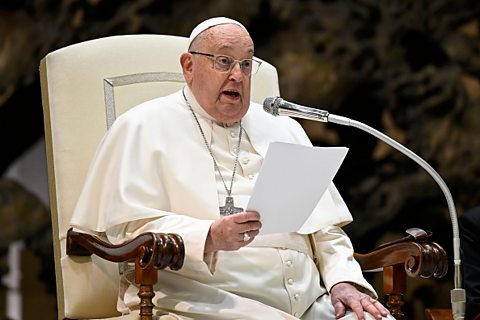
Pope Francis' letter Laudato si', published in 2015, called for a "swift and unified global action” towards the care of the environment. It also speaks of how “the earth, our home, is beginning to look more and more like an immense pile of filth” and emphasises how important it is to tackle pollution.
Christianity teaches, “Be on your guard against all kinds of greed; life does not consist in an abundance of possessions” (Luke 12:15). Many Christians believe they must avoid wasting or exploiting the Earth’s natural resources, as this is an example of the sin of greed, as well as a violation of the duty of stewardship.
Global warming is the dramatic increase in the Earth’s average surface temperature, caused by greenhouse gases such as carbon dioxide and methane being released into the atmosphere known as emissions. Many Christians see this as a moral issue because they see it as harming God’s creation and threatening future generations.
Animal rights
Many Christians believe that animals were created by God to be both used and cared for, and while animals are valued as part of God's creation, humans are considered more important because they are made in God's image.
The The holy book of Christians. It has 66 books split into two sections: Old Testament (39 books) and New Testament (27 books). shows God's love for all creatures, for example in the story of Noah’s Ark, where animals were saved too.
Many Christians believe animal testing is wrong if alternative methods are available, because humans have a responsibility to care for God’s creation. However, because humans are considered more important than animals, some Christians believe animal testing can be acceptable in certain circumstances, such as when it saves human lives.
GCSE exam-style question
Explain two contrasting religious beliefs about the treatment of animals.
In your answer you must refer to one or more religious traditions.
Sample answer
Most Christians believe that animals were created by God to be used and cared for. However humans are still more important because of the belief of ‘Imago dei’ which is the belief that humans are made in the image of God, and they have a soul which many Christians believe is not the same for animals
However, the Bible does speak of God’s care for all His creation such as the story of Noah’s Ark where the animals were kept safe and also in the parable of The Lost Sheep Jesus shows that even the least of the animals should be looked after and not left to suffer.
Christian teachings about the origins of human life
Christians believe that God created humans in his image, a belief called Latin for 'in the image of God'. . This doesn’t mean God looks like a human, but that people share some of his qualities, such as love, creativity and the ability to make moral choices.
According to the Bible, Adam and Eve were the first humans created by God. Some Christians including creationists take a literal view of the Bible and believe that creation happened exactly as described in the Book of Genesis. While other Christians may differ in how they understand the relationship between the biblical account of creation and scientific evidence.
“Genesis is not there to give short, technical answers about how the universe began. It gives us the big answer that things exist because of God's will. One can perfectly well believe in the Big Bang, but believe in it as the will of God the creator.”
Professor John Polkinghorne, Anglican priest and physicist
In the 19th Century Charles Darwin proposed the Theory of Evolution, with evidence that is now widely accepted, including amongst Christians.
Some Christians believe the story of Adam and Eve is not scientific, but teaches important truths, such as humans are special, have souls, and understand right from wrong. They don’t see a conflict between science and religion. The Bible explains why the world was created, and science explains how.
Other Christians who take a literal view of the The holy book of Christians. It has 66 books split into two sections: Old Testament (39 books) and New Testament (27 books). believe that creation happened exactly as described in the The first book of the Old Testament (Hebrew Bible) describing the origins of humanity and humans’ relationship with God.. They believe the first humans, Adam and Eve, were specially created by God. Some of these Christians accept that living things can adapt to their surroundings, but they don’t believe in evolution, saying there isn’t enough evidence.
GCSE exam-style question
Explain two religious beliefs about the origins of human life. Refer to sacred writings or another source of religious belief and teaching in your answer
Sample answer
Some Christians who interpret the Bible literally do not accept the theory of evolution as they believe that the Genesis story of the origins of human life is literally true and that all human life has descended from Adam and Eve. This quote from the Bible may be cited as evidence for this view:
‘God created mankind in his own image, in the image of God he created them; male and female he created them’.
They may believe that whilst the creation story of Adam and Eve is not scientific it shows a truth about God that can be accepted, which is that He cares for humanity and that humans are particularly special as they have a soul and a moral understanding of what is right and wrong.
Christian teachings on abortion
Video
Watch the video below to compare Buddhist, Jewish, and Christian attitudes towards abortion.
Buddhist presenter: How
Christian presenter: do different religions
Jewish presenter: view abortion?
Buddhist presenter: Hello, I'm Buddhist.
Christian presenter: I'm Christian,
Jewish presenter: and I'm Jewish.
Buddhist presenter: And we all believe that life, especially human life, is precious.
Christian presenter: Christians call this the sanctity of life,
Jewish presenter: which means it's holy and should always be protected. In Judaism, we call this pikuach nefesh, which means saving a soul.
Buddhist presenter: Abortion is legal in the UK.
Christian presenter: In specific circumstances which are set out in law.
Jewish presenter: But what do our religions say about it?
Buddhist presenter: Buddhism teaches that we live many lives in many bodies, but this life begins at conception, which is when a sperm fertilises an egg. The first of the Buddha's ‘five precepts’ says we should avoid taking life. So we try to live by the principle of ahimsa, which means ‘non-violence’ or ‘non-harming.’ And many Buddhists say this means abortion can't be allowed. However, some Buddhists believe that if a pregnancy is putting the life of a mother in danger, then an abortion is acceptable. This shows a Buddhist teaching called karuna, meaning compassion, which encourages us to reduce people’s suffering, if we can.
Christian presenter: In the Bible, the writer of Psalms 139 talks about God “seeing my unformed body in the womb.” So many Christians also believe that life begins at conception or soon after and should be protected. The Roman Catholic Church teaches that abortion is never allowed, no matter what the circumstances. Pope Paul VI wrote, all direct abortion are to be absolutely excluded, but in some cases, the Roman Catholic Church does support the principle of double effect. This is when, in order to do something good, something bad will also happen. For example, in the case of an ectopic pregnancy, when a fertilised egg grows outside the womb and puts the mother's life at risk, the church allows treatment to save the mother's life, even though it will result in the loss of the pregnancy. Protestant churches, like the Church of England, are also against abortion, but accept that there are reasons why it might be the best thing to do in some situations. It might be left to individual churches to give advice based on their own moral judgements.
Jewish presenter: An ancient collection of Jewish writings called the Talmud describes a foetus as ‘water’ for the first 40 days, and we take that to mean that it isn't a potential life until then. It isn't a life in its own right until birth. But we believe that a foetus is precious at all times because it's God's creation. So abortion should always be a last resort. Another book called the Mishnah says, “if a woman is having trouble giving birth, her life comes before the life of the child.” So if a mother's life is in danger, an abortion might be necessary to save her. But there are many other things to think about when deciding if abortion is an acceptable choice.
Buddhist presenter: Medical screening tests during pregnancy might show problems in the development of the foetus.
Christian presenter: The child might be born into extreme poverty or dangerous circumstances.
Jewish presenter: So religious believers might need to think about things that would affect quality of life.
Buddhist presenter: The Dalai Lama, the leader of Tibetan Buddhism, said “I think abortion should be approved or disapproved, according to each circumstance.” This shows another Buddhist teaching called Metta, which means loving kindness, and we believe that an aborted embryos, Vijñāna, their consciousness, will pass on to another life.
Christian presenter: Many Protestant Christians, including the Baptist, Methodist and United Reformed Church would agree that abortion is always a difficult choice to make, but it might be the best course of action in certain circumstances. There aren't always simple answers.
Jewish presenter: Some Jews would also say that an abortion should be allowed if the mother's physical or mental health might seriously suffer, or if the baby is likely to be born with a serious health problem. But each situation needs to be judged very carefully.
So all of our religions believe in the sanctity of human life.
Christian presenter: The Roman Catholic Church opposes abortion, but many Protestant Christians, including the Church of England, would say there are situations when it might be understandable.
Jewish presenter: Which is also the teaching in Judaism. Every case is different.
Buddhist presenter: And all of our religions teach us that every decision must be made with compassion.
An abortion is a way of ending a pregnancy. Abortion is legal in the UK in specific circumstances, which are set out in law.
Christians have different views on whether abortion is acceptable. Christians believe in the The concept that life is holy, sacred and precious and belongs to God., meaning life is sacred and belongs to God. For this reason, the question of when life begins holds great significance for many Christians.
The Catholic Church believes life begins at The moment a sperm and an egg cell join, during a process known as fertilisation., so abortion at any stage is wrong. It teaches that life is sacred and only God should decide when it ends. A possible exception to the Catholic teaching on abortion might be ending a pregnancy to save a mother's life. The reasoning for this type of action would be guided by the 'principle of double effect,' the idea that something bad can be accepted if a good outcome is intended."
Some Chrisitans believe abortion is taking a life and breaks the commandment “Do not murder.”
Christian teachings on euthanasia
Euthanasia is the act of deliberately ending a person's life to relieve suffering. Euthanasia or assisted dying is currently illegal in the UK (March 2026).
Christians may have divergent views on euthanasia, and these are often informed by belief in the The concept that life is holy, sacred and precious and belongs to God..
The The holy book of Christians. It has 66 books split into two sections: Old Testament (39 books) and New Testament (27 books). teaches that humans are made in the image of God and that life is sacred, some Christians use this as evidence to support the view that euthanasia is morally wrong since God alone should decide when a life should end.
The Roman Catholic Church condemns Euthanasia:
“Euthanasia is a grave violation of the law of God, since it is the deliberate and morally unacceptable killing of a human person.”
Pope John Paul II, Evangelium Vitae, 1995
GCSE exam-style question
‘Sanctity of Life means that a religious person should never take away a human life’
Evaluate this statement. In your answer you
- Should give reasoned arguments to support this statement
- Should give reasoned arguments to support a different point of view
- Should refer to religious arguments
- May refer to non-religious arguments
- Should reach a justified conclusion
Sample answer
Many Christians believe that because of the sanctity of life, no human has the right to take away another person’s life. The Bible teaches that human life is holy because it is created by God. In Genesis 1:27, it says that people are made “in the image of God”, meaning every human life is special and valuable.
The Ten Commandments include the clear rule: “You shall not murder” (Exodus 20:13). This shows that taking a life is a sin and goes against God’s will. Christians who believe in following the Bible literally would say that all life belongs to God and only He can decide when it ends.
Many Christians are against abortion and euthanasia because they believe all human life should be protected from beginning to end. Some Christians also believe that suffering has a purpose and that people should trust God rather than try to end life.
Other Christians may accept abortion in certain circumstances such if the woman’s life is in danger or if the quality of life of the child might not be good for various possible economic or physical reasons. This can be described as the lesser of two evils.
Some Christians argue that euthanasia can be morally acceptable because they believe God has given people free will. If someone who is terminally ill chooses assisted dying, some interpret Jesus’ teaching to “love your neighbour” as a call to act compassionately.
In their view, helping to end severe suffering, especially when a person’s quality of life is expected to decline dramatically, could be seen as the most loving response. Many Christians believe that humans have been given free will by God, which means that a person can choose when to end their life.
Christian teachings about life after death
Most Christians believe that death is not the end but the beginning of eternal life. They believe in the immortality of the soul and in Jesus’ promise:
“I am the resurrection and the life. The one who believes in me will live, even though they die.”
John 11:25
Christianity teaches that after death they will be judged by God. Some think this happens straight away, while others believe it will take place on The day when Christians believe the world will end and all the deceased people will come back to life so that God can judge how everyone behaved when they were alive. , when Jesus returns. Catholics also teach about purgatory, a place of purification before entering heaven.
Views about the afterlife differ. Some Christians believe people will be raised with a physical body, while others believe only the soul continues. The The holy book of Christians. It has 66 books split into two sections: Old Testament (39 books) and New Testament (27 books). describes heaven in many ways, but most Christians see it as being in God’s presence, where…
“There will be no more death, or mourning, or crying, or pain.”
Revelation 21:4
By contrast, hell is pictured as a place of torment with Satan and his demons, though some Christians understand it simply as eternal separation from God.
Central to Christian belief is that salvation is possible because of Jesus’ death and resurrection. His sacrifice is seen as paying for human sin. Salvation is offered as a free gift from God, but many Christians believe that good deeds are still important as a sign of genuine faith.
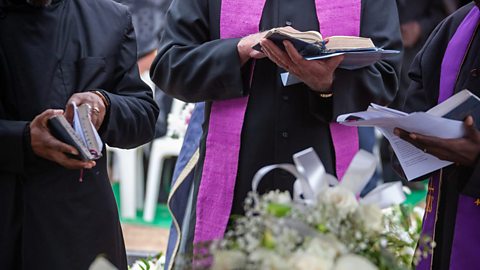
These beliefs shape Christian funeral services. Funerals are usually held in church, led by a priest, minister or vicar, and include prayers, Bible readings and hymns. They celebrate the person’s life but also focus on hope in life after death and the promise of being reunited with God and loved ones.
Quiz - Christianity - Religion and life
More on Christianity
Find out more by working through a topic