What are Mandarin characters?
Unlike the English language, which uses the Roman alphabet, Mandarin does not have an alphabet.
Instead there are Mandarin characters, called Check your connection, refresh the page and try again.hàn zì, and each character represents a word.
Each Mandarin character is made from different components.
Mandarin characters with Burt Bessington
Burt: Hello and welcome to…
Librarian: Shh!
Burt: Oh, sorry, Words of the World!
Mandarin characters have developed over approximately 4,000 years.
But Mandarin characters aren’t letters that tell you how a word sounds - they’re more like pictures or symbols.
You see, the original form of the characters have changed over time to the characters used today.
On with the quiz!
Librarian: Shh!
Burt: Try to match the pictures with these Mandarin characters.
Children: Err… This one, this one… And this one.
Burt: Correct! Someone’s been doing their homework!
Librarian: SHHHHHH!
Burt: The characters for mountain and tree look like the words they represent.
There are around 3,500 common Mandarin characters.
These are all made from different components.
Components are like the building blocks of characters and occur in different places in different characters.
See if you can spot the same component in these characters!
Children: There, there and there.
Burt: Correct!
The meaning component for mouth is in all these characters!
You win our star prize, this megaphone!
Librarian: CONGRATULATIONS!
Children: SHHHHHHH!
What are the components of a character in Mandarin?
There are usually two components to a character:
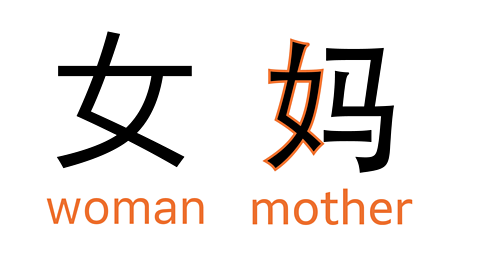
Radical - The component that shows the overall meaning of the character, is called the radical.
For example, in the character Check your connection, refresh the page and try again.mǎ meaning ‘mother’ the radical is Check your connection, refresh the page and try again.nǚ (woman) because of the connection often made between mothers and women.
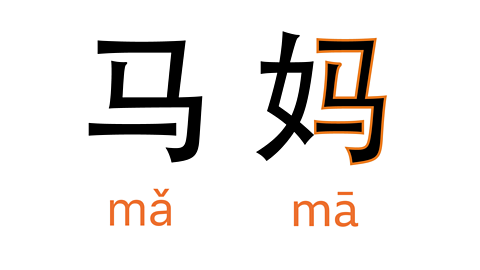
Phonetic - The other part of the character is called the phonetic (pronunciation).
In the ancient form of the language this showed how the character was pronounced and in modern Mandarin it can give you a clue about the pronunciation, eg the Check your connection, refresh the page and try again.mǎ (horse) in Check your connection, refresh the page and try again.mā (mother).
Pronunciation
It is important to remember that the phonetic is only a clue, not an accurate guide.
For example, in the character Check your connection, refresh the page and try again.kàn (to look at), the radical is Check your connection, refresh the page and try again.mù (eye), which helps with the meaning, but the phonetic Check your connection, refresh the page and try again.shǒu (hand) does not give any guide to pronunciation.
Also, sometimes the radical is the whole character, like in Check your connection, refresh the page and try again.mǎ (horse), so there is no phonetic.
Mandarin characters do not tell you how to pronounce them – that’s what pinyin is for.
Mandarin characters started out more like ‘pictures’ but have changed over 4,000 years into the Mandarin characters used today.
This can be seen clearly in the development of the character for ‘mountain’ (Check your connection, refresh the page and try again.shān):

The smallest units of Mandarin characters are strokes.
Download the character practice sheet
Practise writing Mandarin characters. document
Download the PDF and use the grid to help practise writing Mandarin characters.

Quiz
Play Dash and Blink: Missing Mandarin! game
Construct simple phrases and develop an understanding of vocabulary and grammar with this KS2 Mandarin game.

More on Mandarin grammar
Find out more by working through a topic
- count2 of 5
- count3 of 5
- count4 of 5
- count5 of 5

