A communion of saints
In Catholicism, Saints are not just people who have been To declare (a deceased person) an officially recognised saint, it is also a term used to refer to all faithful Christians.
The Church as a communion of saints means that all members of the Church are holy and joined together. This means that:
- There is no division between the Church on earth and the Church in Heaven.
- Christians on earth can offer prayers through the official saints.
- The official saints are in Heaven rather than A place where Catholics believe people's souls are purified of their sins before they go to Heaven. and so are closer to Christ to Catholics do not worship Mary or the saints, but ask them to pray to God on their behalf. This is known as intercession - asking God to help others who need it, eg the sick, poor, those suffering in war. with Him on their brothers' and sisters' behalf.
- Catholics can pray for the dead as they are still part of the communion of saints. This means that Christians on Earth can pray for their dead relatives and friends in Purgatory.
Why is this teaching important for Catholics?
It is part of the The Catechism of the Catholic Church is a reference work that summarises the Catholic Church's doctrine.which all Catholics should believe.
It gives them direct contact with the official saints giving them help, comfort and support from great Christians of the past.
It allows prayers to be offered for the dead so that those in Purgatory can go to Heaven and those in Heaven can pray for those on Earth.
Simon and Sarah explore the life and legacy of St. Patrick and St. Brigid
Hiya.
What badness have you got up to this week?
Sorry.
I don't know what you mean. I'm a saint!
Great segue, this is actually our topic for today, and I don't seem to have you on my list.
Well, what makes them so special?
Are you seriously asking me why the patron saints of Ireland are so special?
Oh, no. Here comes another fact file. Minus craic.
Wrong. I've spiced this one up, so you'll listen. Cue the voiceover guy.
Voiceover:
Many saints became celebrated by the church for their work they carried out on Earth. We've rounded up the best ones and put them on an island for them to compete for the ultimate title.
May the best saint win.
Let's meet our contestants.
First up, it's Saint Bridget.
Saint Bridget:
Hi, Bridget here.
So not many people know a lot about me, but I'm actually the mother saint of Ireland and the patroness of like a million things.
I was born into slavery, but as I got older, I started performing miracles like healing.
I was maybe about ten when I was returned to my household, but as a servant!
Apparently I was really annoying so my father took me to the King of Leinster to sell me.
While they were chatting I gave away his really expensive jewelled sword to a beggar.
Look, I know what you're all thinking, but he needed to feed his family, okay?
The King thought I was class for doing that and convinced my dad to set me free. Finally!
I thought me and the King had a good thing going, so I asked him for some land to build a monastery on.
He said no.
But look, that never stopped me.
So I prayed that he would give me as much land as my cloak covered.
He thought that was funny so was like, "Alright, crack on."
So me and my four sisters grabbed a corner of the cloak and walked in opposite directions and what do you know, the cloak began to grow and spread across many acres.
The king was shook.
He realised how truly blessed by God I was and helped me with money, food and gifts.
Ka-ching.
Narrator:
Now let's meet our next contestant. It's Saint Patrick.
Saint Patrick:
So Patrick here. Well, yeah, I've been a saint for a couple of hundred years now.
I was born in Wales, and when I was sixteen, I got kidnapped by Irish raiders.
I was so scared.
I prayed up to 100 times a day just to get home.
After six years, I had this dream about escaping and escaped, mate.
So yeah, it was a hard time, but I finally got reunited with my family and ended up training to be a priest and, well, pretty much brought Christianity to Ireland.
Not bragging though.
One of my biggest claims to fame was using a three-leaf shamrock to explain the concept of the Holy Trinity.
Represent!
The Irish love me. I've even got my own day over there.
Narrator:
And last but not least, Saint Colmcille!
Saint Colmcille:
Hi, guys. My name is Colmcille.
Who will win the title?
Find out after the next 84,000,782.3 ad breaks.
Oh.
So, still think you deserve to be called a saint?
Well I don't see any of them having 5,000 followers, do I?
St. Patrick - Patron Saint of Ireland
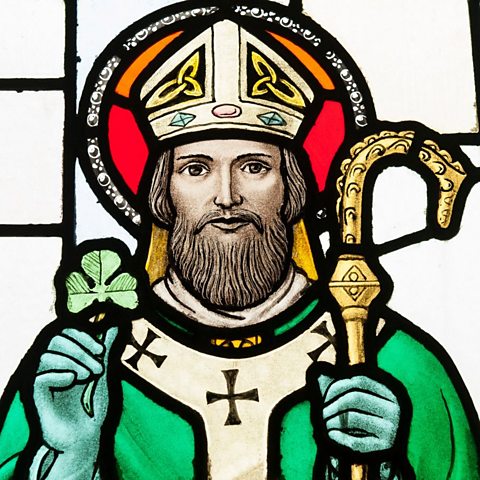
Born: Wales, 4th century
Died: Ireland, 5th century
Buried: Down Cathedral, Downpatrick, Ireland
Feast: 17 March
St. Brigid - Patroness Saint of Ireland
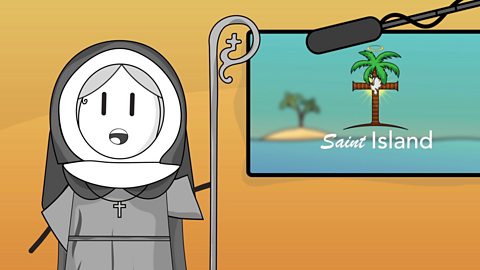
Born: 451AD Faughart
Died: 525AD, Kildare, Ireland
Buried: Kildare Monastery
Feast: 1st February
St. Colmcille
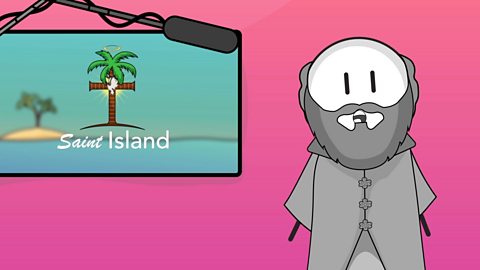
Born: 7 December 521AD, County Donegal, Ireland
Died: 9 June 597AD, Iona, Scotland
Buried: Gartan, County Donegal
Feast: 9th June
He was also known as Columba, a Latin version of Colum. The 'cille' suffix that was added to the end of his name means 'of the churches'.
His life:
- A young Colmcille entered the priesthood at the age of 20 when he became a pupil at Clonard Abbey, situated on the River Boyne in modern day Co. Meath.
- When a cousin gave him some land on the banks of the River Foyle in Derry, he decided to start his own monastery. This allowed him to travel throughout Northern Ireland teaching the pagans about Christianity.
- Colmcille founded around 30 monasteries in just 10 years, inspiring many people with his personal holiness.
- But Colmcille was no angel. His strong personality and forceful preaching ruffled feathers and in 563 AD he was accused of starting a war between two Irish tribes.
- His considerable reputation was respected by everyone in Ireland. He spoke to the assembled nobles and clergy with such force and authority that the king was persuaded to calm hostilities.
- Colmcille spent the rest of his life on Iona praying, fasting, and teaching his monks to read and copy the Scriptures.
- He was a renowned ‘man of letters’, wrote several hymns and has been credited with having transcribed over 300 books and manuscripts.
- Colmcille died on Iona and was buried in 597 by his monks in the abbey he created.
His Legacy:
- Several miracles have been attributed to him, such as:
- healing people with diseases
- expelling malignant spirits
- subduing wild beasts
- calming storms
- returning the dead to life.
- He is one of the three patron saints of Ireland.
- He is the patron saint of the city of Londonderry, where he founded a monastic settlement in 540 AD.
- The Church of Ireland Cathedral in Derry, St. Colmcille's Primary School and St. Colmcille's Community School in Dublin are all dedicated to him.
- Ireland's national flag carrier, Aer Lingus, has even named one of its Airbus A330 airplanes St Columba (reg: EI-DUO) in commemoration of the saint!
Test yourself!
More on The Christian church
Find out more by working through a topic
- count1 of 4

- count2 of 4

- count3 of 4

