What are the key learning points about prescribed practical C2?
An An ionic compound occurs when a negative ion (an atom that has gained an electron) joins with a positive ion (an atom that has lost an electron). contains a positive An atom or molecule that has either a positive or negative electrical charge. (cation) and a negative ion (anion). These both need to be identified to work out the identity of an unknown ionic compound.
Cations can be identified with flame tests.
What are flame tests?
Some metal cations have distinctive colours when held in a blue Bunsen burner flame.
A nichrome wire is used to hold the test solid – nichrome has no flame colour of its own and it has a high melting point.
Identifying cations using hydrochloric acid
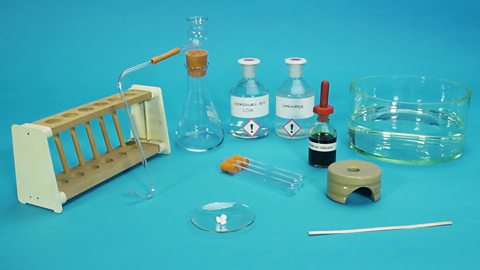
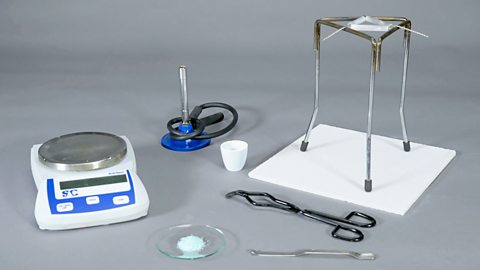
What apparatus is needed for flame tests?
Bunsen burner, heatproof mat
Nichrome wire (in holder)
Ionic compounds to test
Sodium chloride, calcium chloride, lithium chloride, potassium chloride, copper(II) sulfate (1 g of each salt)
Concentrated hydrochloric acid
Safety: Follow the safety advice given by a teacher.
What are the steps involved in carrying out flame tests?
Take a piece of nichrome wire with a loop at one end.
Firstly clean the nichrome wire by dipping the loop in the concentrated hydrochloric acid and placing it in the hot blue flame of the Bunsen burner.
Repeat until the flame is no longer coloured, i.e. impurities are removed.
Dip the clean nichrome wire in concentrated hydrochloric acid and then into the solid ionic compound which is sitting in a watch glass.
Hold the loop with the solid ionic compound in the hottest part of the flame and record the characteristic colour.
Repeat for all the solid ionic compounds available, cleaning the wire loop each time.
Table of results
| Metal ion | Observed colour | Actual colour |
|---|---|---|
| Sodium | Yellow/orange | |
| Calcium | Brick red | |
| Potassium | Lilac | |
| Copper | Green-blue/Blue-green | |
| Lithium | Crimson |
More on Prescribed practicals
Find out more by working through a topic
- count3 of 6
- count4 of 6
- count6 of 6