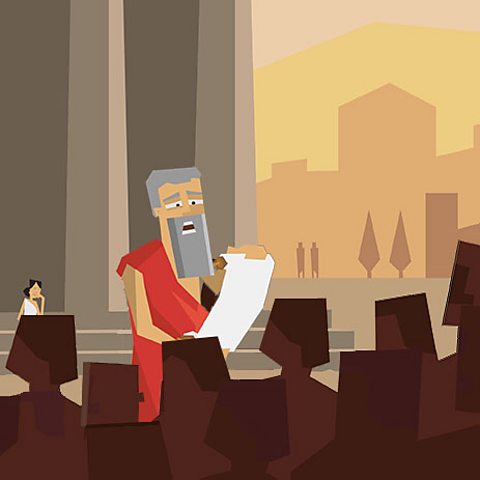
What was life in ancient Greece like?
Families in ancient Greece lived in a warm, dry climate where farming, fishing and trading were common ways of life.
Some people were also scholars,scientists and artists.
Homes were simple but varied depending on wealth.
People wore light clothes suited to the heat.
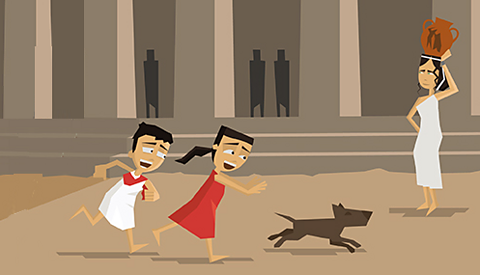
Children played with toys like dolls and rattles while meals were made from bread, olives, fruit and fish.
Ancient Greek families balanced work, learning and tradition in their daily lives.
Important words for the ancient Greeks
| Keyword | Definition |
|---|---|
| Household | A Greek home, including everyone who lived and worked under one roof. |
| Enslaved people | People who were forced to work for families and did many important jobs. |
| Trades | Jobs that require practical skills, such as farming or crafting. |
| Philosopher | A thinker who studies questions about life and knowledge. |
What roles did family members have in ancient Greece?
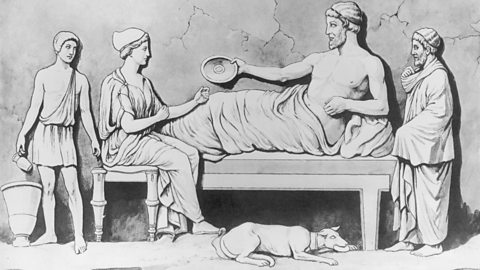
Fathers were the head of the family. They owned the land, made important decisions and represented the household in public.
Mothers looked after the home. They cooked, spun wool, wove cloth and cared for the children.
Boys from wealthier families were taught subjects such as reading, writing, maths, music and physical training, preparing them for later public or military life.
Girls stayed at home and learned skills like weaving, cooking and helping to manage the household.
Enslaved people did many jobs, such as cleaning, cooking, farming or looking after animals.
Grandparents sometimes lived with the family and helped raise the children.
What were Greek homes like?
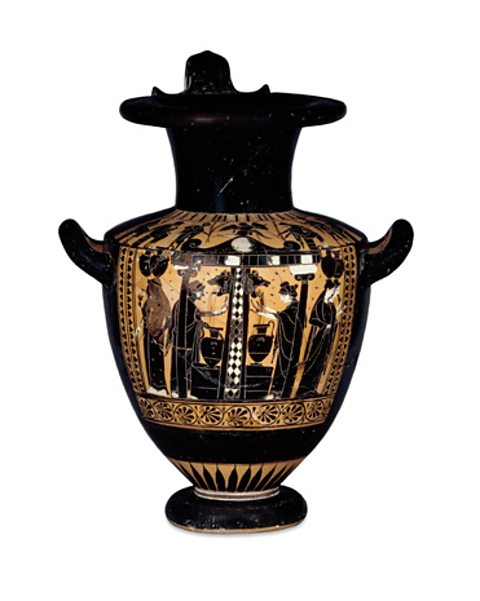
Ancient Greek homes were built around a courtyard or garden.
The walls were often made from wood and mud bricks.
They had small windows with wooden shutters to keep out the hot sun.
They didn't have much furniture inside.
Many homes didn’t have a bathroom. There were public baths.
Most people washed using a small bucket or in a nearby stream.
At night, Greeks slept on beds stuffed with wool, feathers or dry grass.
What was education like in ancient Greece?
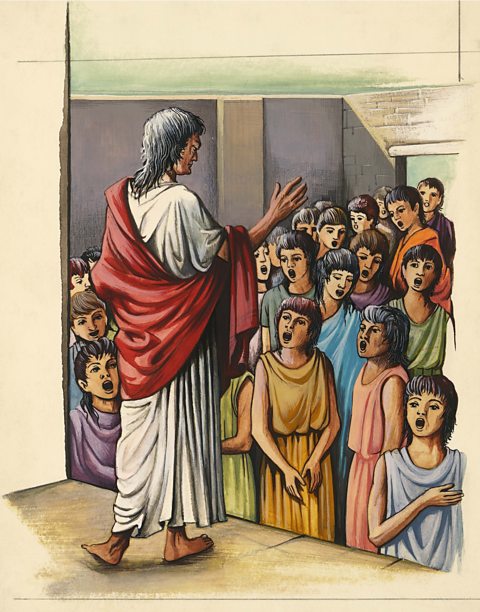
In Athens, boys went to school from about age 6 or 7 until 13 or 14. They studied reading, writing, maths, music and literature. Gymnastics and sports were also a key part of their training.
Girls’ education was different. Spartan girls trained in physical activities like boys so they would grow strong and healthy.
Athenian girls mostly learned domestic skills at home, while only a few received wider education.
In Sparta, boys followed a very different path: from age seven, they were trained for the military with intense physical and disciple-focused education.
What were Greek clothes like?
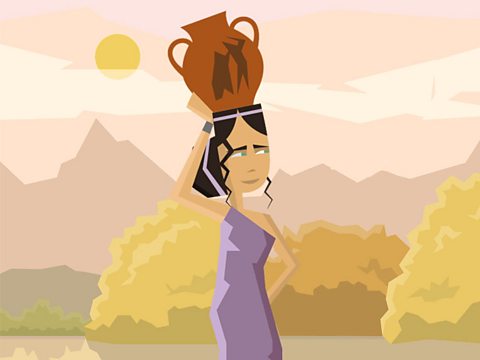
A Greek woman wore a long tunic called a chiton.
Over this, she wore a cloak draped from her shoulders, called a himation.
Young men wore short tunics, while older men preferred long ones.
Enslaved men often wore just a strip of cloth called a loincloth.
- Many people walked around barefoot.
- Some wore leather sandals or, for horse-riding, high boots.
- Many people wore wide-brimmed hats in hot weather, to shade their faces from the sun.
What toys did children play with?
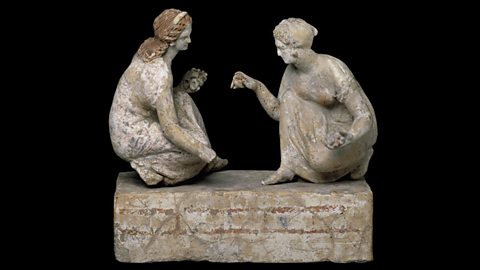
Children played with small pottery figures, and dolls made of rags, wood, wax or clay
Some of these dolls even had moveable arms and legs!
Other toys were rattles, hoops, yo-yos and hobby horses (a pretend horse made from a stick).
Children also played with balls made from tied-up rags or a blown-up pig's bladder.
What did the Greeks like to eat?
Take a look at some of the items the ancient Greeks might have eaten at each meal:
- Breakfast - fruit with bread dipped in wine
- Lunch - bread and cheese
- Dinner - porridge made from barley, with cheese, fish, vegetables, eggs and fruit
- Pudding - nuts, figs and cakes sweetened with honey
Everyone ate with their fingers, so food was cut up in the kitchen first.
Only wealthy people ate a lot of meat. They would eat hares, deer and wild boar killed by hunters.
Octopus and other seafood was often eaten by people in ancient Greece.
Men and women usually ate separately in ancient Greece. However, people sometimes ate together at festivals, feasts, and special gatherings.
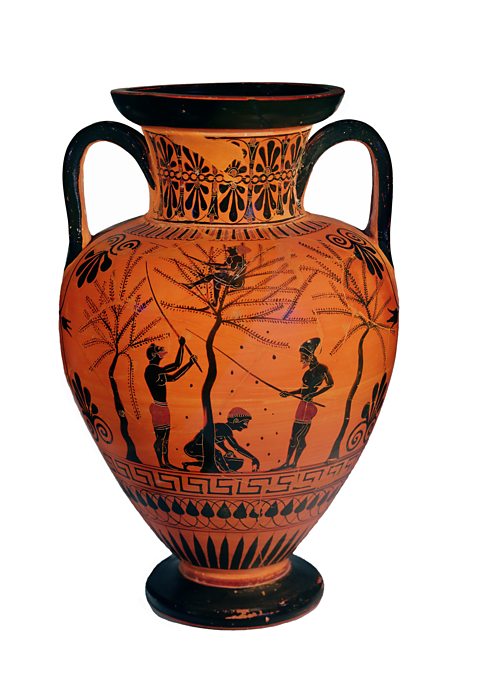
Men and women usually ate separately in ancient Greece.
Everyone ate with their fingers, so food was cut up in the kitchen first.
Only rich people ate a lot of meat. They would eat hares, deer and wild boar.
Octopus was a favourite seafood.
Think like a historian
Have a look at the thinking points below and think about your answer to each question. You could even write them down on a piece of paper or discuss them with somebody else if you want to.
- Why do you think boys from wealthy families and poorer boys had such different experiences of education?
- How might the education of Spartan boys have prepared them for the adult lives differently from Athenian boys?
- Why do you think fathers were given more power than mothers in ancient Greek households?
- How might the roles of boys and girls in the family have shaped their future as adults?
You may have thought about how wealthier boys could afford schools and tutors because their families had money, while poorer boys had to learn practical trades to support the household.
You may also have thought about how Spartan boys were trained mainly in military skills so they could become strong soldiers, while Athenian boys studied subjects like reading and music to prepare them for adult life.
Fathers were seen as the head of the household because ancient Greek was a patriarchal society. This means men had more power than women. They could own land, vote and make important decisions.
Boys were trained to work, farm or fight in the army, so as adults they had public jobs. Girls were taught to cook, clean and look after the home, so their adult lives were mostly about being wives and mothers.
Activities
Activity 1: Ancient Greek family
Click on the family below to find out a bit about their life
Activity 2: Quiz – Life in ancient Greece
Grown-ups corner
Are you a parent, carer or teacher?
Take a look at some of the links below on KS2 History which are packed full of knowledge, videos, quizzes and activities.
Ancient Greece: Everyday life in the city-states
Bitesize for Teachers
Ancient Greece: Structures, statues, poems and plays
Bitesize for Teachers
Horrible Histories: Raid and Trade game! game
Play Horrible Histories: Raid and Trade KS2 History
More on Ancient Greece
Find out more by working through a topic
- count4 of 8
- count5 of 8
- count6 of 8
- count7 of 8