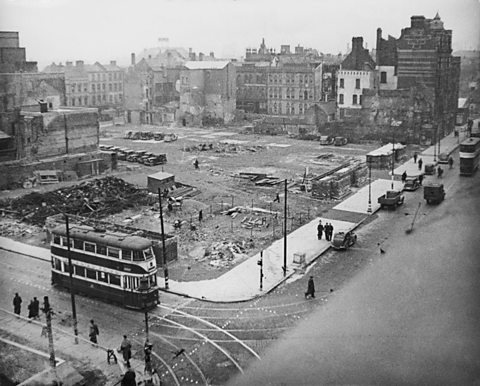
The bombing of British cities: Swansea, Belfast and Glasgow
Before the war, the government prepared civilians for air attacks. People were given gas masks but fortunately gas was not used in the Second Word War. The Anderson shelters that people were encouraged to build in their gardens were very necessary during bombing raids. In cities, people also found other places for safety – for example, Londoners sheltered in the Underground, while people in Cardiff used castle cellars.
The Luftwaffe carried out the aerial bombing attacks, known as the ‘Blitz’ between September 1940 and May 1941. During this period, over 43,500 civilians were killed across Britain.
Wartime propaganda and newspapers often highlighted the idea of the “Blitz spirit”. This presented people as brave, united and determined, even during heavy bombing.
London
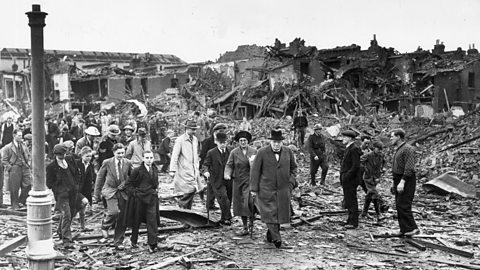
- London was one of the main targets and was bombed repeatedly from September 1940 into 1941.
- Almost 30,000 were killed in London during the Blitz, and many thousands lost their homes.
- Famous buildings, including St Paul’s Cathedral and Buckingham Palace, were damaged during raids.
Swansea
- Swansea was bombed over several nights in February 1941.
- The raids targeted the port, docks and nearby industries, which were important to the war effort.
- Over 200 people were killed or injured, and large areas of the town centre were destroyed.
Belfast
- Belfast experienced several major raids in spring 1941.
- Industrial targets such as shipyards were attacked, but housing areas were also badly hit.
- The Blitz killed almost 1,000 civilians, and many were left homeless after the bombings.
Glasgow
- Glasgow and the surrounding Clydeside area were important industrial targets because of shipbuilding and factories.
- Bombing raids caused significant damage to workplaces and homes.
- The were around 50,000 people living in the town of Clydebank, an industrial area of Clydeside, and 35,000 were made homeless as a result of the Blitz.
Coventry
- Coventry suffered a very destructive raid in November 1940.
- The city centre was badly damaged by high explosives and incendiary bombs.
- Over 500 people were killed and over 800 injured, and a large part of the city was left in ruins.
Other cities
Many other British cities, including Birmingham, Bristol, Cardiff, Liverpool and Manchester, were also bombed. These attacks aimed to disrupt industry and transport networks, as well as to lower morale across the country.