World Cup fever is sweeping the nations, with the 2026 competition well underway across the US, Canada and Mexico.
Everyone’s got their favourite World Cup memories, from incredible goals to jaw-dropping upsets, but one thing’s for sure – no World Cup is complete without an iconic anthem!
As such, here at BBC Bitesize, we made it our mission to find out what elements make for a World Cup banger. We spoke to pop singer and presenter Mark Rhodes – formerly of Sam and Mark fame – to discuss his new World Cup anthem, as well as music experts and UK students, to find out what they think makes for a classic tournament tune.
Watch: How to make a World Cup banger
Kimberley: Mark, you've got a new single out 'Sing It Everybody', what's going on? How did that happen? Tell me!
Mark: Essentially what it was, it was a charity single that I wanted to bring out because I work a lot with the Wolves Foundation, and I do a radio show that covers a lot of the charitable organisations and the football clubs in the West Midlands. So, I just thought, you know what? I've got a musical background. It's a charity single. I just thought, you know, football's in my blood. You know, a big Wolves fan, obviously a massive England fan as well for the World Cup. So yeah, I just thought, yeah why not, why not?
Kimberley: So talk to us a bit about the community aspect. Do you think that's what makes a good football track, something where everyone can get involved?
Mark: I think it's the most important thing, isn't it? You know, lyrics wise, um, they need to be easy to sing. They need… it needs to have a good beat to it. It needs to be easily sung on the terraces so everybody can get involved. The song needs to be individual, needs to be catchy , and it needs to resonate with normal people who watch and support football.
Kimberley: Yeah, absolutely. And do you think it's more lyrics that are important or melody or the general 'chantability' factor?
Mark: Chantability is a great word. I'm absolutely using chantability.
Kimberley: You can have that one for free.
Mark: I think. I think it's all those things, but I think lyrics wise, not as important. I think the melody, you need to be bouncing, you need – because obviously you're watching the game. You're, you're excited. Hopefully, if you're an England fan. And you want to be able to sing it without actually worrying about the lyrics and knowing what the actual lyrics mean. Vindaloo - what's that about? Who cares though, because it's an absolute classic.
Kimberley: Do you have any World Cup songs that you enjoy or England songs that you enjoy? What are your favourites of those?
Student: Um, Waka Waka by Shakira. Yeah, very good song.
Student: Three Lions.
Student: Three Lions. Um, because it's been sung for ages, hasn't it? So it's good.
Student: Wavin' Flag is my favourite World Cup song.
Kimberley: What about you? What's your favourite.
Student: Southgate You're The One.
Student: I don't mind It's Coming Home and Vindaloo.
Student: It gets stuck in your head. Good song.
Student: It's like everyone coming together and jumpy, and like for different nations, it like represents them.
Student: When songs include where the players from and where they're brought up.
Student: Um, I'd have to say Nessun Dorma, because I think it gets everyone riled up and it's quite emotional.
Student: I think it gets like everyone pumped up for the match and makes everyone in a good mood.
Jean: Going back to the history of football. People would have gone together to the football on a Saturday and sang together. Often hymns like Abide with Me or Jerusalem. And then on Sunday they would have gone to church together and sung those same hymns. The brilliant thing about Abide with Me is that it's very slow. It's at almost a walking pace, so that everybody in the crowd can latch on to the momentum of that particular song.
Mark: These football songs that you hear, um, on the terraces, it gets the normal fan off their seats. You know, you've got songs like Vindaloo, Three Lions, of course, like classics. My dream is one day to have 'Sing It Everybody' sung by everybody, which would be lovely.
How do you write a great World Cup song?
Be it lyrics, melody or overall 'chantability', there's any number of elements that go into crafting a perfect World Cup song, but which of these is most important?
Well, according to Mark Rhodes, it's a little bit of everything, but the most important thing is to keep it simple. Mark recently released 'Sing It Everybody', a World Cup charity single to benefit the charitable foundations of football clubs across the West Midlands. As such, he's pretty well placed to discuss the ingredients that go into cooking up a catchy World Cup track.
"Lyrics wise they need to be easy to sing," Mark told us, highlighting the importance of songs being easily accessible to supporters on the terrace, whilst also earmarking the need for a beat that allows supporters to bounce along to the song.
Mark felt the key to a good football song was to make it catchy and simple, a sentiment echoed to us by music industry veteran Dave Philpot – who has worked with the likes of Fatboy Slim and The Charlatans.
Dave told us that the best football songs, like many of the best pop songs, tend to be simple and easy to sing along to. This allows supporters to be united, creating a strong sense of connection amongst the crowd, something Dave believes is absolutely vital.
That sense of unity amongst supporters harkens back to the very beginning of football's relationship with music, with football historian Professor Jean Williams telling BBC Bitesize that the original chants on British terraces were actually hymns, including songs like Abide With Me and Jerusalem, which speaks to the larger goal of singing in football, which is to allow supporters to feel they are part of something bigger than themselves.
Writing a great national World Cup song
When discussing the difference between a national World Cup song – such as Three Lions '98 – and a global World Cup song – such as Waka Waka – Dave felt it was important that the song reflects the country's national identity. “You couldn’t have written Three Lions if you didn’t grow up wanting England to win something," he told us, feeling that the authentic, supporter-driven lyrics were a key component in that song's lasting legacy.
This belief was reiterated by Mark Lippmann, the CEO and Founder of a Manchester-based record label, who told us: "[Three Lions] is part of the national identity every time a major tournament comes around. The balance of hope with self deprecating humour feels incredibly English."
Finally, we asked Mark Rhodes what he would recommend for anyone out there interested in writing their own World Cup track. He prefers to write melody first, though was keen to say there was no right or wrong order, before breaking the song into little sections, using each to tell a distinct, personal story about your love of football.
What is the official 2026 World Cup song?
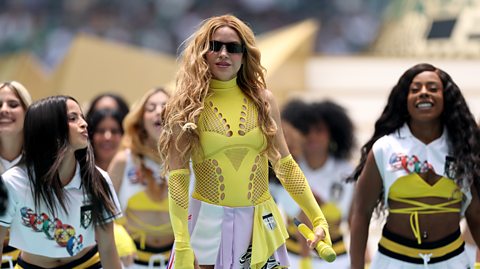
The official FIFA World Cup song for 2026 is 'Dai Dai' by Shakira and Burna Boy. Released on 15 May 2026, the song was performed at the tournament's opening ceremony and is set to be performed again at the World Cup final half-time show at MetLife stadium in East Rutherford, New Jersey.
As well as performing it, Shakira and Burna Boy are both credited writers on the song, alongside a host of other names including England's Ed Sheeran.
'Dai Dai' makes mention of a number of famous footballers that've made their marks on World Cups past, including Lionel Messi, Cristiano Ronaldo, Mohammed Salah and Diego Maradona.
Take our quiz: What was the official song of your first World Cup?
What are the most famous World Cup songs of all time?
Italia ‘90 marked the first time FIFA commissioned an official song for the World Cup. There’d been a number of tracks over the years that were associated with the tournament unofficially, but it was ‘Un'estate italiana (To Be Number One)’ that officially got the tradition underway.
We’re now onto our 10th official lead track, with a whole host of starry names having contributed tournament tunes over the last 36 years. Some of these songs have caught on more than others, most notably Shakira’s “Waka Waka (This Time for Africa)” which has become a favourite for fans ahead of the planet’s premier sporting event.
Artists like Pitbull, Jennifer Lopez and Will Smith have contributed songs for World Cups of the past, with Shakira returning to the mic once more for this year’s tournament.
Alongside the official FIFA anthems, countries often commission an official song of their own. The most notable of these, from a domestic point of view, is probably the Baddiel, Skinner & Lightning Seeds song ‘Three Lions’.
Originally commissioned by the FA for the Euros in 1996, a follow-up was released ahead of the 1998 World Cup titled ‘Three Lions ‘98’. The song, which laments the years of hurt endured by England fans since the last Men’s World Cup win in 1966, has become an enduring and iconic anthem for England supporters, often played in fan parks and stadiums ahead of England men’s and women’s games.
Far from the only success the FA has seen in their music commissioning, 1990’s New Order track ‘World in Motion’ remains one of the most popular and well-regarded tournament tracks ever produced.
Other official England tournament tracks have featured contributions from notable figures such as Ant & Dec, Gary Barlow and the Spice Girls.
What are the most famous unofficial football anthems?
Despite the best efforts of FIFA or football associations, a football anthem lives or dies by the reception it receives from football fans. Over the years, fans have taken a number of songs into their hearts, official or otherwise, stitching them into their memory of major tournament campaigns.
In that respect, 2026 has been no different, with fans of both qualifying home nations adopting unofficial anthems for their campaigns. From an England point of view, Wonderwall by Oasis seems to be the chosen track, sung in unison by players and supporters following England's opening match win against Croatia in Dallas.
For Scotland, it was the Baccara song 'Yes Sir, I Can Boogie', released in 1977. The song has followed Scotland over multiple tournaments, perhaps reaching peak iconic status as it was belted out by Scotland and Boston Red Sox supporters at Fenway Park. To read more about the amazing story of how an almost 50 year old track became the unofficial anthem of the Scottish men's national team, check out this article from BBC Sport.
No stranger to an unofficial anthem, Scotland have adopted a number of other unofficial World Cup tracks over the years. Most famously, perhaps, with 'Ally's Tartan Army' by Scottish comedian Andy Campbell, which was released to mark the Scottish national team's qualification for the 1978 World Cup.
Other songs like '500 Miles' by the Proclaimers have proven popular with the Tartan army at home and abroad, whilst 'Sweet Caroline' by Neil Diamond and 'Vindaloo' by Fat Les have become favourites for supporters of the England men's and women's national teams.
Where can I read more about music and the World Cup?
Looking for more content to keep you in the World Cup mood? BBC Sport's World Cup page is the perfect place to keep yourself up to date with all the latest news from the tournament, and you can watch World Cup action live or on-demand with BBC iPlayer.
From BBC Bitesize, you can check out this article explaining how players from multilingual nations communicate on the pitch, or have a go at our World Cup Fact or Fake quiz!
And if you want to learn more about music and songwriting, check out BBC Bitesize's music resources, as well as this article on writing your own original song.
This article was published in June 2026
World Cup 2026: How do multilingual nation players communicate on the pitch?
BBC Bitesize spoke to football journalist Valentin Schnorhk to find out how multilingual national footballers communicate.

Can you beat a World Cup presenter in our brainteaser challenge?
Watch BBC World Cup presenter and Match of The Day host Mark Chapman attempt to top the puzzle league - then have a go yourself

Beth Mead: “I won the Euros on my period”
BBC Bitesize's new three-part series 'Girls in PE: Breaking Down the Barriers' takes a look at why so many teenage girls continue to drop out of PE at school.