Hello Europe, this is Bitesize calling!
It’s now been seven decades since the first ever Eurovision Song Contest was held. Starting from humble beginnings with just a handful of countries competing, today the contest is famous worldwide and has seen generations of acts from across Europe and beyond take part.
From powerful ballads to dance anthems, memorable rock performances and quirky lyrics – Eurovision has seen it all. In more recent years, it’s fair to say the UK hasn’t had the most success in the contest – but we have taken home the trophy a few times in the past.
To celebrate 70 years of Eurovision, BBC Bitesize takes a look back at how the contest began, the previous UK winners and more famous faces through the years. You can also take our IYKYK quiz below to find out which song won the Eurovision Song Contest the year you were born!
What is Eurovision and why was it created?
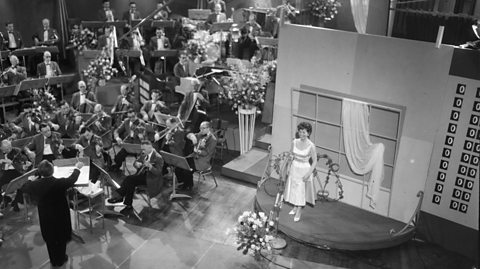
The Eurovision Song Contest is an annual international song competition which was first established in 1956. The world's longest-running annual international televised music competition, it sees participating nations from all over Europe - and a few from outside Europe - send a song and an act to perform in the contest
The winner is then decided by a combination of public and jury votes. The inaugural Eurovision took place in Switzerland on 24 May 1956, with only seven countries taking part - Belgium, France, Germany, Italy, Luxembourg, the Netherlands, and of course, Switzerland.
Each country performed two songs, and this is the only time in the contest’s history this has happened. The host country won the first Eurovision Song Contest with the song Refrain by Lys Assia.
The UK were too late in submitting entries and so joined the competition the following year. Held in Frankfurt in 1957, the UK’s first entry to Eurovision was Patricia Bredin with song All, who placed seventh.
The idea for the contest was put forward by Marcel Bezençon who worked for the European Broadcasting Union (EBU) - an organisation of TV companies in and around Europe. Inspired by Italian song contest the Sanremo Music Festival, the idea of Eurovision was to promote post-war harmony and cooperation across Europe, as well as test what could be done with early live TV technology.
Eurovision has since been held every year, aside from in 2020 when that year's contest was cancelled in response to the COVID-19 pandemic. A huge success, the contest has also birthed the Junior Eurovision Song Contest, first held in 2003, and it inspired the 2020 Netflix film, Eurovision Song Contest: The Story of Fire Saga, starring Will Ferrell and Rachel McAdams.
How many times has the UK won Eurovision?
In more recent years, the UK hasn’t had the best record when it comes to the Eurovision Song Contest. But we have claimed the title five times in total.
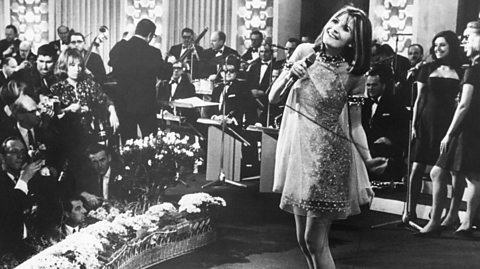
The first ever UK winner of Eurovision was barefoot icon Sandie Shaw who scored 47 points in Vienna with now famous song Puppet on a String. By 1969, artist Lulu secured the UK’s second win in Spain with song Boom Bang-a-Bang.
However, Lulu was part of a four-way tie for winner that year alongside the Netherlands, France, and Spain. After all four countries scored 18 points, the voting and judging system was updated to avoid it happening again.
In 1976, band Brotherhood of Man won the competition for the UK in The Hague, Netherlands. Their popular hit, Save Your Kisses For Me, also became the UK’s biggest-selling single that year.
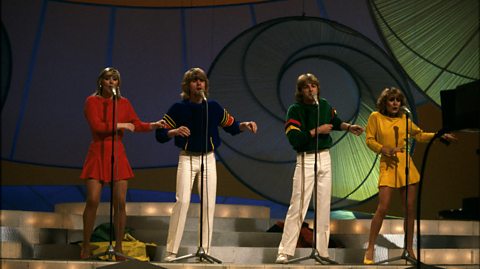
Perhaps one of the most memorable and catchy songs in Eurovision history came from the UK’s fourth winner, Bucks Fizz. In 1981, the pop quartet won the contest with the much‑loved song Making Your Mind Up.
The UK's most recent Eurovision Song Contest winner was Katrina and the Waves in 1997, with song Love Shine a Light. But the UK has also hosted the Eurovision Song Contest on numerous occasions.
London hosted the contest in 1960, 1963, 1968 and 1997. Other UK Eurovision hosts include Edinburgh in 1972, Brighton in 1974, Harrogate in 1982 and Birmingham in 1998.
The last time the UK hosted Eurovision was in Liverpool in 2023, after winners Kalush Orchestra from Ukraine could not hold the competition due to the country’s invasion by Russia. The UK had placed second the previous year with Sam Ryder's song Space Man.
Who are the most famous Eurovision contestants?
Through the generations, there have been so many famous contestants to take to the Eurovision Song Contest stage. The contest skyrocketed several artists to fame, whereas others were already successful in the music industry when they decided to take part.
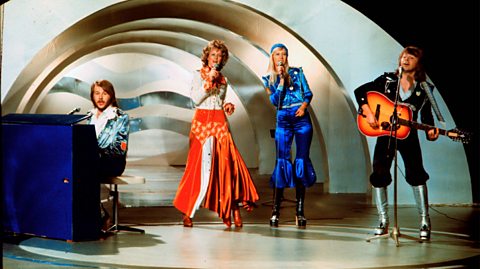
The most famous Eurovision winners of all time include ABBA from Sweden who won in 1974 with hit Waterloo. That same year, years before she played the iconic role of Sandy in musical Grease, Olivia Newton-John also represented the UK in Eurovision with entry Long Live Love.
In 1988, Celine Dion gained international recognition when she represented Switzerland with the song Ne partez pas sans moi. And in more recent years, we’ve seen Italian band Maneskin, who won Eurovision in 2021, achieve global stardom.
Through the years, several established artists have also taken part. This includes Cliff Richard in 1968, Michael Ball in 1992 and Bonnie Tyler in 2013.
Some celebrities have also come close to representing the UK – like Coronation Street star Kym Marsh.
What song won Eurovision the year you were born?
What can Eurovision teach us?
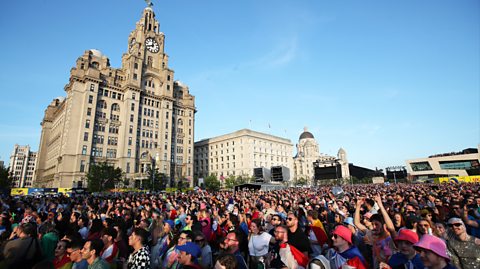
To many, Eurovision is more than just a music competition. Every year, it sees fans from across Europe and beyond travel to visit new countries and embrace new cultures because of their love of the historic contest.
And there is a lot that Eurovision can teach us. When it comes to the music and performers every year, the contest celebrates different languages, cultural traditions and musical genres. It also promotes diversity, inclusivity and togetherness, becoming a safe space for so many communities, including the LGBTQ+ community.
The Eurovision Song Contest alumni are authentically themselves and stand out for their confidence and creativity on stage. Every year, millions tune in to support their own act and to enjoy the success of artists and songs internationally.
Who won Eurovision 2025?
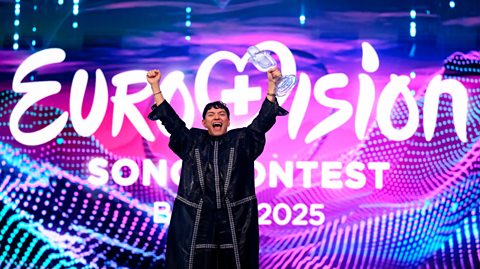
In 2025, Austria won the Eurovision Song Contest which was held in Basel, Switzerland. It was singer JJ’s operatic ballad, Wasted Love, that took the top spot scoring 436 points in total.
The win marked the third time Austria has won the competition. It was Israel that came in second place, followed by Estonia in third.
The UK entrant for 2025 was girl group Remember Monday, who performed song What the Hell Just Happened?. Out of a possible 26, they placed 19th.
When is Eurovision 2026 and where can I watch it?
The 70th Eurovision Song Contest will be held in Vienna, Austria in 2026. It follows JJ’s victory at the Grand Final in 2025 in Basel, Switzerland.
The 2026 Grand Final of the Eurovision Song Contest will take place in Wiener Stadthalle, Vienna, on Saturday 16 May. The Semi-Finals will take place on Tuesday 12 and Thursday 14 May.
The Grand Final and the Semi Finals will be broadcast live on BBC One and iPlayer, plus via BBC Radio 2 and BBC Sounds. Graham Norton will also return to provide the BBC One TV commentary for the Grand Final.
Who is representing the UK in Eurovision 2026?
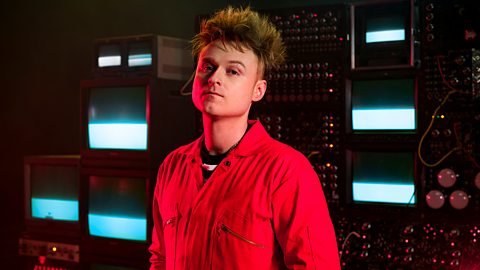 Image source, BBC/Michael Leckie
In May 2026, LOOK MUM NO COMPUTER will be representing the United Kingdom at the 70th Eurovision Song Contest in Vienna, Austria. The experimental musician and popular content creator will perform his “completely wacky” song titled ‘Eins, Zwei, Drei’ which means ‘one, two, three’ in German.
LOOK MUM NO COMPUTER burst onto the scene as Sam Battle, the frontman of the indie rock band ZIBRA, in 2014. After the band performed at Glastonbury in 2015 for BBC Introducing, he launched his solo career and has since become known for his electronic and synth sounds.
In 2016, he also launched his YouTube channel. It has since amassed over 85 million views and 1.4 million combined subscribers and followers across various social accounts.
Celebrate 70 years of Eurovision with BBC History. Let's delve into the past to share brilliant moments from the famous song contest through time.
This article was written in March 2026
Image source, BBC/Michael Leckie