Environmental sustainability
Maximising the impact of our content, whilst minimising the impact on our planet

Nature Positive
Managing our impact on nature to do more good than harm to our planet
Nature Positive is focused on guiding the BBC toward doing more good than harm to our planet. The BBC is dependent on nature as the subject of our landmark natural history content, the location for productions and for the materials and services required for operations. Nature Positive also supports compliance with environmental protection law. We are assessing where the BBC may negatively impact nature and will explore how to avoid or reduce impacts, as well as supporting restoration. During 2025/26, we approved our Nature Positive delivery plan and completed an assessment using the Taskforce on Nature-related Financial Disclosures (TNFD) framework.
Net Zero
Adopting a decarbonisation first approach that is underpinned by the science
The BBC’s Net Zero Transition Plan sets out how we will continue to produce world class content to the highest sustainable production standards. We have science-based targets to reduce our greenhouse gas emissions, with a clear ambition to be Net Zero by 2050. Decarbonising our value chain continues to be our key focus and we are working to ensure the correct initiatives are in place to achieve our near-term targets. During 2025/26, we launched our Strengthened Approach to Sustainable Production for TV, achieved an A rating for CDP’s Supplier Engagement Assessment and completed foundational data improvements to unlock our long-term progress.
People Positive
Informing and educating audiences on the most pressing issues facing our planet
Building a culture of sustainability is the foundation of People Positive. We aim to understand how audiences engage with sustainability and to empower staff, suppliers and partners to deliver our sustainability strategy. During 2025/26, we expanded our portfolio of staff training with a new course for teams working in Sport. We hosted our annual Climate Creatives and Supplier Symposium events, as well as a new COP30 Business Leader event designed to engage businesses with COP without needing to travel to Belém. We also developed tools to track where sustainability themes are embedded in BBC content, as we aim to amplify the impact of our priority activities across the BBC.
Note: Operational and value chain emissions have been restated for 2019/20 and 2024/25.
- 55% reduction in total waste generated in UK operations (2024/25: 47%, Target 50% by 2030/31)
- 38% reduction in Scope 1 and 2 (market-based) emissions against our 2019/20 base year (2024/25: 31%, Target 46% by 2030/31)
- 12% reduction in total Scope 3 emissions against our 2019/20 base year (2024/25: 7%, Target 28% by 2030/31)
- No. 1 - BBC is the first-choice media brand for content about environmental topics and issues
BBC’s climate-related disclosure
On this page and the Sustainability data pack, we provide disclosure in line with the Companies (Strategic Report) (Climate-related Financial Disclosure) Regulations 2022. The information forms part of our Non-Financial and Sustainability Information Statement required under the Companies Act 2006 and is applicable to the BBC Group.
We note the evolution of best practice, with the publication of the UK Sustainability Reporting Standards (UK SRS) in 2026, and will consider voluntary alignment, now the Task Force on Climate-related Financial Disclosures (TCFD) has been disbanded and market practice is set to evolve.
Responsibility for climate-related risks and opportunities
Impacts from climate change and the transition to a lower carbon economy have the potential to create both risks and opportunities for the BBC. The BBC’s world-renowned environmental content is a long-standing strength but there are climate-related risks for us to monitor and mitigate.
Environmental sustainability has been a critical project for the BBC, within a transformation portfolio designed to deliver our Value for All strategy. During 2025/26, we have designed the appropriate operational model to embed sustainability as a business as usual function led by Group Sustainability. The approach reflects the maturity of our sustainability strategy, with the focus now on the long-term delivery of our Nature Positive, Net Zero and People Positive pillars. The Group Chief Financial Officer is the sponsor, with accountability as a member of the Executive Committee and the Board. The Director of Sustainability is responsible for managing delivery. See our full governance structure.
To monitor activity across the BBC Group we have a Sustainability Steering Group, which includes senior leaders from across the BBC, to shape climate strategy and consider related risks and opportunities. The Steering Group is supported by a Sustainability Programme Board, who meet monthly to share best practice, identify risks and coordinate activities across the BBC. All activities are supported by dedicated expertise and tools, including carbon accounting platform and abatement model, which track progress against our targets.
Climate-related risks and opportunities of strategic importance are brought to the Executive Committee for approval and to the Board for oversight. A milestone for 2025/26 was the approval of our Nature Positive and People Positive delivery plans by our Executive Committee, following the publication of our Net Zero Transition Plan in 2024/25. The Audit and Risk Committee continued to receive quarterly performance updates, with the frequency of review proportionate to the management of other priority risks for the BBC.
Identifying, assessing and managing climate-related risks and opportunities
To ensure a resilient BBC for the future we need to understand the potential impacts of climate change across the entire BBC Group. Each part of the BBC is responsible for understanding and managing climate-related risks and opportunities on an ongoing basis. Identified risks or opportunities are reported monthly through our governance structure.
Integration with risk management
Environmental sustainability and climate change is considered one of the BBC’s priority risks and is integrated with our risk management process. The approach recognises that action is required now to anticipate and mitigate the most significant risks from climate change. See Our principal risks for the BBC’s risk management approach.
Climate scenario analysis
Group Finance perform annual climate scenario analysis to explore our resilience to common physical and transition risks and to understand potential opportunities, which we consider over the short, medium and long-term. Time horizons follow our science-based targets to ensure alignment with our plan to deliver the BBC’s Net Zero strategy. The analysis assesses the potential financial impact of identified risks and opportunities as either high, medium or low significance, which is informed by Group risk and opportunity thresholds.
The BBC uses both a Net Zero and Current Policies scenario. The Net Zero scenario aligns with our science-based targets and UK policy, with Current Policies chosen to reflect the direction of travel from currently implemented global policies. Data sources include the Network for Greening the Financial System, the International Energy Agency, and Representative Concentration Pathways, as the basis of the Intergovernmental Panel on Climate Change’s analysis. Outputs are reviewed by our Director of Sustainability to inform our annual disclosure.
| Selected climate scenarios | Global temperature trajectory to 2100 |
|---|---|
Net Zero | 1.5°C |
Current Policies | 3.5–4.5°C |
Assumptions and limitations
Scenario analysis is a simplification of the real world and we recognise its limitations. We have taken external advice and believe our approach to be consistent with common practice. Each year, the aim is to refine the analysis and our latest assessment includes updated data sources, new consideration of extreme heat risk and potential impacts to licence fee income from our climate-related reputation. In future, we may introduce new scenarios, or model newly identified risks and opportunities. We may also change our approach in response to new information or available tools. We do not place sole reliance on the conclusions for decision making.
Resilience to climate-related risks
Delivering our mission means using all tools available to inform, educate and entertain. We must travel, purchase goods and services, and use technology, all of which has an impact on the environment. We have assessed a number of climate-related risks with the table below summarising our risk classification and strategic responses.
Financial impact of climate change
Our view is that climate change does not threaten the BBC’s three-year financial plan. See Group Viability Statement. We are managing identified risks and opportunities by continuing to invest in sustainability expertise and technology across the BBC, whilst managing activities proportionally to other priority risks.
During 2025/26, we have focused on decarbonising our value chain, which involves engagement activities with our supply chain and industry partners. Operating costs for sustainability are included in our three-year plan. No unexpected, or adverse, material costs linked to climate-related risks are recorded for the financial year.
Transition climate-related risks
The BBC has a reputation for world-renowned environmental content and audiences, staff, and partners are likely to expect the same care and commitment in quality to how we manage our operational impacts. We may also face new costs from changes to policy.
The latest risk assessment considers the reputational risk of greenwashing and introduces analysis of potential licence fee income loss. The 2025/26 model considers behaviour change, potentially driven by changes to public perception over time. We have upgraded our risk from greenwashing from low to medium under a current policies scenario to reflect the additional potential impact from the expanded model scope.
The scope of the risk associated with staff and talent attraction and retention is unchanged but has been downgraded under a current policies scenario from high to medium, following a refresh of secondary data sources supporting modelling assumptions.
As the use of AI expands at the BBC, we are committed to understanding its impact in the context of our sustainability strategy. Many aspects remain uncertain, but BBC teams are working closely to consider the impact of AI adoption. We continue to engage with suppliers to improve our data quality and have produced guidance for our staff on the impacts of AI with suggestions for responsible use.
Across identified transition risks, strategic responses are in place to protect the BBC, providing we continue to deliver our operational Net Zero strategy, maintain our editorial standards and sustainability-related reputation with licence fee payers.
Physical climate-related risk
The BBC does not operate in a carbon intensive sector and, although we rely on physical assets and locations, we do not face the same direct exposure to physical risks as other sectors.
Over time, however, the severity and frequency of physical risk events is expected to increase and we continue to model potential disruption due to flooding in the UK and overseas sites. We have upgraded the risk from low to medium under a Net Zero scenario due to an increase in total assets in scope for modelling. Disruption could be significant in the long-term but we believe the risk is mitigated by insurance for BBC assets and business continuity planning.
For 2025/26 we have considered the impacts of extreme heat for independent and BBC productions for the first time. The analysis found no clear risk to the UK production assessed. International exposure varies and adaptation can already be necessary. The analysis did not highlight sharp changes to risk levels for the two locations assessed, which were selected based on existing exposure levels. Further analysis is necessary to consider the total potential risk.
BBC analysis to date has not identified a clear short-term additional adaptation need. We continue to consider our exposure, and have mitigation strategies for identified risks.
We are increasingly considering our nature-related impacts and dependencies and have completed initial analyses focused on independent productions and licensing activities in our commercial business.
Climate scenario analysis: Summary of assessed climate-related financial risks
| Significant risk or opportunity | Time horizon | Description | Potential financial impact if no action is taken to mitigate risk | Impact at 2030 (Current policies, 3.5–4.5°C) | Impact at 2030 (Net Zero, 1.5°C) | Strategic response to mitigate risk |
|---|---|---|---|---|---|---|
Increased costs from carbon pricing, offsets and taxation | Long-term (2040 to 2050) | UK and international Net Zero commitments may result in the acceleration and implementation of carbon pricing mechanisms, including emission caps, offsetting requirements and taxes. | Increased direct costs associated with the BBC’s carbon footprint and indirect costs through BBC suppliers passing on carbon costs. | Medium risk | Medium risk | Continued focus on decarbonising the BBC in line with our strategy to minimise potential future costs. Exploration of projects to accelerate decarbonisation activities, such as carbon budgeting and pricing. |
Reduced staff and talent attraction and retention | Long-term | The BBC’s decarbonisation strategy and reputation on climate-related matters may affect attraction and retention of BBC employees. | Increased staff costs to incentivise and retain employees and additional costs related to hiring due to higher attrition rates. | Medium risk | High risk | Ensure the BBC’s Net Zero strategy is progressed, and public targets are achieved in line with our Transition Plan. Training and development of staff in addition to ongoing engagement to communicate our strategy. |
Reputational risk from greenwashing | Long-term | Public perception of mismatch between content messaging and poor performance against targets, or public action misaligned with BBC’s Net Zero strategy. | Loss of income from reputational damage resulting lower licence fee income, reduced partnership opportunities as customers shift to competitors and potential cost from climate litigation. | Medium risk | Medium risk | Ensure the BBC’s Net Zero strategy is progressed, and public targets are achieved in line with our Transition Plan. Targeted engagement and support for productions and supply chain partners. |
Flood risk causing damage and service disruption | Long-term | Increased precipitation and event intensity may increase the risk of flooding, increasing the risk of damage to assets, infrastructure and disruption to services. | Increased costs from repairs and maintenance, increased insurance premiums, as well as service disruption leading to a loss of income. | Medium risk | Medium risk | Insurance cover for BBC assets and contingency plans in place to minimise disruption. Annual risk assessments to model potential damages. |
- Time horizon: Short (2026-2029) Medium (2030-2039) Long (2040-2050)
- Impact at 2030: Estimated risk without strategic response
Case study: Death in Paradise
Death in Paradise is set on the lush fictional island of Saint Marie and is filmed in Guadeloupe, a Caribbean archipelago that has served as the production base for all 15 series. The islands are home to thousands of people and abundant flora and fauna.
The BBC carried out analysis to understand potential nature-related risks and opportunities, in line with TNFD. The goal was to understand if by commissioning Death in Paradise there is risk of creating unintended nature-related harms, to help develop a model for Nature Positive action.
Production activity depends on factors such as access to clean water and must consider waste management and the potential for air and noise pollution. The visual amenity of the islands is also a key dependency for Death in Paradise.
Nature and climate are deeply interconnected. Climate change will also result in impacts from extreme heat, which, in the context of production, could lead productivity loss and increased adaptation cost. Guadeloupe may experience additional periods of drought by 2050, which has the potential to disrupt life on the island.
The analysis will inform the BBC’s long-term Nature Positive approach, as we continue to assess the BBC’s potential impacts, and explore opportunities aligned to developing best practice.

Opportunities from climate action
The BBC’s Net Zero strategy aims to support a resilient BBC for the future. Opportunities are modelled alongside risks, with assumptions refreshed annually. The table below summarises identified opportunities for the BBC from the climate transition.
Savings from energy efficiency
The BBC’s Net Zero Transition Plan focuses on phasing out fossil fuels, which can lead to opportunities from energy efficiency. Teams continue to explore further actions to reduce energy consumption and to realise related savings. The BBC must use energy, so the opportunity is limited to eliminating excess and our ability to optimise. New technologies may also be more energy intensive. During 2025/26 we revisited power down and self-generation opportunities, as well as refreshing our carbon abatement models to include estimated financial savings.
Award winning events
Radio 1’s Big Weekend 2025 in Liverpool marked a step change in the BBC’s commitment to delivering lower-impact live events. Liverpool is the world’s first Accelerator City for climate action, as part of a UN programme. The BBC, working with partners and suppliers, produced the event to reduce emissions, minimise waste, and engage audiences in sustainable choices.
Key successes include a 25% increase in low carbon food options selected, and a redesigned waste management approach, which supported a 40% reduction in waste from 2024. Our efforts set a new benchmark for sustainable delivery and earned the event the UK festivals Green Award 2025.
Bringing industry together
The BBC hosts events including Climate Creatives, Green Sport Awards and Supplier Symposium. Sustainability focused events help bring people together and invite collaboration on industry-wide challenges.
Climate scenario analysis: Summary of assessed climate-related financial opportunities
| Significant risk or opportunity | Time horizon | Description | Potential financial impact if action taken to realise opportunity | Impact at 2030 (Current policies, 3.5–4.5°C) | Impact at 2030 (Net Zero, 1.5°C) | Strategic response to realise opportunity |
|---|---|---|---|---|---|---|
Savings from energy efficiency | Short-term (2026 to 2029) | Roll out of energy efficiency improvements to BBC buildings, operations, and from sustainability focused behaviour change. | Reduced direct costs from energy consumption across BBC’s entire estate. | Low opportunity Estimated additional opportunity with strategic response: | Low opportunity | Continued implementation of energy efficiency and estate optimisation programme. Business case development for energy efficiency measures including power downs and self-generation capacity. |
Engaging audiences and producing factual content | Long-term (2040 to 2050) | BBC can be a leader in the production of factual content by continuing to engage, inform and entertain audiences. | BBC’s factual content appeals to wider audiences and new markets, enabling new partnership and funding opportunities for content. | Low opportunity | Low opportunity | Ensure the BBC’s sustainability strategy is progressed, and public targets are achieved in line with our Net Zero Transition Plan. |
Reputation of climate leadership | Long-term (2040 to 2050) | BBC can take a leadership position in the media industry through the delivery of our Net Zero strategy. | Increased or retained income driven by reputational benefits, as well as increased partnership opportunities. | Low opportunity | Low opportunity | Ensure the BBC’s sustainability strategy is progressed, and maintain high editorial standards for climate-related content. |
- Time horizon: Short (2026 to 2029), Medium (2030 to 2039), Long (2040 to 2050)
Case study: High impact drama, Low impact production
The War Between the Land and the Sea follows an ordinary man, Barclay, as an ancient species rises from the sea, threatening humanity. The story foregrounds environmental themes including pollution, overconsumption and habitat destruction, as tensions escalate with Homo Aqua.
Sustainability was in action off-screen as well, with the production team focused on four key areas including travel, energy, food and waste. To eliminate fossil fuel consumption for power generation, the production made use of LED lighting rigs, renewable mains power and hybrid generators – as well as placing greater focus on train travel, lower-impact catering choices and the reuse of sets.
The show exemplifies how sustainability can come together both on-screen and off-screen and, in April 2026, won the first ever Sustainable Production RTS Cymru Award.

Delivering our Net Zero targets
To deliver the BBC’s Net Zero Transition Plan we have targets to reduce our greenhouse gas emissions, which are consistent with climate science, UK legislation and were approved by the Science-based Targets initiative. Consistent progress against our targets will meet stakeholder expectations and support a resilient BBC for the future.
Operational emissions have reduced by 38% against a 2019/20 base year, and we are on track to deliver a 46% reduction by 2030/31 (Scope 1 and 2 market-based). Emissions from value chain activities have reduced by 12% against a 2019/20 base year, as we aim to achieve a 28% reduction by 2030/31 (Scope 3). By 2050/51, we aim to reduce operational and value chain emissions by at least 90% against a 2019/20 base year.
Improving data quality
During 2025/26, we have improved data quality by introducing genre-level emissions benchmarks for independent production. We have also reclassified and recalculated emissions associated with the transmission of BBC World Service content, as a correction to reflect operational control. For both changes, our 2019/20 base year and 2024/25 prior period are restated in line with our recalculation policy.
Operational decarbonisation
Following restatement, transmission for BBC World Service content, and a power generation facility, now account for 37% of operational emissions (Scope 1 and 2), previously classified within the BBC’s value chain (Scope 3). The remainder of the BBC’s operational footprint is focused on BBC operated buildings and vehicles. Target performance remains on track, with ongoing initiatives supporting decarbonisation.
Progress across our value chain
Emissions from value chain activities can be more challenging to reduce. We have focused on improving data quality associated with independent productions – the largest source of emissions for the BBC. By updating our methodology, we can reflect estimated emissions reduction of 25% due to fewer productions between 2019/20 and 2024/25, with a further 24% reduction from policy change to phase out diesel use on production from 2025/26.
Growing revenues from BBC Commercial’s consumer products business drove a 162% increase in estimated emissions from licensees relative to our 2019/20 base year. As with independent production, we are working to improve data quality and move away from a revenue-based estimate to better reflect real-world activity.
Emissions from business travel continue to reduce, with a 45% reduction compared to 2019/20. Financial savings measures are expected to further reduce non-essential travel volumes, with staff to avoid travel where virtual options are sufficient.
Forward looking summary
Restated performance shows clear progress toward the BBC’s 2030/31 targets. Further progress is unlikely to be linear, with initiatives taking time to reach full maturity and to be visible in our reported data.
Tracking sustainable production
For non-News TV production, we continued to mandate the submission of a carbon footprint and carbon action plan via BAFTA Albert during 2025/26. 744 productions are expected to complete a carbon action plan for 2025/26 (2024/25: 701), with 100% mandatory carbon footprint calculation also expected (2024/25: 97%).
We also set standards across our audio production through EcoAudio certification. 98% of in scope teams in 2025/26 achieved certification across their output. Our goal is to raise the standard for sustainable production, as we put principles in place to maximise the impact of our content, whilst minimising the impact on our planet.
Case study: Sustainable production
In 2025, we launched our Strengthened Approach to Sustainable Production for TV. It focuses on reducing emissions from energy and travel, and we now require suppliers to have company-level sustainability policies. We will also continue to provide one-to-one decarbonisation support for selected productions in 2026/27.
A key change is the phase out of diesel generators on all UK based shoots, applicable from September 2025. Lower carbon alternatives include mains electricity supply, battery systems and certified alternative fuels. This complements BAFTA Albert’s SPARK: Clean Temporary Power plan, a pan-industry roadmap for transitioning to clean temporary power. Together, the measures are expected to drive significant decarbonisation by 2030, directly supporting our Net Zero strategy.
The BBC is on track to deliver our operational emissions target and we have succeeded in reducing total value chain emissions
The BBC's Science-based Targets and performance relative to baseline
Emissions from BBC operations
Scope 1 and 2 (market-based) (Units in tonnes CO2e)
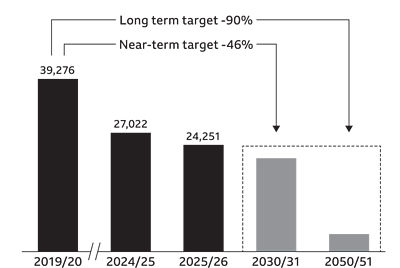
2019/20 and 2024/25 as restated. See Sustainability data pack for complete emissions disclosure, energy consumption and waste data.
Value chain emissions from BBC activities
Scope 3 (Units in tonnes CO2e)
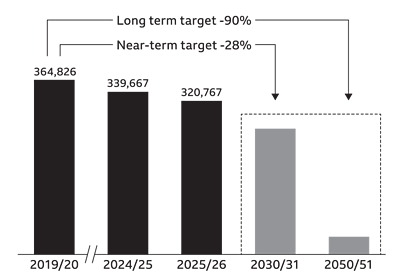
- For mandatory Albert footprint calculations this is 75% completed plus 25% expected
- For mandatory Albert carbon action plans this is 544 completed plus 200 expected
- Updated for 2024/25 based on total confirmed Albert footprints and carbon action plans