The War Between the Land and the Sea - Creating a new Doctor Who spinoff
We spoke to writer Pete McTighe
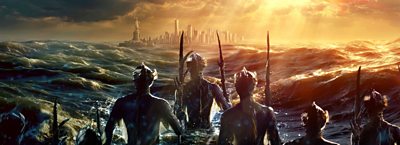

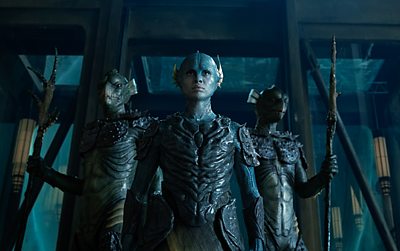
The War Between the Land and the Seashowcases how the world reacts when a fearsome and ancient species emerges from the ocean, dramatically revealing themselves to humanity and triggering an international crisis.
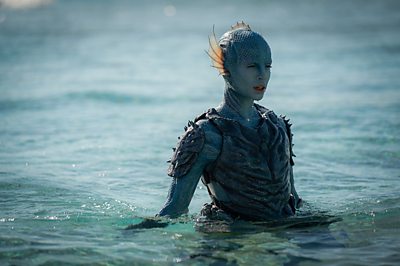
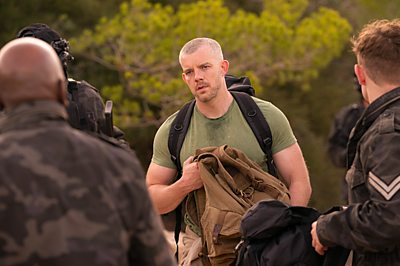
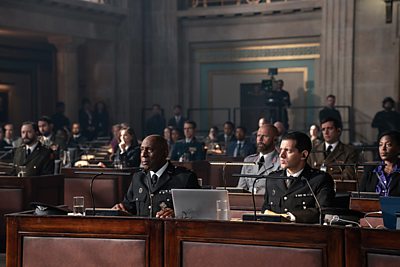
Barclay (Russell Tovey) is a low-level UNIT staff member whose ordinary life becomes a world of terror when an ancient species rises from the sea. He becomes humanity’s ambassador when the mysterious Salt (Gugu Mbatha-Raw) emerges from the Tank at a summit on the Thames.
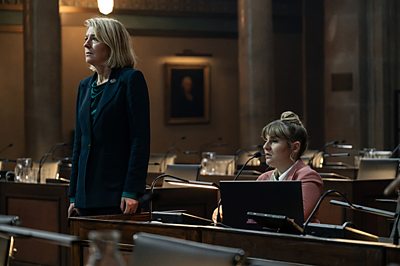
And UNIT, led by Kate Lethbridge-Stewart (Jemma Redgrave), fights for control as humanity faces destruction.
We spoke to Writer and Executive Producer Pete McTighe about his new drama, set in the Whoniverse.
Could you introduce The War Between The Land And The Sea?
The War Between the Land and the Sea is a five part epic cinematic spin off from the world of Doctor Who. You don't need to know anything about Doctor Who to come into it. It's a brand new show, but it's a drama that explores what would happen if an ancient civilisation that lived beneath the sea woke up and suddenly wanted their planet back. And there's a central character called Barclay, played by Russell Tovey (who's amazing), who is very much at the heart of this huge worldwide conflict that then erupts when this happens, supported by units who are a military task force established in Doctor Who, who carry on to the show. And it's up to them to help save the world. So yes, it's epic and it's a roller coaster. And yes, I love it!
What was your favourite part about writing the series?
To be honest, it felt really easy to write. I think because Russell T Davies had written such an extraordinary episode one and we worked so well together. It was just fun, you know, we had a lot of laughs. We broadly plotted out where the other episodes would go, and then I'd just kind of go away and write them. So it was a relatively simple, straightforward process.
My favourite part of the show was actually the kind of reward that you get for writing. That's the afterwards pre-production period where you're working with an incredible team, with Russell and with everyone at Bad Wolf and an amazing director, and you're having three hour meetings about what the sea levels look like now and designing props and costumes and what's the music going to be and the look of the show, all of that kind of stuff. Being involved in every facet of the production I love and find really interesting. I'm always on set and I'm just very involved in every aspect of shows that I make, and that's what I enjoy about it. It is kind of my reward for writing, but I also think when you're a writer of something, if you can shepherd it through production as well, I think you do end up with a with a better product at the end of the day.
How did writing the series as a co-writer with Russell T Davies work?
Russell and I have known each other for ages, so it's always a joy working with him. He had written episode one before he wrote any of the 60th anniversary Doctor Who specials. So, quite a long time ago he'd written it and it kind of sat on the shelf. And then when I had delivered my first draft of my Doctor Who episode, Lucky Day, he said, there's something else that I'd like you to have a look at. Do you know, do you want to be involved? And I read this script and thought it was extraordinary. And of course I was involved. Absolutely. From reading page three or four, I was in!
We were filming Doctor Who at the time, so we didn't have a lot of time to plot stuff. Russell had broad ideas about where he wanted the show to go. So for every episode, we would just sit down and snatch time here and there, an hour here, an hour there, and talk about what we think might happen. And then I'd go away and write, and then we'd come back together and, you know, move certain things around. So, for instance, some characters that I established in episode two, we would then go back into episode one and seed them there, so they're established in there. I knew that he would be writing the finale, so I had to write episode four, leading towards certain plot points and knowing what was coming. But it was just a really lovely, close working relationship, and we just laughed a lot. It was never a drama. And yeah, it was great fun writing.
Is it challenging writing for Doctor Who due to its extensive legacy?
Doctor Who is really hard. I think it's massively easier if it's in your bones like it is in mine. And it has been from from when I was around four years old.
I think, you know, there are a lot of eyes on this show. There's a lot of pressure that goes with it. It's got this extraordinary 60-plus year legacy and a really vocal fan base. And so you have to kind of be across all of those things. And, you know, luckily, I am across all those things just coming from the fan perspective. You have to know all that stuff and not just the show, all the peripheral stuff as well. There's the world of Doctor Who. There are so many magazines and comics and audio adventures and all sorts of things. You have to know all that stuff and be across all that stuff to be able to kind of forget it and then be free with your writing.
I think the great thing about Doctor Who is that it can always be reinvented. You know, with every new Doctor, every new era, you can reinvent it and refresh it. But always, with a show that's been going for this long, there are obviously also a lot of pitfalls and traps within it as well. And I think I've seen a lot of those traps where, in the 60 years, things are certainly are not going to work as well as they should or things that do work. You can identify those. And because I have all that stuff just in my DNA anyway, that means I can be freer to explore new ideas. And I know inherently what's going to work and what isn't going to work. That's always kind of fun to do.
I think the crucial thing about writing Doctor Who for me is that when I'm writing it, I am putting my absolute heart and soul into every word on every page. And that's just because I love it so much. And I think that's what you have to do as a writer, no matter what you're writing. When people come up to me and say they're applying for a job on Casualty or EastEnders or whatever it is, what should they do? And my advice is always, well, how well do you know the show? And, you know, maybe they've seen a few episodes or whatever. And I'm like, no, you have to really be steeped in that show. If you really want to work on that show, you need to love it. You need to find a way to love it and be really passionate about it. And luckily, that's what I have in me anyway, about Doctor Who. As a writer, you should love what you're writing and you should feel really passionate about it because I think when you don't, you can tell. With Doctor Who, I work really hard at it, and I write it because I love it. And then I think, if you can do that for a job, then you know you're winning.
Is that level of passion also important on more authored projects?
Definitely. I think it's the same with original authored pieces as well, because, when I was writing, the first episode of Wentworth or when I was writing The Pact, you have to find a way into those characters and to absolutely love and connect with them to propel you through an entire season of story. So it doesn't matter what I'm writing, I always make sure that I love it, and if I don't love it, then I end up not writing it. And it's that simple. You know, life is too short. I think if you do find yourself writing something you're hating, don't do it. Find something else. Find something you're really passionate about because you'll end up with a much better script, and you'll end up being a much better writer if you're writing stuff that you love.
How was writing The War Between The Land And The Sea different from writing an episode of Doctor Who?
It's really quite a tonal shift I would say. We kept bandying words around like, more grounded and gritty and stuff like that. And The War Between is still very funny. It has a similar sensibility to Doctor Who, but it's a brand new thing. Coming into it, that's what we really wanted to achieve - this standalone show where you didn't have to have Doctor Who knowledge, that you could come into brand new, fresh and just enjoy it. And it was really crucial that we did that and I think we did definitely achieve it. Tonally it is quite different, the world without the Doctor is a very different place. But that's also what makes it really exciting to write, because the Doctor can't swoop in at the last minute and save everyone. You've got ordinary people like you and me who have to save the world, and that means it's all the more exciting to write those characters.
What would be your three desert island DVDs?
If I were stuck on a desert island with a solar powered DVD player, the three series I would take with me would be Doctor Who, obviously, and I would expect it to be everything: classic series, new series, everything. That's a lot of DVDs, but, hey! So I would take that, it's my favourite show.
I would take Twin Peaks, David Lynch's incredible mystery craziness thriller horror show. When I was growing up, that was really fundamental in teaching me that you could be quite weird with television sometimes, and it works if you're confident in your style and the story that you're telling, you can do all sorts of strange things and it can actually work if it's all part of the same world. I just think it's genius. A masterclass. So Twin Peaks.
And the last thing I would take would be the 2003 reboot of Battlestar Galactica, which I think is just one of the best science fiction series of all time. Phenomenal storytelling. Ron Moore, the showrunner, is incredible. All of those writers, all of those actors, it's kind of a four or five season arc, which is just chef's kiss. So they're the three that I would take and I would just watch them on a loop forever.
Related Links
- Watch The War Between the Land and the SeaOn BBC iPlayer
- Watch our interview with Pete McTigheOn the BBC Writers website
- Read 'Kerblam' by Pete McTigheIn the Doctor Who Whoniverse Script Library
- Read 'Praxeus' by Pete McTighe and Chris ChibnallIn the Doctor Who Whoniverse Script Library
- Read 'Lucky Day' by Pete McTigheIn the Doctor Who Whoniverse Script Library
- Explore the whole Whoniverse Script LibraryOn the BBC Writers website
- Pete McTighe introduces his drama 'The Pact'On the BBC Writers blog
Latest blog posts
More blog postsSearch by Tag:
- Tagged with BlogBlog
- Tagged with 20252025
- Tagged with Pete McTighePete McTighe
