
Writing the Detectives: Blues and Twos – All In This Together
As the award-winning drama Blue Lights returns we take a look at the origins and ongoing appeal of the police ensemble drama on TV.

There have always been Cops on the Box.
The very nature of crime and its investigation provide both impetus and structure to the construction of a story and antagonists and protagonists to see it to its end. And so it should be no surprise that, in fiction form, from its literary origins, through theatre, radio and film incarnations, it should arrive at the door of the upstart medium of television… and find that door firmly open.
Fabian of the Yard is often cited as the first police procedural to be shown on British Television – on the BBC – with its broadcast starting in November 1954 and running until September 1956. An independent production, made for sale to the US market, where it was titled Fabian of Scotland Yard or Patrol Car, it was based on the career recollections of the real-life Chief Detective Inspector Robert Fabian, played in the series by Bruce Seton and who himself appeared in a filmed epilogue at the end of each story, informing the audience of the outcome of the case (not infrequently a murder) in its factual outcome.

But it wasn’t actually the first police drama to be broadcast on British television. Or by the BBC.
That accolade is more likely to be awarded to one of the live dramas broadcast (or rather ‘telecast’) by the BBC from their studios at Alexandra Palace in the late 1930s, to a small and nascent audience, notably Telecrime (a title that preceded George Orwell’s time at the BBC, but could well have come from his nomenclature!) a series with each short episode a whodunit, the storylines providing the audience with enough evidence to solve the crime by themselves and one of the first drama series of any kind written specifically for television, as opposed to being adapted from previous stage or radio material.
In late August 1939 the output also included The Ringer, by the famous and almost impossibly (and even some considered perhaps notoriously!) prolific crime and thriller writer Edgar Wallace, whose career saw him produce 170 novels, 957 short stories and 18 stage plays. If those statistics make you feel unproductive, we’ll leave out his poetic, factual, historical and journalistic endeavours! He also wrote a number of screenplays and passed away in Hollywood in 1932 while working on the original version of King Kong. In all, 160 films have been based on his work and The Ringer first appeared among those in cinematic and stage form. Featuring the eponymous lead character, a reformed criminal and master of disguise who assists the police, his contact at the Yard was Chief Inspector Bliss, played in the television version by the tall and gentlemanly Harold Warrender (who can thereby lay claim to have embodied one of the very first Cops on the Box). By the inauspiciousness of its broadcast date, The Ringer also achieved the accolade of being the final drama broadcast before the closure of the television service for the duration of the Second World War.

But… Blues and Twos.
At time of writing, we are anticipating – with justified excitement – the broadcast of the fourth series of the Belfast-set police series Blue Lights.
Blue Light Shows has become a colloquial term of reference in the industry (or is that trade?) for series, both drama and factual, featuring not only the police, but the wider emergency services. ‘Blues and Twos’ refers specifically to Ye Days of Yore (for some of us!), when the blue lights of police patrol vehicles, not infrequently revolving, would accompany the ubiquitous ‘nee-naw’ of the sirens of the times (in one episode of The Sweeney Inspector Jack Regan’s flying squad driver asks him if he should put the Two Tones on – likely triggering an affirmative and acerbic reply!). But, as Declan Lawn, co-creator of Blue Lights, says, the title doesn’t come from a reference to the industry description covering police procedurals, but rather from the hours that he and fellow creator Adam Patterson spent riding in police patrol vehicles in Belfast during their research and the officers’ response to a call, saying that this was a ‘blue lights run.’ Which meant urgency… and added jeopardy.
Police Procedurals have of course become a vast area of historical (and contemporary!) television production and study, with seemingly endless permutations of conception, format and genre (and indeed, sub-genre). But in this article, we’re going to look at one genre in particular…
…the Police Ensemble.
Blue Lights is about a group of police officers, working out of the (fictional) Blackthorn police station in Belfast. As distinct from the lead character, or detective duo-led series, the ensemble spreads the story-telling weight among the cast. It’s a form we are now familiar with, but one that appeared relatively late on in the development of the police procedural.
And the series that is most cited as the progenitor of the police ensemble genre, is the celebrated – and indeed revered – Hill Street Blues. Created by the great Stephen Bochco, it debuted on January 5th 1981 and followed what had been a vintage period for US cop shows during the 1970s – The Streets of San Francisco, Columbo, Hawaii-Five-O, Kojak, Starsky and Hutch… and many more. But these were police investigative teams led by charismatic figureheads, or mismatched but still highly effective detective duos, trios, or… Columbo! But with the turn of the decade, Bochco looked to the working days – and lives – of a police precinct as a whole. Employing handheld cameras – an innovation for a TV series at the time – gave a documentary feel, making the viewer feel that they were in there amongst the cast, an active observer as the characters battled to do what was right and often having to resort to doing just what worked, in the stark economic and social landscape of the unnamed Midwestern city where the series was set.
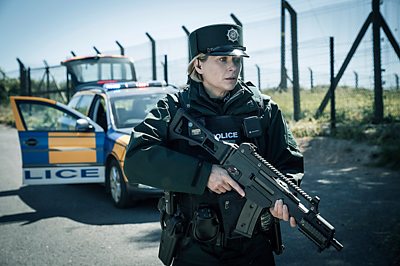
The characters in Blue Lights would recognise those challenges… and the compromises and jeopardies that come with their jobs.
Declan cites Hill Street Blues as an influence on Blue Lights, as well as shows such as NYPD Blue and The Wire. Multiple characters in multiple, but inter-crossing, storylines, some resolved in the period of an episode, others running as story arcs through multiple episodes and series. Interestingly, he says that their original concept focused on the character of Grace Ellis, played in the series by Sian Brooke, the social worker from England turned constable in the Police Service of Northern Ireland (PSNI). But the more research Declan and Adam carried out, observing not only police stations but the action and interaction of police sections (squads or units), the more the width and depth of story presented itself and that came with the necessity – and desire – to open up that wealth of material and potential to a wider cast, in what Declan describes as ‘an emergent process’. And so Blue Lights became an ensemble.
And he cites the overarching theme of the series to be – change over time.
That’s an important observation that could – and indeed should – be tested upon every drama series (and we might say pitch!). How does change happen, in the series? How do the characters change, in relation to the events they find themselves in – and where has this left them, at the end of an episode, or a series? The scripting team at BlueLights do this with whiteboards assigned to character arcs, showing where the characters start and where we finally find them. But crucially, these arcs are influenced by incidents, informing and changing how the characters respond, react and… change. And this process, travelling through the scripting process with each character and their interlocking arcs and thence played out on screen, is what Declan terms a ‘tapestry of causality.’

In this way, one story strand or arc seemingly at a distance from another, can create a ripple and resonance of consequence that can end in a completely unexpected and shocking event – such as when in a routine and almost mundane act Gerry Cliff (played by Richard Dormer) runs a Dublin-registered numberplate through the system and this leads to him catastrophically stumbling into Mo McIntyre’s gun deal – and a parallel MI5 operation - losing his life and the ramifications spreading out through the reactions of his colleagues and the intersections of policing, intelligence and organised crime in the city.
In the world of police drama – and writing police drama – Chaos Theory may indeed play out, via the Butterfly Effect – a butterfly flaps its wings and elsewhere on the planet, it raises a tornado. What seems like an incidental storyline can ultimately impel the main storyline to a devastating and unforeseen conclusion.
And there is history. And in Belfast, there is much of that. Unlike the generic and anonymous city of Hill Street Blues, which has its own backstories and troubles, Belfast has the Troubles as a very particular backstory. And one which very much informs what can be a tense and dangerous present.
But there is also humour, necessary humour on the job, in response to its demands and tensions. And sometimes terrors. It is the dark, deeply ironic and fatalistic humour – and here deployed with the wry edge of Ulster - that is an idiom in itself for those who daily encounter the criminal, the desperate, the pathological and the hopeless. Designed and deployed to… get them through.
In other UK forces, armed officers check in their weapons at the end of their shift. In Blue Lights and in the Police Service of Northern Ireland, where officers are routinely armed, they do not. They take them home. Because the threat they face during their shifts, is also present when they are off duty – which is made clear in the series.
And when an officer falls in the line of duty – Gerry Cliff, in his deeply shocking end – the producers apply the absolute measure of authenticity, in emotion and resonance.

But have we in the UK, seen police ensemble dramas before? And did they exist, before the patrol cars of Hill Street rolled out of the precinct, to the famous and gently melancholic theme tune by composer Mike Post?
Another famous theme tune might announce that we have – an arrangement of the traditional Liverpool folk song Johny Todd, by Fritz Spiegel (and can be heard each time Everton and Watford take the pitch at home games), that heralded each episode of… Z Cars.
Created by Troy Kennedy Martin, Z Cars was set in Newtown, a fictional realisation of the many new estates and suburbs being built in the 1960s and was intended to represent the gritty realities of a society undergoing social and historical upheaval and also in contrast to the BBC’s then current hit police series – Dixon of Dock Green, viewed by many of the younger drama tyros as being too ‘cosy’ ( !! ), which did indeed hark back to the earliest form of procedural presentation, with Jack Warner’s Dixon addressing camera directly and that often with a homily, assuring the audience that wrong had been righted and order restored (ironically, the first appearance of Jack Warner as Dixon had seen him shot dead – by Dirk Bogarde – in the film The Blue Lamp). Z Cars was altogether more dynamic, built around the response vehicles of the eponymous title – Ford Zephyrs and Zodiacs - and featured a main cast drawn from across the station’s ranks, including Stratford Johns as DCI Barlow, James Ellis as Constable Bert Lynch and a young Brian Blessed as PC ‘Fancy’ Smith. Among other guest members of the force was another young actor – John Thaw, proving his police chops long before embodying those vastly differing titans of police procedural, Jack Regan and Endeavour Morse. Its initial run ending in 1965 (later to be revived), Z-Cars was spun off into Softly, Softly,Softly-Softly Task Force and other derivatives, those more concerned with individual figures than the spread of the ensemble.

And then there was The Bill.
Developed from the single drama Woodentop, written by Geoff McQueen and broadcast on the 16th August 1983 – and which came to serve as the first episode – it featured PC Jim Carver’s (played by Mark Wingett) first day on the job at Sun Hill Police Station, mentored by the experienced PC June Ackland (Trudie Goodwin). (Carver went on to appear in 784 episodes and Ackland in 978!) The show, in its initial phase, concerned itself with the life of the characters over the period of a shift – much like Hill Street Blues – and also engaged with the social realities and upheavals of the 1980s – and usually featured a main ‘story of the day’, with surrounding action. One production tenet was that a police officer was to be featured in every single scene, thereby maintaining the sense for the audience that they were seeing events through the eyes of the shift themselves. An initial main cast of 13 came to feature 174 characters over the years, as the duration of the show’s episodes lengthened from 22 minutes to 46 (an ITV ‘hour’) and the format moved from standalone stories to a more serialised approach, up until the series’ end in 2010.
There have been – many – other ensemble procedurals. In the UK we might make honourable mention of The Cops, Backup and Holby Blue and the also-Northern Ireland-set Hope Street. And in the US, as well as the aforementioned NYPD Blue and The Wire and a myriad more, there have been the multi-series franchises, such as Law and Order and CSI, each derivative, while maintaining the DNA of the mothership, discovering a new ensemble and story engine that gives impetus in their particular setting.

But in all these the wide cast allows for the mosaic of storytelling that could be said to be the defining feature of the Ensemble – instead of the skill and instincts and charisma of a single lead or detective duo (or sometimes trio) in solving a single case, the ensemble allows – as the genre thereby allows - for the wider picture of a group of disparate individuals trying to get through their shifts, pursuing different suspects and cases (story strands or arcs), in conflict with others and sometimes with one another, in jeopardy and in hope… and that hope wrapped up in the desire to do the best job possible, often and usually in the most trying of circumstances.
The final words should go to Sergeant Philip Esterhaus – played by the dignified Michael Conrad – of Hill Street. From the pilot episode, amid the raucous assembly of the morning rollcall (a somewhat more ordered event at Belfast’s Blackthorn Station) and following the run-down of the day’s orders, Esterhaus would pause, gaze out at his squad – cops, but ordinary people all – and exhort:
‘Hey… let’s be careful, out there.’
They are words that, more than forty years later, Grace Ellis and her colleagues could take with them, as they leave their own roll call and go on patrol on the streets of Belfast, hoping to do their best, fearing but prepared for the worst and unknowing yet what is about to greet them… out there.
Jeremy Hylton Davies began his writing career in 1995 and for the BBC has written across television drama, continuing drama, docu-drama and radio and independently acts as executive producer and in co-production and development. He is a visiting lecturer for the National Film and Television School (NFTS) and BBC Voices.
Related Links
- Watch Blue Lights including Series 4 from 29th SeptemberOn BBC iPlayer
- Creating Blue LightsHear from writers Adam Patterson and Declan Lawn
- Writing for Series 2 of Blue LightsWriters Bronágh Taggart and Noel McCann talk about their experience in the writers' room and writing their own episodes.
- Writing the Detectives: What Makes Crime Cosy?From Christie and Sayers to Death in Paradise, what puts the cosy into crime? And why do we love it so much?
- The History of the BBCVisit the website
Latest blog posts
More blog postsSearch by Tag:
- Tagged with Crime dramaCrime drama
- Tagged with Writing the detectivesWriting the detectives
- Tagged with By GenreBy Genre
- Tagged with BlogBlog
- Tagged with 20262026
