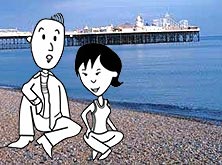
| | There are two main ways of asking questions - directly and indirectly. Both have the same meaning but we use indirect questions when we want to be more polite, more formal or less confrontational. We can ask a direct question - Where is Brighton Pier? Or to be more formal or polite, we can ask an indirect question - I wonder if you could tell me where Brighton Pier is? |
| When we create indirect questions, the question (What time is it?) becomes part of a longer sentence or questions (Do you know.?) and the word order changes from the order of a direct question. For example:
Direct: What time is it?
Indirect: Do you know what time it is? Direct: Why was he late?
Indirect: Can you tell me why he was late?
Direct: What is that?
Indirect: Would you mind telling me what that is?
|
When there is no auxiliary verb (be, do have, can, will etc) in a sentence, we need to put in do, does or did when we create a direct question. When we make this into an indirect question however, we don't use the verb 'do'. For example:
Direct: When does the lesson end?
Indirect: Could you tell me when the lesson ends? Direct: What car does she drive?
Indirect: Can you tell me what car she drives? Direct: How did you make that cake?
Indirect: Would you mind telling me how you made that cake? | If there is no question word (who, what, when, why, how) in a direct question, we need to use if or whether in the indirect question. For example:
Direct: Did she make it on time?
Indirect: Can you tell me if she made it on time?
or
Can you tell me whether she made it on time? Direct: Is this the right bus for Oxford Street?
Indirect: Do you have any idea if this is the right bus for Oxford Street? Direct: Is she French?
Indirect: Do you know whether she is French (or not)?
|
| a pier:
a large platform which sticks out into the sea and which people can walk along
poxy (informal):
rubbish, not good a spot:
a place
|
| | | Last 3 episodesLast 3 language pointsLast 3 quizzes |
|