This page has been archived and is no longer updated. Find out more about page archiving.
Skip to main contentAccess keys helpA-Z index

You are in:Learning English > The Flatmates
Learning English - The Flatmates
The Flatmates
News imageNews image
Archive Language Point 161

Language Point logo

Imperatives

News imageKhalid's birthday
News image

Imperatives

News image

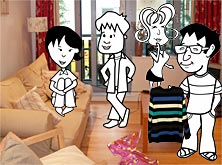
In this episode of the Flatmates Helens says to Khalid:

'Don't forget to make a wish!'

Tim also says to Khalid:

'Don't say it out loud!'

These are both examples of what are called imperatives and in particular, negative imperatives.

The imperative is a verb form that is used to give orders, instructions, advice, encouragement etc. It's formed by using the base infinitive of the verb (the infinitive without to). You don't need a subject.

Sit down!
Be quiet!
Go away!
Put it down there.
Try speaking more slowly.
Take care!
Be careful!

You can make an imperative more emphatic (stronger) by adding 'do' before the verb.
This can also show more politeness or more concern as well as being a strong order.

Oh doshut up! (Strong order)
Welcome, do sit down. (Formal / polite)
It's a long journey, do take care. (showing concern)

In all cases pronunciation is very important. The same words can show anger or politeness depending on the tone of voice.

Negative imperatives

News image
Sometimes you want to tell someone NOT to do something. This is a negative imperative. In this case you simply add the word 'Don't' before the verb.

Don't sit down!
Don't open that door!
Don't forget to make a wish!
Don't say it out loud!
Don't be silly.
Don't worry!
Don't be sad!
 

Imperatives - other notes

News image
Although you don't need to use a subject pronoun with imperatives, you can use a noun or pronoun to make it clear who you are talking to.

Peter sit down. Everyone else stay standing.
Don't worry everybody, it's only a drill, not a real fire.

Note that using 'You' before an imperative can show anger or that you are putting yourself in a position of authority. The pronoun 'you' comes before the imperative and not after.

You come here!
You calm down!

In negative imperatives the pronoun 'you' comes between 'don't' and the imperative.

Don't you leave!
Don't you speak to me like that!

Adverbs like 'always' and 'never' come before imperatives.

Always look both ways before you cross the road.
Never drive without your seatbelt fastened.
 

Vocabulary:

News image

You shouldn't have!
a polite way of accepting an unexpected gift.

cast-offs
clothes that you no longer want that you give to other people

a re-gift
a creative use of English, not a real word but a way to make 'a cast-off' seem less negative.

crafty
clever and imaginative but in a slightly dishonest way

News image


News image
News imageMost Recent
News image

Last 3 episodes


Last 3 language points


Last 3 quizzes


What's next?

What's next logoThe quiz