When Paul, a reverend who lives in the Lake District, received a call from social services, he didn’t expect to be welcoming a new member into his family.
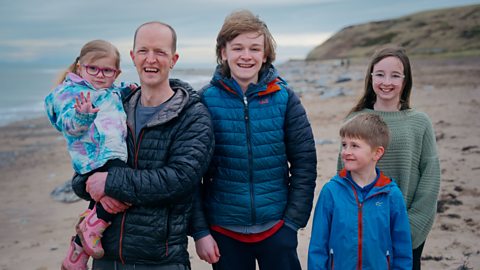
One weekend in 2024, three-year-old Sidney joined Paul, his wife and their four children, after her mum, a friend from Paul’s church, was unable to look after her.
It soon became clear that Sidney was going to be with them permanently.
Watch Paul explain his family’s story of kinship care…
“She has changed my life and brought great healing to my heart.”
What is kinship care?
To find out more, we spoke to Rhiannon Clapperton from Kinship, a charity that offers support and advice for kinship carers.
“Kinship care is when a relative or family friend - sometimes it can be someone who's less connected than that - steps in to raise a child or children when their parents can’t," explains Rhiannon.
The alternative often means that a child may have to go into the care system, in a new environment.
In Paul’s situation, Sidney was his goddaughter. Her birth mother was a friend they had met through church. Rhiannon says that kinship care, “can happen in quite sudden and unexpected circumstances."

"We received a social worker’s phone call that explained Sidney was unable to stay with her mum for that weekend." - Paul
Rhiannon explains that kinship care, “often doesn't happen in a particularly planned way." Kinship carers often step up in the time of crisis. “Kinship care wasn't in their life plans, it sort of just happened.”
"After that first weekend, it became clearer and clearer that we were talking about the rest of her childhood." - Paul
Who can become a kinship carer?
There are no strict rules about who can become a kinship carer - but it’s generally someone who's involved in the child’s life already.
“Where social workers might be involved for some reason, they will often look at extended families first: for example grandparents, aunties, uncles, maybe older siblings who are adults,” Rhiannon explains.
“But we’ve worked with a Brownie leader, who ended up becoming a kinship carer to one of the Brownies in her pack."
"And I remember meeting a kinship carer who's looking after the granddaughter of her ex- partner. So, it's not always the obvious family ties…"
What’s the process of becoming a kinship carer?
Kinship care stories and the processes to become a carer vary a lot.
“There are different types of kinship care,” Rhiannon says. “There can be arrangements within a family. Perhaps someone's really struggling to cope and there's an intervention, maybe from grandparents for example. They might say 'the children can come live with us' and that just happens."
“Then there are kinship foster carers – they’ll have contact with social workers, they'll be recognised as foster carers, and they'll have to do all the documentation associated with that."
"Then there’ll be kinship carers who go to the family courts and get different legal orders.”
Paul got a special guardianship order for Sidney, which Rhiannon says, “gives the carer certain parental responsibilities”.
“Ultimately, there is no set process for becoming a kinship carer.”

How long can you be a kinship carer?
“There’s no hard and fast rule,” Rhiannon says. Paul and his partner, for example, became Sidney’s permanent guardian. However, kinship care might not be long-term. It might span, for example, the length of an illness or a prison sentence, when a parent is unable to look after their child for a period of time.
This doesn't mean anything counts though. “We're conscious about blurring the lines between someone going to grandma and grandad’s for a few days to give the parents a rest, which isn't kinship care,” says Rhiannon.
What are some of the challenges of being a kinship carer?
Becoming a kinship carer can be challenging, with particular practical, financial and emotional hurdles, especially in the short-term.
“If you've suddenly taken on the care of a baby, you know you need to get to the supermarket and get yourself some nappies and some wipes,” Rhiannon says.
“If you work full-time, how does that work? We know that a huge proportion of kinship carers end up having to reduce their working hours, or end up leaving work, because there's no paid statutory leave for kinship carers. It's no mean feat.”
Supporting a child who might have gone through, or might be continuing to go through, a traumatic experience can also be a daunting prospect.
“Regardless of the specific circumstances, being in a position where you are no longer with your mum or dad – this can be really traumatic. And that can manifest itself in lots of ways, like issues with attachment. Trying to navigate their way in this new world, even if it's with people they love and who are familiar, is really difficult. But trying to do that when you can't articulate how sad and confused you are, that's really, really hard."
“A lot of kinship carers tell us that the challenges are huge, but the rewards are bigger: seeing the difference that they can make to the life of a child, or children, that they love.”
She has changed my life, and brought great healing to my heart and I’ll be thankful for that for the rest of my life” - Paul on Sidney
What financial support is there for kinship carers?
“Only kinship foster carers are entitled to financial support (nationally). Otherwise, financial support is at the discretion of different local authorities," says Rhiannon.
Kinship have a ‘compass’ on their website to help you find out what you would be entitled to as a kinship carer, as well as other free advice and support that's available.
“We work with kinship carers to help them access grants from other charities,” Rhiannon explains. “So there is more support out there.”

Advice for potential kinship carers
Rhiannon’s message to someone in a position of becoming a kinship carer is simple: “Most kinship carers say to us, for all the challenges, they wouldn't change it for the world. Stepping up for their children is absolutely what they want to do."
"And at the end of the day, you’re not in it alone. There is now a big community of kinship carers out there and the power of kinship carers supporting each other through peer support, sharing their experiences, is so powerful. I think kinship carers being more visible and being better recognised, is a huge part of that.”
“Kinship care is sort of the oldest form of children's social care. It has been around forever. The idea of ‘it takes a village’ - this is the village stepping up."
I can’t imagine life without Sidney now" - Paul
Check out our collection for carers as part of BBC Caring Matters.