:: Pass it on!» | | E-mail this story to a friend - click here |
:: Have your say » | What do you think of this page? Send us your opinion...
Have your say |
:: Add to this page» | Do you know of any other local history stories which should be listed here?
Contact us |
:: Do you photo?» | We always need pictures. Do you have any relevant pictures you can let us use?
We'd be soooo grateful | |
:: Seen a mistake?» | We're only human - we make errors.. If you see one, or there's a broken link...
Please tell us |
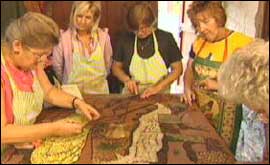
| | Every year between May and September, the people of Longnor and surrounding villages in the Staffordshire and Derbyshire Peaks, create huge floral designs to dress their natural springs and wells.
In Longnor, Theresa Riley revived the tradition 21 years ago. She comments: “We make this huge slab of clay, leave it overnight and then it’s time to get creative!”
Endon
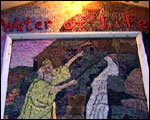 The Staffordshire village of Endon also holds annual well-dressing ceremonies. In Endon this coincides with the coronation of the Well-Dressing Queen, Morris dancing and a tradition known as Tossing the Sheaf. The Staffordshire village of Endon also holds annual well-dressing ceremonies. In Endon this coincides with the coronation of the Well-Dressing Queen, Morris dancing and a tradition known as Tossing the Sheaf.
Dressing Wells
Participating villages are very competitive and try to ensure their well-dressing designs remain a secret from other villages. The well-designs are decided upon months before they are unveiled and are not revealed until the last possible minute.
Origins
The origins of well-dressing remain a mystery but it may date back to the Celts. The Staffordshire/Derbyshire border can be quite remote in places so perhaps it was harder for the Saxon, Danish and Norman invaders to impose their customs. Maybe this is why well-dressing is still alive and kicking today in this area.
Christians
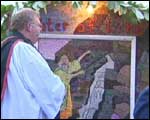 Theearly Christians didn't like well-dressing as they saw it as water worship and so promptly put an end to it. The village of Tissington (just over the Staffordshire border) was the first place to reintroduce well-dressing in 1349, just after the village had escaped an outbreak of Black Death. Theearly Christians didn't like well-dressing as they saw it as water worship and so promptly put an end to it. The village of Tissington (just over the Staffordshire border) was the first place to reintroduce well-dressing in 1349, just after the village had escaped an outbreak of Black Death.
How it's done
Firstly the wooden boards which thedesigns will be mounted on are taken to the localriver or pond and are left to soak for several days before being covered in clay.
After this pictures are created using living plants, flowers, petals, berries and seeds. The pictures are often biblical scenes, usually constructed by the Women's Institute of youth organisations such as the Scouts or Guides.
Sarah Williams |