
 Inside
Out - South West: Monday October 30, 2006
Inside
Out - South West: Monday October 30, 2006Scam mail
 |
Inundated
with scam mail |
Most of us look forward to the post arriving, but these days it seems that an increasing proportion of what drops through our letter boxes is unwanted scam mail.
Scam mail is different from junk mail, and it's potentially harmful.
This type of mail promises cash or other prizes, and it can involve large amounts of money being sent by the recipient to a company.
Often the so-called 'lucky winners' receive nothing in return.
Mail nightmare
For the past two years 87-year-old pensioner Vic Haynes has been caught up in an international mail scam nightmare and has lost thousands of pounds.
It all began when he started replying to letters promising big cash prizes.
In return he simply had to purchase small items from magazines or pay a so-called 'admin fee'.
Each time the amounts were small, but soon the payments and the letters snowballed.
Vic received thousands of letters over a period
of about 18 months.
As soon he started responding, Vic was placed on what's known as a 'Sucker's List'.
Suckers List
A suckers list is a mailing database - details are sold around the world.
Firms can target someone who has fallen for a scam before, and if you've fallen for it once, you're more likely to fall for it again.
 |
| Big cash prizes - but few recipients ever see the money |
The mail
offering prizes and gifts is a 'come on' to the customer.
It says 'here’s a gift, we’re pleased with your business - we’d like to keep your custom, please send us another £10, £20'.
But Vic was so convinced the mail was genuine, he kept sending cheques and sometime forwarded his bank account details which the scammers then used to drain his account.
His son Mike
now keeps a careful eye on all his mail:
"There was one particular company - where he sent off direct debit details – and they have taken money out of his account without his permission."
When Mike found out what his dad was up to, he was horrified.
Vic was spending so much on mail scams that he had no money to feed himself.
So Mike closed down his dad’s bank account and opened a new one.
"I’m certain he was conned because of the wording on them," says Mike.
"You have to have a degree in English to understand them, to appreciate what it says."
Despite the small print, these envelopes often leave you in no doubt - "You have won £30,000".
Vulnerable people
Older people are particularly susceptible to the scam mail con, as Rachel French from Age Concern Devon explains:
 |
| Vulnerable older people are often taken in by scammers |
"The problem with old people is that they're very trusting and vulnerable in all sorts of ways – they're often bereaved or living on their own or they're housebound...
"Sometimes they think, 'I could make some money out of this', because they're on low incomes or fixed incomes, and so they're very trusting and just believe it at face value, and send it back or respond.
"Most people who are more into today's world would say, 'this is a scam' and chuck it away.
"But older people seem to be sucked in."
Winning tactics
Pensioner
Bill Jordan got a call saying he'd won over half a million pounds on an Australian
lottery.
But there was a catch - he was told that he would have to pay the tax.
He sent £1,200 off and didn't hear anything.
Two months later he received another phone call asking for a further sum of money.
But by this stage Mr Jordan had already sent off more than £6,000 in four separate instalments.
Bill looks back with sadness:
"I just feel ridiculous - that I could have been so easily taken in by these people. But I believe I was at a low ebb. My wife died in 1997 in rather nasty circumstances.
"There I am on my own wondering what to do with life. That's why I was so easily conned."
He's not the only one who's been conned - there are many more cases like his.
One woman spent her entire life savings – an astonishing £140,000 – on these scams.
She refuses to stop and it's not just her bank balance that's suffering - it's her health and welfare.
Her son Stuart is very concerned:
"My mum isn’t daft. She’s coming up to 80-years-old but she’s got all her senses. You can have a sensible conversation but this just seems to be a blind spot.
"It is a compulsion she has. She’s got to keep on doing it. I think it’s an addiction, like if you get addicted to gambling."
His mum isn't alone - she's one of five million people in Britain conned into spending £1 billion a year on these scams.
 |
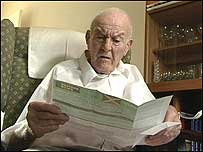
| Lottery scam - Bill Jordan reads the small print |
And with such huge sums involved, it’s likely that the proceeds go to fund serious organised crime like drugs and terrorism.
But one thing is certain - those who reply to the scam mail never profit.
Her son has tried hard to stop his mother's
compulsive habit:
"I’ve tried to involve everybody. The doctor said she’s not gaga - she knows what she’s doing. So there's nothing he could do.
"I’ve talked to trading standards and I think they’re breaking heads trying to stop these people...
"And I’ve been in there and I’ve picked it all up, and she said, 'I’ll call the police''... she’s right, it’s her money her life she does what she wants."
Preventative action
Local police say that mail scams simply aren’t enough of a priority for them to investigate.
Trading Standards say that their hands are tied - there is very little that they can do to combat foreign fraud, as Kim Lewis Williams from Cornwall Trading Standards explains:
"It's very difficult to stop because they're based abroad. They move.
"Just because it says they're based in Spain doesn't mean they are. They will often use English PO Box addresses or what we refer to as mailing addresses.
"Any address that starts off PO Box…. is likely to indicate the mailer is actually based abroad."
It can also take Trading Standards several weeks to close a company down, and even then it can take just days for the scammers to open up a new PO Box.
Delivery problem
If scam mail is trying to scam people out of money, why do the Royal Mail deliver it?
There are two major problems - first, the Royal Mail is duty bound to deliver the envelopes because they are addressed.
It also has agreements to deliver mail that comes from other countries.
However, the Royal Mail doesn’t deliver material such as pornography that contravenes criminal law.
Our conversations with Royal Mail indicate that it would look at doing something about scam mail, if highlighted by Trading Standards.
Royal Mail says that it would have to have the evidence before taking any action.
However, the Royal Mail refused to look at our evidence - 8,000 letters from just two mail scam victims.
Your experiences
We want to hear about your experiences of scam mail.
email
your experiences to insideout@bbc.co.uk
If you're receiving scam mail,
there are several things you can do.
You could bin it or, better still, return it to the sender.
Another option is to contact Consumer Direct on 08454 040506.
Alternatively you can get in touch with Inside Out South West, Seymour Road, Plymouth, PL3 5BD.
Never
send money in the post and, if an offer sounds too good to be true, it probably
is.
Links relating to this story:
The BBC is not responsible for the content of external websites
Father of marine biology
 |
| Founding father - Philip Henry Gosse |
Inside Out retraces the steps
of Philip Henry Gosse, the father of marine biology, who lived in Torbay.
The
Victorian craze for rock pooling was driven by this remarkable scientist and author
who lived from 1810 to 1888.
His love of nature began in earnest when he
went to the seal-hunting stations of Newfoundland to work as a clerk at the age
of 17.
Early journeys
He travelled
across Canada, the United States and the Caribbean teaching himself biology then
began writing about flora and fauna.
On his return to England at the
age of 38 Gosse married devout Christian Emily Bowes.
 |
| Reconstruction of Gosse's discoveries |
The pair, who shared an intense belief
in a completely literal form of Christianity, had an extremely happy partnership
and Gosse flourished.
By the early 1850s he had established himself as
the most popular natural historian of his day, particularly obsessed with marine
life.
He would stride purposefully out to sea at low tide and explore rock pools armed with a crow bar and hammer.
If he could not find a way down
a sheer rock face, he would just jump right in.
Victorian
craze
Gosse sparked a Victorian craze for sea creatures, discovered
the scarlet and gold star coral, and invented the modern aquarium.
Crisis
came in Gosse’s life in the mid 1850s following the painful death of Emily
and the emergence of a new theory of evolution.
Gosse admired Darwin hugely
but could not reconcile his ideas with his own fervent fundamentalism.
 |
| Evolution of life - Scarlet and Gold Star Coral |
Shortly before Darwin
published Origin of the Species, Gosse published Omphalos, a book containing his
own theory of creation.
He argued that God must have created the world
with all the signs of age, such as fossils, canyons and growth rings in trees
already there, and so no evidence that we can see of the presumed age of the earth
and universe can be taken as reliable.
Gosse believed therefore that
we can see of the presumed age of the earth and universe from these signs - and
they can be taken as reliable.
His thesis was extremely badly received,
savaged by critics on either side of the debate.
But Gosse nonetheless
left a wonderful legacy, as summed up by Inside Out presenter Mike Dilger:
"A
sense of wonder, amazement and almost childlike enthusiasm for all of our intertidal
creatures..."
Links relating to this story:
The BBC is not responsible for the content of external websites
Readers' Comments |
A selection of your comments... I cried when I watched your programme tonight - everything
that was being said by the victim's families has been said by me to my 86 year
old mother who has lost thousands and thousands of pounds to these crooks. She has lost everything including her luxury bungalow
and now lives in sheltered accommodation. She has spent everything she has on
these monsters and her health has recently suffered severely due to the fact that
she has not been eating enough because she has no money left for food. I recently got in touch with Trading
Standards who actually came out to visit my mother because the case was so severe.
The officer was so patient with her and spent nearly two hours explaining that
there was no money to be won - ever, as these companies are on the whole, run
by fraudsters. At the end of the meeting, he asked her to throw away all the hundreds
of letters she has stashed around her bungalow and her answer was "just wait
until the end of the month because I'm expecting my big win next week"!!!
I have recently had to stop paying it into her bank so as to force them to stop issuing her with more cheque books. (Despite her history the bank insists that while money is being paid into her account she is allowed to be issued with a cheque book). They do not take any responsibility
for the fact that when the cheques bounce, as they invariably do, they just charge
her £38.00 each time. Her pension is hers to do with as she wishes, so I
still give her the money, but to see her spending it all on these cheats breaks
my heart. I can now though, at least make sure she has enough food to eat each
week. I've never replied to any scam. I have no store cards. So how do these scammers get my address? It makes a sham of the public electoral role. I have two reasons for writing in. 1) With all the concern for the environment, has is it ever been calculated how many trees/CO2 are used to fuel all the scam/junk postal mail? 2) Some scam/junk letters look so official I now feel compelled to destroy it all in case it is used for identity theft. On the internet
there is a move towards holding ISPs responsible for the Spam originating from
their networks. So why can't a similar move come to the postal system, getting
the Bulk Scams stopped at source. Re- tonight's programme about elderly people being conned out of money by fraudsters sending unwanted mail asking for cash - you didn't mention that if that people registered with the Mail Preference Service they could opt out of having scam mail sent to them. Their (younger) relatives could register them with the MPS thus hopefully preventing these scams taking place. Write
to Door to Door Opt outs, Royal Mail, Kingsmead House, Oxpens Road, Oxford Saw your programamed tonight but was astonished to see that you DID NOT MENTION the MAILING PREFERENCE SERVICE which would have stopped all this post if not for those currently involved but for others watching. I have belonged to this for years and get no rubbish - you are lacking if you DO NOT MENTION BOTH THE MAILING AND THE TELEPHONE PREFERENCE SERVICE. A phone call will do for each of them. Barry Bryson Inside Out's producer of the programme writes in reply: MPS won't stop scam mail because it doesn't apply to mail sent from abroad, which is most scam mail. In addition, MPS only works by getting the mailing companies to take people's names off their lists. Scammers are unlikely to bother to take any notice of who is or
isn't signed up to MPS. There are two winners with scam mail. The scammer, for running the scam, and the post office for delivering it. The solution is simple. Every time you get a piece of scam or junk mail in the post - addressed or unaddressed - even if you open it in error - do the following: Cross out the address (if it has one - put it in a plain cheap envelope if not) and write - ''please return to sender'' on it. I do it religiously. It forces the Post Office to handle it again and costs them time and money. If only we could get lots more people doing it the Post Office may not be so keen to keep putting this stuff through our doors! I currently have a big bundle to return and
I am going to fill local Post Boxes with it a Christmas - the Post Office's busiest
time. It is, of course, a great shame that generally older and more vulnerable people are targetted and in some cases scammed for thousands of pounds. However, I have no idea why you decided to portray the local post office manager as some sort of baddie in all this. The interview was such an unintelligent attack on someone who might well have had some ideas about what could be done in the future to combat this increasing problem. Instead, you chose to antangonise him with no journalism "insight" arising from that and may well have made people feel that the Post office is somehow complicit in all this - which is clearly ridiculous. Very disappointing and it just felt like you wanted to film some sort of "scoop" moment for the cameras - it is not the right target. Simon Davey |