Inside British number one Kartal's remarkable comeback

Sonay Kartal has become the British number one for the first time
- Published
Six months ago, Sonay Kartal could not stand up and brush her teeth without "being in agony".
The pain caused by a stress fracture in her back eventually subsided, but the 24-year-old Briton still had a long road to full recovery, which needed to be navigated with patience and hard work.
Kartal did not make her return to competitive action until little under a month ago.
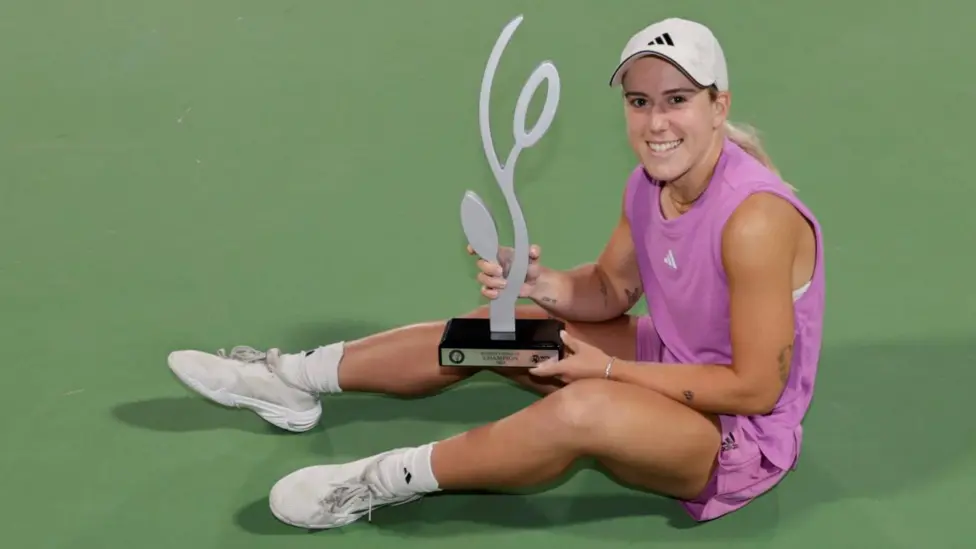
But on Monday, she became the new British number one after an extraordinary week at the Wuhan Open, where she reached the biggest final of her career in just her third tournament back.
"In the first month or so, I was at home in bed - sometimes I had good days but there were also bad days where I wasn't really able to walk without some form of pain," Kartal said.
"It was a slow process and it makes you think you do take every day things for granted a bit."
Kartal misses out on Wuhan Open title against Chwalinska
Given where Kartal was six months ago, and the length of time she was out injured, reaching the Wuhan final cannot be overstated as an achievement.
As a WTA 1,000 event, it is in the tier of tournaments directly below the Grand Slams and attracts the strongest fields on the women's tour.
Kartal knocked out a series of opponents with considerable pedigree - including current top-10 players and former Grand Slam champions - before running out of steam against this year's French Open runner-up Maja Chwalinska.
Falling to a brutal defeat from a set and break up in the final will undoubtedly sting. Kartal, though, quickly acknowledged the bigger picture is already more positive than she could have predicted.
Kartal was ranked 54th in the world when the back issue struck at Indian Wells in March and she used a protected injury ranking - given to players who have been out for six months or more - to compete in Wuhan.
Earning 650 points as the runner-up saw Kartal's ranking rocket from 170th to 49th - and now closing in on a career-high of 44th achieved in July 2025 after reaching the last 16 at Wimbledon.
And it is an example of the WTA's special ranking rule working as it is intended: providing a fair platform for a player to re-establish her position after a prolonged and unavoidable absence.
Regaining her ranking just 10 matches into her comeback will have real significance for the 2027 season.
Kartal will no longer need to use a protected ranking to enter tournaments including the Australian Open, meaning she can have greater choice over when and where to play as she continues to manage her workload.
On Monday, she pulled out of the Japan Open in Osaka, where she was due to play her first-round match on Tuesday.
"My goal on the Asian swing was just to try to defend those points I had from last year and make the use of the protected ranking worthwhile," said Kartal, who also won two matches at the China Open in Beijing.
"I think I've gone above and beyond that. The goal has been achieved this week and I'm in a good spot for the rest of the year and next year."
Kartal's re-emergence is timely too when considering the bigger picture of British success at the highest level.
With Kartal absent from three of the four majors, no British women went past the second round of a Grand Slam tournament in 2026.
Kartal has only managed to do that twice in her career - reaching the third round at Wimbledon in 2024 and going one stage further last year - but showed in Wuhan she has the ability to thrive at elite level.
She became the first British player to reach a WTA 1000 final since Johanna Konta in 2019 and, despite losing to 22nd-ranked Chwalinska, still recorded the best result by a British woman since Emma Raducanu won the US Open title in 2021.
Alongside Arthur Fery's extraordinary run to the Wimbledon semi-finals in the summer, it is a much-needed bright spot for the nation's tennis fans.
How far can Kartal go?
Similarly to Fery, she is not blessed with the height and power which many of the leading players on both tours are genetically given, but she certainly has enough damaging tools which can help anchor her inside the top 50.
In Wuhan, her consistent hitting from the baseline, supreme athleticism and level-headedness were the keys to her success.
Staying fit over the coming months will be another important factor.
Kartal says the stress fracture in her back has completely healed and her team say she "worked her socks off, 9-5 all the time" during rehabilitation to ensure she could hit the ground running when she did return.
It was telling that Kartal quickly paid tribute to her coach Ben Reeves, fitness coach Ian Aylward and physio Dani Gillanders after collecting the runners-up trophy.
"If it wasn't for them I wouldn't be here," Kartal said.
"It makes it even better that the three people who helped me get back to fitness and fixed my back are with me. It's been a special week for all of us."
Related topics
- Published6 July 2025
- Published30 September 2024

- Published28 August