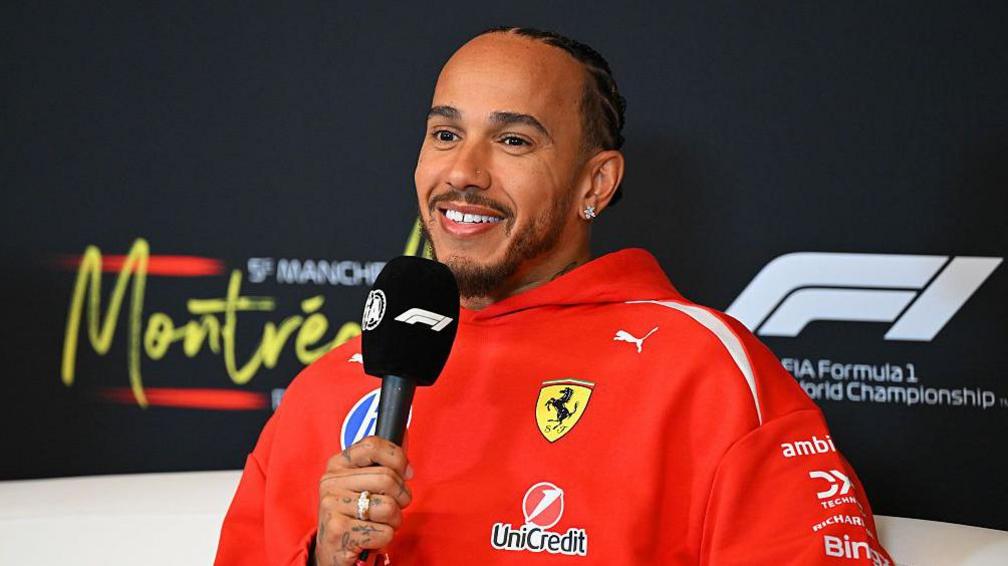
What is going on with Ferrari and will Verstappen quit? F1 Q&A

Max Verstappen and Lewis Hamilton have 11 world titles between them
- Published
Kimi Antonelli extended his lead in the drivers' championship after Mercedes team-mate George Russell retired from the Canadian Grand Prix.
Ferrari's Lewis Hamilton finished second and Max Verstappen's Red Bull made up the top three.
Russell was successful earlier in the weekend when he converted sprint pole to a win on Saturday.
BBC F1 correspondent Andrew Benson answers your latest questions after the Montreal race weekend.
How ironic that Hamilton should finish behind Antonelli - but what is going on with Ferrari? Has their simulator been holding Hamilton back? - Tom
Lewis Hamilton was in good competitive shape in Canada, and was quicker than team-mate Charles Leclerc all weekend.
After the previous race in Miami, he had mentioned that he felt the Ferrari simulator was sending him up the wrong path on set-up, so he intended not to use it before Canada, and in Montreal he confirmed that had been the case.
He said: "I felt like we started on the right foot, came with the right attitude, and the car really generally felt great."
This is a sticky situation because Hamilton does not want to be seen to be criticising the simulator. At the same time, he thinks he has locked on to a reason for why he has been struggling for much of the time at Ferrari and wants to make it public.
"The simulator," he said after the race, "I'm sure I would drive it at some point. What could be good is, for example, going back and doing correlation to this weekend so we can find out where it's missing.
"The test driver will only know what they know because it's only Charles and I get to drive the car.
"So, the positive of being able to drive the real car, go back and say, 'This is actually what it feels like. These are the things that we're missing [from the simulator experience].' So we can improve it. I'm always there to help the team move forward and develop it.
"Now, whether I use it to prepare for another race? Probably not. There are just too many risks. If you look at the two best races I've had, I didn't use a simulator. And that's honestly how it was.
"Pretty much all the championships [I won] before, except for probably 2008, I didn't use the sim. So it's not a necessity. It's a tool that can be powerful. But for me, I'm old school. I'm probably better without it."
There is one unanswered question here. When Hamilton says the "two best races" he has had this year, he is referring to China and Canada.
But these are also two tracks where he has always been extremely strong. You could say they are his best circuits, along with Silverstone and Hungary.
So, while there is no reason to doubt Hamilton's concerns or observation about the simulator, there probably needs to be some more corroborating evidence over a larger number of races before firmly concluding this is a definitive solution to and explanation for his previous issues.
Why it 'clicked' for Hamilton and Ferrari in Canada
Do you honestly think Max will quit F1 at the end of the season if the engine changes aren't coming? - Paddy
There is no questioning the fact that Max Verstappen is being genuine when he says he doesn't think he can face another year driving the cars as they are.
In Montreal, he made it pretty clear that he does not fancy sticking around if the engine rules don't change. "It's just mentally not doable for me to stay like this," he said. "It's really not."
After the race, he admitted he had "enjoyed a lot" his battle with Hamilton. But he also expanded on why he doesn't like the new cars or, more precisely, the new engines, with their need for constant energy management.
Verstappen said that racing in the Nurburgring 24 Hours had reminded him "how pure motorsport can be".
In F1, this year, he said: "For me, while driving, it's all a bit confusing. It's not what Formula 1 should be about. It's way too complex.
"Most of the rules, the fans don't even know what we are dealing with while driving, what is allowed when you're behind or when you're the car ahead, what we have to do on a formation lap or what we have to do in an out-lap, or how much battery that we're allowed to charge.
"It's just such a shame that we have to deal with all these things. F1 just needs to be more pure and I really hope that what they try to do [for] next year will go through because I think that is necessary, the minimum necessary, to make it a bit more natural and a bit more back to normal, or at least a bit more pure racing.
"As drivers, give us any kind of car, we'll always race and give good entertainment or a good show. Doesn't matter that people say, 'Oh, but look now, the show is great, the cars were fighting.' But it has nothing to do with the car. It just needs to be more pure."
Verstappen is the most outspoken, but all the drivers basically feel the same way.
Antonelli said after the race that "still sometimes it triggers you a little bit how the system works".
And Hamilton said: "It still continues to be a weird feeling", adding: "You go on the power, you open up the [straight-line mode], and then the power dies halfway down the straight and the RPM starts dropping.
"It doesn't feel what motorsport should be. The engine should be ringing its neck right to the end of the straight and just pulling and pulling."
Verstappen is referring to the current attempt by F1 bosses to change the split between internal combustion and electrical power to 60:40 next year rather than the nominal 50:50 (in reality about 54:46) at the moment.
This is likely to be done by increasing the fuel-flow limit, and would reduce the need for energy management, especially in qualifying, and make the driving more "on the limit" again.
The regulators also have a chance to address some of the peculiarities of the new rules which are making the cars and engines extremely difficult to handle on warm-up laps because of the requirement not to go over a particular energy limit.
I won't go into that here because it's incredibly complex - but when you hear about what the drivers are having to do, the reaction is to scratch your head and wonder how on earth F1 ended up in this mess.
Although the FIA said more than two weeks ago that there was an "agreement in principle" on the 60:40 move, there has so far not been enough support from engine manufacturers for the changes to go through.
However, bosses are trying to lean on the companies opposed - Ferrari, Audi, Honda and Cadillac. And there is hope that an agreement, with suitable compromises addressing the concerns of, particularly, Ferrari and Audi, can be reached this week.
It's worth mentioning that the rules have had some superficial positives, mainly to do with racing.
The new cars are lighter, smaller, and more nimble. And 'overtake mode' - which gives a car behind an extra 0.5MJ of electrical energy per lap if within a second of the car in front - has led to the multi-lap battles in which cars pass and repass a number of times that have become a feature of this year's racing.
The hope is to be able to retain this while addressing the concerns about the way the new engines have negatively affected the purity of driving.
Given their flying start to the season, do you think it's too early to say the title is Mercedes' to lose, or have they simply adapted to the new regulations better than everyone else? - Chris
Mercedes have taken pole position for and won every grand prix so far this season. The only time they have been beaten was in Miami, where McLaren's Lando Norris took pole position for and won the sprint.
Their average advantage in qualifying over the next fastest car - the McLaren - is 0.369 seconds.
After five races, Kimi Antonelli's championship lead over the first driver not in a Mercedes is 56 points - more than two clear wins.
So, yes, they are strong favourites for the championship and, yes, it's their title to lose, if you want to put it that way.
The question, as things stands, is just how dominant this season will end up being, rather than whether Mercedes will end it winning the drivers' and constructors' championship.
However, that's not to say they will have things all their own way from now on.
In Miami, McLaren proved that Mercedes are beatable - Norris should have won the grand prix, too, but McLaren failed to pit him at the right time and keep track position at the front.
And Monaco, the next race, is expected to suit Ferrari. They've always been strong there, the car's characteristics this year seem to fit the slow and twisty Monaco track well, and Charles Leclerc, in particular, is amazing around there. Lewis Hamilton is not exactly shabby either.
Whether any team can improve their car enough to mount a consistent challenge to Mercedes on a race-by-race basis, however, is another question.
Of course, other teams have upgrades coming - but so do Mercedes.
If they come out of the Spanish Grand Prix, the week after Monaco, with another convincing win, then it really will look like they are in total control of the season.
As last year, showed, though, you never know. These cars and regulations are very new. It's far from impossible someone will catch up - and McLaren would be considered the team most likely to do so.
The question will be how long that will take, and whether Mercedes' advantage in the championships is by then realistically recoverable.
Mercedes team-mates go head-to-head for F1 crown
With all the talk about changing the split between internal combustion and electrical energy for next year, do they just need to add a bigger fuel tank or totally redesign the engine? - Peter
If the change to a 60:40 split - or thereabouts - between internal combustion and electrical power goes ahead, it will require a revised engine design for all companies.
This is one of the issues at the centre of the debate mentioned in the previous answer.
Audi's objections to the rules are to do with cost. Ferrari's centre on the rules around extra development permitted to manufacturers who are assessed to be behind the best engine by specific amounts.
Ferrari is hoping to be granted this extra development, but are arguing that Mercedes don't need it because they're ahead. If the rules change, everyone can redevelop their engines.
Politics have ended up involved in a matter which, ideally, everyone would address thinking only of the interests of the sport.
But that's always the case in F1 - it's a competition, so teams have a responsibility to look after their own competitive interests.
Some teams were concerned that they would need to build a new chassis for next year to incorporate the bigger fuel tanks that would be needed for a handful of races to get to the end of the grand prix in the event the rules were changed.
This was a problem because a good number of teams are planning to carry over their chassis into next year to save money and stay within the cost cap.
But Racing Bulls team principal Alan Permane revealed at the weekend that there was an agreement to shorten the races with the highest fuel consumption by a lap or two if necessary, to ensure teams can keep their current fuel tank size.
Get in touch
Send us your question for F1 correspondent Andrew Benson
Related topics
- Published23 May
- Published21 May