Can Scotland learn from history-making Norway?
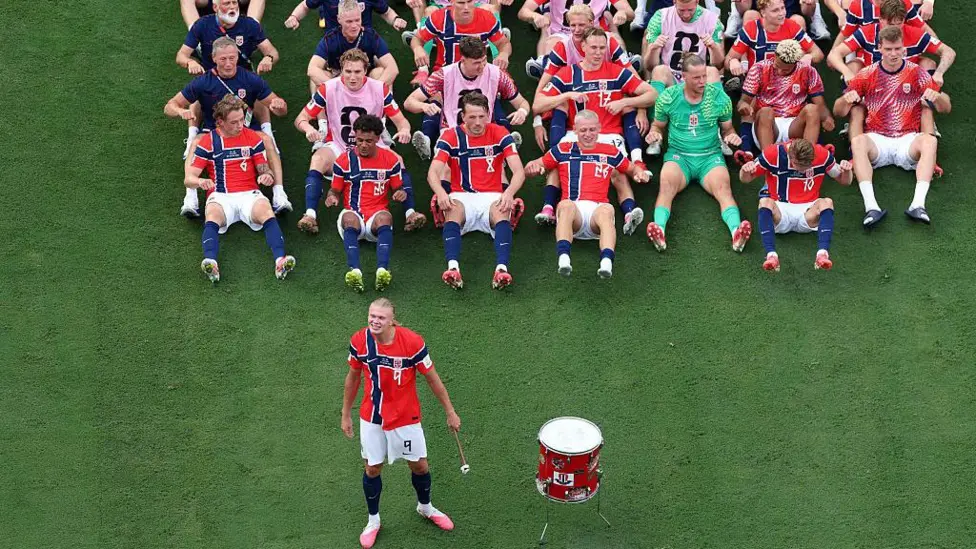
Norway's previous best at a World Cup was reaching the round of 16 in 1938 and 1998
- Published
With 92 minutes on the clock, when they were leading record World Cup winners Brazil 2-0 in their round of 16 match, ITV commentator Sam Matterface said Norway were "a force to be reckoned with".
He then went on to rattle off the raft of changes the Norwegians made in the last 15 years - and which appear to be paying dividends - before emerging from the tournament doldrums to dominate Carlo Ancelotti's much-fancied side on the biggest stage of them all.
Brazil were barely allowed a sniff in New Jersey as two goals from their "absolute monster" of a world-class forward in Erling Haaland steered Norway into the quarter-finals for the first time on their return to the tournament after a 28-year absence.
The Manchester City striker and his mates face the team from the land of his birth - England - on Saturday and will no doubt gain support from a section of Scots who will swap Viking gear for the sombreros donned for the Auld Enemy's previous match with Mexico.
But how much attention should Scotland really be paying to the Norwegian system given their own failure to reach the group stage following their own 28-year wait for a return to the World Cup?
Why new Scotland head coach has tricky task
- Published30 June
Reacting and investing when in a rut
Just 11 days before Haaland took his tournament tally to seven goals, Steve Clarke's side were left bruised by the Brazilians as they failed to achieve their goal of reaching the knockout stages for the first time.
Since then, fingers have been pointed at the players, the Scottish FA and the head coach, who resigned in the aftermath.
Former England striker Ian Wright said "somebody is letting down Scotland on a massive scale" and called for a "bolder, braver vision" as he drew comparisons with Norway's impressive domestic broadcast deal and their stars' ability to shine on centre stage.
The two nations have almost identical populations, so how have the Scandinavians aced their plan of attack?
Well, for starters, they realised when they were in a rut and acted on it.
After a decade or so of failing to qualify for major tournaments - since Euro 2000 - the authorities hit the reset button.
A whack of investment into coaching courses, artificial pitches and a National Team School (NTS), in addition to a shift in domestic strategies.
From 2016 to 2025 alone, 539 new artificial surfaces were built and another 586 renovated, with the landscape flipping from a lack of interest and enthusiasm to swarms of people squashed together in Times Square taking part in a 'Viking row' together.
How 'remarkable' Haaland led Norway to win over Brazil
The well-travelled Norwegians, who have captured the hearts and imaginations of many World Cup watchers with their enchanting celebration, were led by Haaland post-match on Sunday.
Although he beats his own drum to a tune few others can match - his 16 goals in qualifying just one example of that - he is one of 17 in Stale Solbakken's 26-man squad in the United States who played in the top four European leagues last season (Premier League, Bundesliga, La Liga and Serie A).
However, many of them - including Haaland and Arsenal captain Martin Odegaard - are graduates of the NTS, which was founded in 2013 with the plan to nourish the next generation and plot a pathway from every corner of the country to the national team.
In comparison, the SFA announced in November they would be closing their performance schools - in operation since 2012 - with the BBC understanding the decision was partly been taken due to a lack of talent coming through the ranks.
Napoli midfielder Billy Gilmour and Everton right-back Nathan Patterson are the poster boys from the system.
Haaland leads Norway's celebrations
Domestic clubs playing their part
When drawing comparisons with Norway, it cannot be overstated how the outrageous Haaland hauls them up a fair bit. Without him, who knows where they would be?
However, this is not the first time the comparison with our Scandinavian pals has cropped up. It has in the domestic game too.
A matter of months ago, all the talk was about the Bodo/Glimt fairytale in the Champions League.
Their meteoric rise in the past two seasons, from becoming the first Norwegian side to reach the semi-finals of a major European competition when they faced eventual-winners Tottenham Hotspur in the Europa League to making the knockout stages on their debut in the continent's premier club competition last term, caught the attention of almost everyone.
However, this has not been a story of two terms. Bodo/Glimt started again from scratch in 2016 following their relegation from the top flight. Now, they are reaping the rewards.
The club from the Arctic Circle are, understandably, the model for many in Europe now, but they are doing their bit for the national team too - and have been for some time, with one of their goals from their sea change in approach developing local talent.
Only four players in the national squad play in Norway's domestic league, with three of them signed up to the Glimt, nicknamed Superlaget (The Super Team).
Twenty five of the 26 players all came through on their home shores, with Rangers midfielder Thelo Aasgaard the outsider having learned in Liverpool's system. Only he and Haaland were not born in Norway.
Clarke named eight players from the Scottish Premiership, while 10 of his men were at clubs in the Premier League and Serie A last season.
Seven did not spend any of their youth days in Scotland.
Following Clarke's resignation, it is understandable that many supporters will be hoping for a change in the national team, on and off the park.
However, examples like this high-flying, headline-grabbing Norway spark the question if even greater change is required.
- Published6 June
- Published1 April