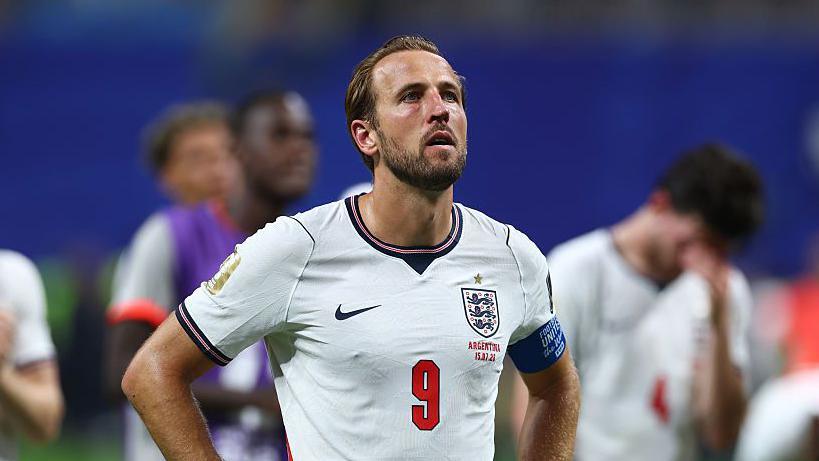
How coach-on-pitch Messi undid England's tactics on the fly
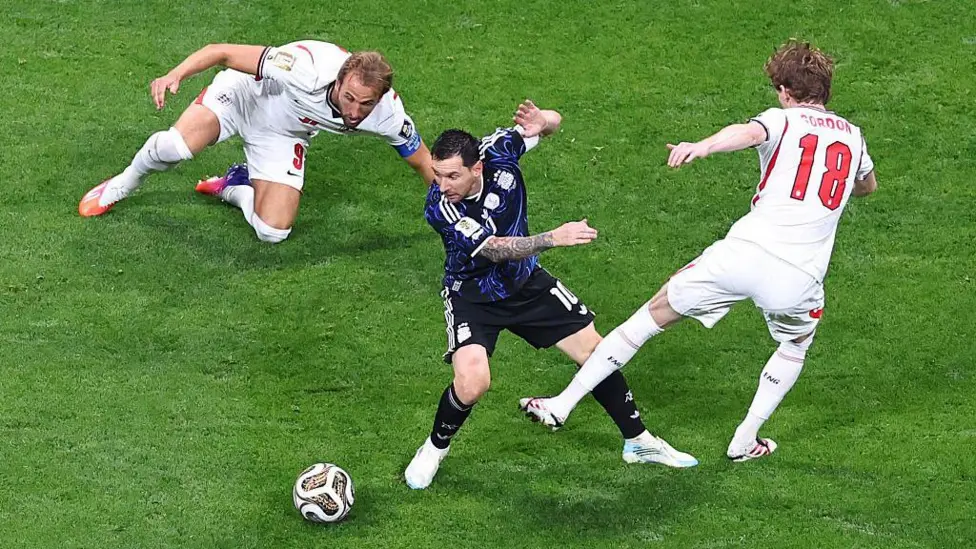
Lionel Messi found space as England struggled to cope with the veteran's sharp-witted play
- Published
England pride themselves on their physicality, so shouldn't it have suited them to face a 39-year-old who spends most of his time walking?
Well, that's not quite how it turned out.
Lionel Messi is less athletic compared to his younger self, but his footballing intelligence makes up for the physical drop-off.
As England conceded control of the World Cup semi-final because of their own fatigue and Thomas Tuchel's in-game changes, veteran Messi strolled authoritatively and effectively served as Argentina's on-field coach.
So how did Messi find and exploit England's weaknesses to deliver victory for Argentina in Atlanta?
How Argentina gained a foothold after England's start
In the first half, England looked to press Argentina high.
Wingers Anthony Gordon and Morgan Rogers were tasked with pressing the two Argentina central defenders – angling their body in a way that made finding the full-backs harder for goalkeeper Emiliano Martinez and his centre-backs, Cristian Romero and Lisandro Martinez.
For Argentina, it felt like the simpler passes were on through the middle of the pitch, but in playing these they fell into England's trap early on.

Rogers and Gordon pressed to prevent Martinez finding his full-backs. Harry Kane and the midfielders took a more man-to-man approach centrally. Martinez went long from this situation.
Jude Bellingham was positioned deeper than Argentina might have expected. Rather than leading the press, he was being asked to pay close attention to Enzo Fernandez. Declan Rice did the same with Alexis Mac Allister and Elliot Anderson found himself paired up to Messi.
England wanted to physically bully Argentina when the World Cup holders tried to play their famously central-focused football.
The England midfield trio, showing energy early on, did well to stifle Argentina. Anderson in particular was snappy, early to his duels, smothering Messi well.

In the 10th minute, Anderson intercepts a pass intended for Lionel Messi. This front-footedness and anticipation was seen throughout the first half.
But Messi, like Fernandez and Mac Allister, began to grow into the game.
Argentina's captain started to take deeper positions, posing Anderson a dilemma - how far should he follow him? Messi's walking pace, a tool of great deception, came in handy here too.
From almost a standing start, Messi would burst into life, darting towards the ball. With the defending side having to react to these sudden movements, the advantage was increasingly with Argentina, especially as England's press faded as tiredness began to set in.
With players dropping towards the ball in this way, Argentina were able to bring the ball up the pitch as a unit and begin to gain some control.

Messi dropped deep, separating himself from the England midfielders, before helping Argentina move up the pitch
How Messi masterclass mangled England hopes
England gave Argentina & Messi 'too much respect'
England scored through Anthony Gordon in the 55th minute and held the lead for half an hour.
Fernandez struck a brilliant equaliser in the 85th minute, after Messi picked him out near the edge of the penalty area.
Lautaro Martinez then won the game in stoppage time with a header from Messi's cross.
Between Gordon's goal and Argentina's equaliser, England had only 12% of the ball which meant they spent most of the second half defending in deep positions.
It became a tussle of Argentina's attack versus England's defence, which lived a charmed life for a while.
Argentina persisted though, with Messi exploiting weaknesses in England's structure and flaws in individual players' habits to inspire his side's comeback.
After getting some joy against Messi in the early stages of the game, Anderson's front-footed approach became less effective with Messi adapting on the fly to his direct opponent's playing style.
In fact, Messi began to use Anderson's aggression against him. He held the ball for as long as possible, drawing the 23-year-old out, before flicking the ball around the corner for team-mates in the knowledge there was now space to attack in the zone Anderson had vacated.

Under pressure from Anderson, Messi absorbs contact before passing it to a team-mate well positioned to attack space left by the England midfielder
For Argentina's opening goal, Messi, after playing a one-two following a short corner, took advantage of Anderson's willingness to engage in duels again.
As Messi dribbled in-field, Anderson left his central position to double up on the eight-time Ballon d'Or winner.
Messi cleverly delayed his pass, releasing it only after attracting players towards him, which allowed Fernandez plenty of space in which he could gather the ball, pick his target and strike decisively at goal without being challenged.

Messi's gravity draws both Djed Spence and Anderson towards him. Messi then finds Fernandez just outside the penalty area, and he has space to strike with clinical accuracy beyond Jordan Pickford.
Recognising space and creating tension
England focused on blocking space centrally, looking to defend their lead and stop Argentina playing their natural game.
Messi left his central position and instead stood where space emerged. Against England's deep and centrally compact shape, this space was either deep – in front of England's block – or wide on the right touchline.
By moving into these empty spaces unmarked, Messi was either free to receive the ball with time and space, or he would drag players towards him, disorganising England's block and opening up space elsewhere.
The positions he took up were unorthodox, but they allowed him to grasp control of the game with his familiarly impressive dribbling and passing.

Messi took up positions in empty spaces, which posed difficult questions for England's defenders who had to decide whether to hold their shape or apply pressure
Taking advantage of Bellingham's position
As great as Bellingham was in attack during the tournament, his defensive positioning on Wednesday led to situations that allowed Messi to attack dangerously.
In a 4-4-2 block, the near-side striker is commonly asked to come across to help defend the wide areas. Down Argentina's right, this would have been Bellingham's job.
Messi, recognising that Bellingham was often caught high up the pitch, or drawn towards the ball, would use this as a chance to hold a position in the space behind him.
To be more specific, this space was towards the right and often just deep enough to make it hard for England's central midfielders to get close.
This made it easy for Argentina to sustain attacks and created small-sided games that resulted in dangerous crosses into the box. Messi and a team-mate were often two against two on the right flank, but if both the winger and full-back joined Messi, there were occasions where Argentina had a three-against-two overload if Bellingham hadn't come across.

Bellingham is caught high and central as Messi moves to the right. Argentina have a three against two on the flank with Messi on the ball.
How Argentina undid Tuchel's tactical tweaks
Argentina committed many attackers into the box when the ball was crossed, which explains Tuchel's move to a back five – looking to gain numerical equality in the box.
But the England head coach's decision to move to a 5-3-2 suited the game Messi had decided to play.
With England's back five pinned deep, the three central midfielders struggled to cover the width of the pitch.
Messi recognised this and was able to then play closer to goal but still in that deeper, right-sided role.

England's 5-3-2 was drawn towards the ball on the left side of the pitch. Shifting play towards the right, Messi would hold his position in space outside the third central midfielder of England, in this example, Morgan Rogers.
Following Declan Rice's substitution and Nico O'Reilly's introduction, England moved to a 5-4-1 which provided better coverage in wide areas. The issue England had now again related to Bellingham as he was moved into an unfamiliar holding midfield role.
From here, Bellingham's natural instinct was to drop closer towards his own goal before then having to make longer sprints when looking to close down Argentina's midfielders outside the box. Bellingham struggled to get close and it allowed Argentina to move the ball from the left side of the pitch to the right, where Messi could work his magic.
Bellingham's deep position afforded Fernandez the time and space to get a shot off from distance – under little pressure – resulting in the corner Argentina equalised from.

Bellingham in an unnatural position did not manage vertical distances as well as a natural defensive midfielder like Declan Rice. Fernandez was able to shoot here before winning a corner that led to Argentina's equaliser.
By flipping the roles of Fernandez and Mac Allister, giving the latter the go-ahead to attack crosses in the box, and by introducing the aerially impressive Nico Gonzalez and Lautaro Martinez and bringing on Rodrigo de Paul out wide, Argentina were suddenly looking like threatening England's goal with every attack.
Head coach Lionel Scaloni and Messi had combined to create an attacking set-up that gave them easy access to the right wing, with reliable crosses and strong attackers to head the ball too – and they had this for the best part of half an hour.
With England's starters battling fatigue, many out of position, and facing attacks launched largely by arguably the greatest footballer of all-time, it was no great surprise that Argentina put up what many would consider their best period of attacking football in the tournament so far.
Four ways Argentina overcame England
Related topics
- Published16 July
- Published16 July