Infantino opens door to 64-team World Cup
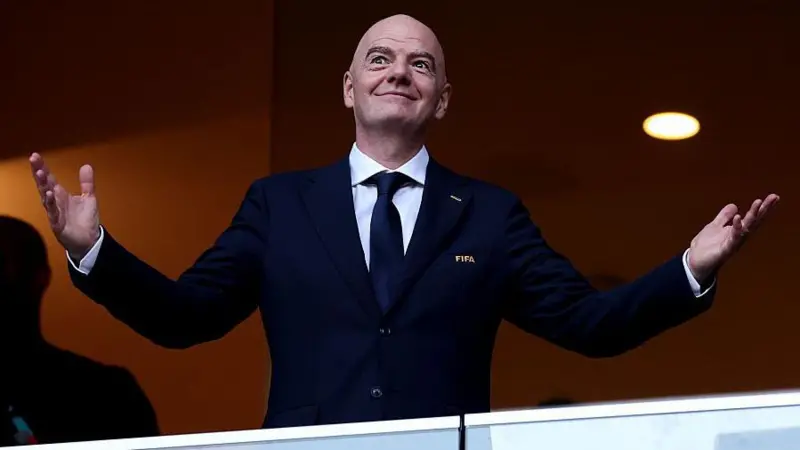
Infantino has been Fifa president since 2016
- Published
Plans for a 64-team men's World Cup are set to be assessed after the 2026 tournament, with Fifa boss Gianni Infantino saying the event needs to be "for the whole world".
The proposal for an expanded tournament was put forward last year, and Infantino says the success of the expanded 48-team tournament means Fifa should look at how a 64-team World Cup could work.
"These are all issues that we will be examining after the World Cup," Infantino told Swiss broadcaster Blue Sport, external when asked if the tournament could grow to 64 teams.
"When organising a World Cup, it's important to organise it for the whole world - not just Europe and South America, but effectively the entire world. Every nation should be allowed to dream of participating in the World Cup.
"You can see that the quality of the teams is extremely high, and it's getting higher and higher, all over the world. If you don't give smaller countries a chance to participate in the World Cup, they'll lack the incentive to keep improving."
Infantino said that the first 48-team World Cup has been "a huge success", citing the progression of nine out of 10 African teams to the knockout stages.
"At the last World Cup, there were only five teams from Africa," he said. "That just goes to show how important it is to include all teams - to give them this opportunity to participate."
The Fifa council approved the expansion of the World Cup from 32 to 48 teams in 2017.
An official proposal to boost the 2030 World Cup to 64 teams was put forward by South American governing body Conmebol in April 2025, but no decision has been reached.
The 2030 edition will be mainly co-hosted by Spain, Portugal and Morocco, with the three opening matches to be hosted by Argentina, Uruguay and Paraguay to celebrate the centenary of the competition. Uruguay hosted the first World Cup, in 1930.
Uefa president Aleksander Ceferin is among those to have dismissed the 64-team proposal, with the Slovenian saying it is a "bad idea" for both the tournament itself and the qualifying process.
Asian Football Confederation (AFC) president Sheikh Salman bin Ibrahim Al Khalifa agreed, saying further expansion would bring "chaos".
Victor Montagliani, president of the governing body for football in North and Central America and the Caribbean (Concacaf), said the suggestion "doesn't feel right" and he believes the expansion would damage "the broader football ecosystem".
However, Andrew Giuliani, executive director of the White House's World Cup task force, said the United States could consider making a bid to host the 2038 World Cup and would be able to "handle it" if expanded to 64 teams.
Fifa's official position has always been it will discuss expansion ideas with stakeholders and it is duty bound to consider any proposals from council members.
The Fifa council would make the ultimate decision, but there are no signs it is something expected to happen imminently.
Expansion would pose challenges for hosts
When Infantino was first elected in 2016, part of his manifesto was to increase the size of the World Cup from 32 teams to 40.
In less than a year, that rose to 48 and was approved by the Fifa council, effective from the 2026 finals.
Since then, speculation has never gone away that Fifa would like to go further and faster.
Going up to 48 teams for the 2022 finals was discussed, but it was accepted that Qatar would not be able to host a tournament of that size on its own.
And this is the issue – the bigger the World Cup becomes, the more challenging it is to host.
This year it is in three countries across a vast area. In 2030, matches will be played in six countries – Morocco, Portugal, Spain, plus Argentina, Paraguay and Uruguay as centenary hosts.
Just how Saudi Arabia would be able to cope with a 64-team tournament, featuring 128 games, in 2034 is unknown.
Yet it is a great vote winner for Infantino on two counts.
Firstly, it gives more countries the chance to play at a World Cup. Indeed, a 64-team World Cup would see almost a third of the 211 Fifa-affiliated countries qualify.
A bigger World Cup also means more revenue to be distributed to the member associations.
Related topics
- Published11 July

- Published18 July

- Published25 September 2025