France superstars thriving thanks to Deschamps' bold changes
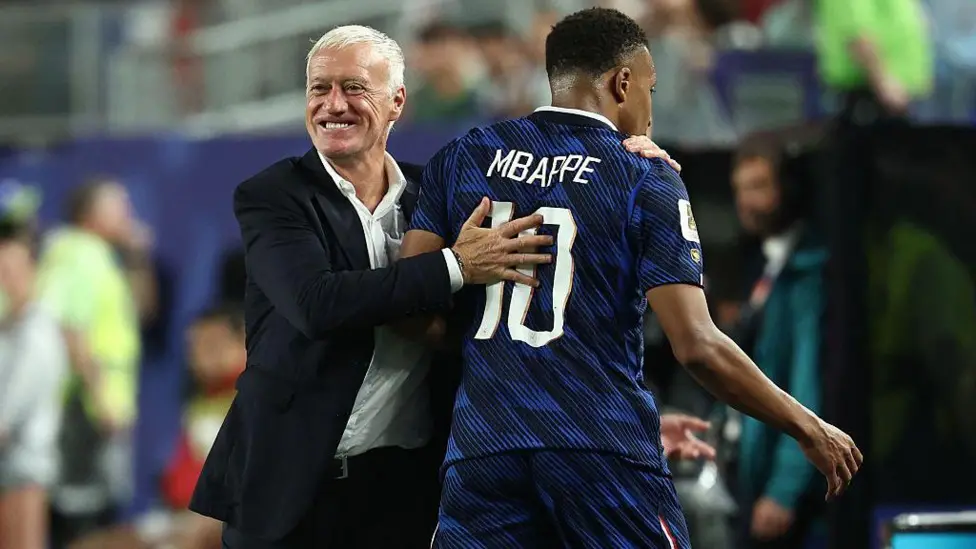
Deschamps has proved adept at handling big-name players such as Mbappe
- Published
It is hard to argue against the suggestion that France have the best squad in international football.
You might therefore think managing such an elite group of players is an easy task - but this is not necessarily true.
For evidence, look at the number of occasions when clubs have crumbled under the wealth of talent signed or the challenge of managing the personalities of superstars.
Since taking the France job in 2012, Didier Deschamps has continually reinvented his sides and got the most from France's huge pool of talent.
Even more impressively, he has earned a reputation for doing so mid-tournament - tweaking his system game by game to land on formulas that win the World Cup or come very close to doing so.
This familiar pattern seems to be emerging in this World Cup too.
Deschamps has been especially adept at maximising his top attacking talent and appears to have prioritised getting the most from Kylian Mbappe.
Mbappe, now 27, prefers to be involved in the game rather than just being a last-line runner to finish off moves - as he did so brilliantly as a 19-year-old in France's 2018 win.
Fitting him in as a number nine while making the rest of the team tick is Deschamps' big challenge at this World Cup.
In qualifying, Deschamps had built a logical, if unusual, system. On paper, it was a lopsided 4-2-4 or a 4-2-3-1.
Hugo Ekitike played on the left, with Mbappe dropping deep and pulling wide, close to the Liverpool forward. Ekitike, from the wing, or Dembele - from a more standard number 10 position - could both move into centre-forward positions. Michael Olise played on the right wing.
In the opening game of this World Cup against Senegal, Deschamps set France up in a similar manner, with Desire Doue coming in for the injured Ekitike.

France's side, although similar in terms of set-up to the one that started the tournament (above), has already been changed notably
What Deschamps was doing with this rarely seen system was fitting his favoured players in the roles they perform for their clubs.
For Real Madrid, Mbappe plays as the striker with license to roam, particularly to the left. For Bayern Munich, Olise hugs the right touchline, cutting in to shoot or play dangerous passes. Dembele plays as a roaming false nine who can drop deep for Paris St-Germain - hence Deschamps fielding him just behind Mbappe - and so on.
However as the game against Senegal progressed, there were points of friction in France's game and Deschamps looked to fix things - fast.
Off the ball, France defended in a 4-4-2 shape, with Mbappe and Dembele up top. Olise defended on the right of midfield. France, under instruction, pressed high - but the distances between the attackers and midfield two of Adrien Rabiot and Aurelien Tchouameni were too great and Senegal created dangerous chances by exploiting this space.
The ball was often played wide to a Senegal full-back from the centre-back before being passed into a deep-lying midfielder in the space between France's front two and in front of their midfield.
This had to be fixed.

France began the tournament pressing in an aggressive 4-4-2. While they still look to pick moments to press - such as against Norway at goal-kicks - it appears they are now more deliberate when they do so
In possession, Tchouameni dropped to form a back three for France, splitting William Saliba and Dayot Upamecano. This gave France a three against two on the first line, which made sense.
The midfield however, looked awkward. Left-back Theo Hernandez took a more inverted position, as did Olise from the right wing. Both players flanked Rabiot in the middle of the pitch, with the former Crystal Palace player finding himself in holding midfield positions at times, perhaps with a nod to using his long-passing quality deeper.
The width of the pitch was held by right-back Jules Kounde and left-winger Doue. Dembele played in a free role as the number 10 and Mbappe was up top.

Tchouameni dropped deep from a midfield position to form a back three when France had the ball against Senegal

Here we see France's back three on the ball. In front of them, Olise (in possession) has dropped from the right wing into an unusually deep position. Rabiot and Hernandez all are positioned on the same 'midfield' line
Deschamps identified that the spacing of France's defensive set-up was off and that offensively the players were in zones that didn't best suit many of them. He changed things at half-time and has continued to do so to great effect.
The biggest change has been swapping the roles of Olise and Dembele. The reigning Ballon d'Or winner being moved from a central role to the right of midfield would be a decision coaches might lack the courage to take, but it has had positive effects in and out of possession.
With France struggling out of possession, Dembele's work-rate from this wider position has helped France form a more solid defensive unit.
Rather than pressing high in a 4-4-2 when Senegal had good possession of the ball, Deschamps moved his France side into a more compact 4-4-1-1, blocking space instead.
This protected Rabiot and Tchouameni in midfield and France have since been difficult to play through.
Olise's central positioning has also benefited Mbappe, with the Bayern Munich assist king France's most proficient player at threading through balls between defenders.
Plus, on winning the ball back, launching dangerous counter-attacks has since become more viable.

France moved to a more pragmatic 4-4-1-1 shape that blocked space and nullified the methods of attack that Senegal were getting joy from in the first half

From a central position, Olise was more effective in finding Mbappe in behind
Although Dembele is excellent in those central attacking midfield positions, he gets into them by starting in a traditional centre-forward position but then dropping deep. That natural instinct to drop deep reduced France's presence in the box.
Olise, who believes his best position is as a number 10, naturally stays deeper before making runs into the box. Flipping this dynamic has worked well for France during longer attacking spells.

Here we see Mbappe drop deep to show for the ball while Olise makes a counter-movement into a striker's position. In this situation, Dembele's natural instinct is to do the same job as Mbappe - dropping deep to get on the ball as he does so well for PSG under Luis Enrique
In settled attacking possession, France now also position Kounde more centrally. He still gets high up the pitch but from here, he can provide immediate cover if France lose the ball. He also acts as a decoy - drawing players away from the winger, by holding his central position, or by making a late overlapping run.
Senegal left space out wide, looking to protect the centre of the pitch, but the Barcelona defender failed to take advantage of that.
It is only logical that a natural forward player like Dembele in those situations has been able to thrive instead, excelling against Senegal before scoring a first-half hat-trick against Norway from that right-wing position.
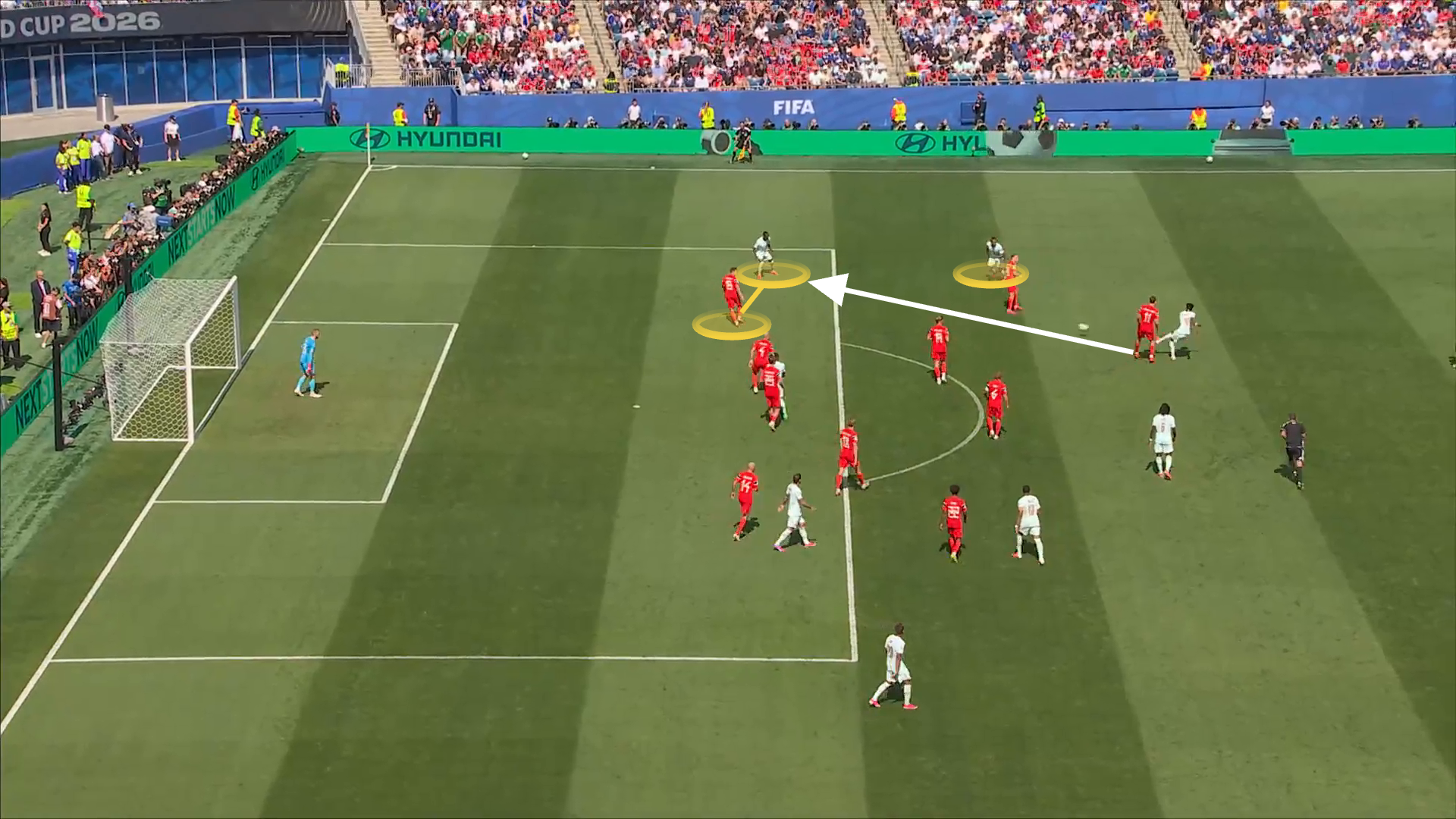
Image caption, Kounde's deeper and more central position allows Dembele to receive the ball, one v one against the Norway full-back


1 of 2
These changes have been impressive to witness in real time and what really stands out is that Deschamps has retained a level of fluidity while adapting the system.
Tactical tweaks made by coaches at the top level often come with some rigidity, as they look to solve a specific problem.
Deschamps' approach, as it always has, instead focuses on the player's skill-set, creating conditions on the pitch that can maximise them collectively.
It's why in recent games, despite the tweaks, we've still seen Mbappe, Olise, Doue, Dembele and Bradley Barcola all rotate across the forward line, playing small-space combinations built on strong on-field understanding rather than patterns.
France have looked more threatening offensively and more stable behind them, which is a winning combination in any era.
