


Summer, Inner Hebrides
Lis Lee
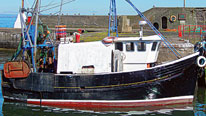
Gone to Coll. That was the note I stuck to the door. When my husband came home, the pushchair, my toddler son and I were gone. It was dark when we came home after a pet of a day as a neighbour would say. Four women and our five young children had been invited to spend the day out on a big yellow fishing boat crossing from Mull to the small island of Coll in the Inner Hebrides. Ewan was a prawn fisherman. We often watched his boat coming and going from it's mooring at Ulva Ferry. My little son and I frequently saw boxes of prawns landed and sent on their way, by road, and then the island ferry from Craignure, before being flown to the continent.
That day at the pier, holiday-makers were lining up for a rigid inflate-able to take them to the island of Iona. As Ewan's yellow fishing boat waited to cast off I could see two older local men on board as well as Ewan. He was talking to one of the Iona day-trippers on the pier. The man, an Australian, liked the look of our boat and the sound of a trip to Coll. So he parted from his girlfriend and clambered aboard. He waved at the inflate-able as it roared off. In warm sunshine the sea was calm and yet the island where we were headed looked an awfully long way away on the horizon. The sea was enormous. I felt adventurous. Our boat had not left the loch before whisky bottles appeared. It wasn't going to be a dry voyage. We women talked to each other and the children. They were all used to boats, ferries and the sea as islanders are. We had thrust food and drinks into bags for our children. Waves and seagulls followed the boat. There was a slight breeze. I don't recall how long it took to reach Coll, maybe an hour or so.
As we left the loch and Mull behind I saw a small green island ahead. Closer and I saw a few houses, a hotel and a church. Beyond the pier there were narrow roads, sheep, yet no other signs of life. The men tied the yellow boat up to the pier and we unloaded pushchairs and children. We had to pass everything up and over the wooden rails. The men headed for the hotel, not a long walk sober. We women took the children to explore this new place, pushing our pushchairs. It was quiet save for birds and sheep. It was Sunday. No one came to look at our chattering group which I thought strange.
We walked past the few houses and sheep grazing on the sward. There were no trees. As the afternoon wore on we all trailed to the back of the hotel. A door was open and, as I had done as a small child myself in another place, I peered in. We all did. I couldn't make anything out but the smell was familiar. Drink and smoke. Cosy. Ewan appeared and offered food. Chips were popular. He passed plates out of the door. Soon we decided it was time to head back to Mull and the four men came out. It was clear they had been enjoying the company of island men that lunch-time. We set off down the road to the pier and when we reached it I saw the big yellow fishing boat was hanging by its mooring lines from the wooden rails. The tide had gone out. There was enough water under the hull to float the boat and the men were in a hurry to climb down. They helped each other, we women helped them. The pushchairs, bags and children were passed down.
Last on board was the Australian. All the way from the hotel I had watched him attempting to keep his feet on the ground. His knees were hitting his chin at each step. On board, he lay down on the deck. We all settled down. One of the local men began to mumble and sing in what sounded like German. A friend once told me he had been a prisoner in the Second World War. When he had a few drinks he began to remember the past.
Ewan started the engine and we cast off. Well away from Coll and with Mull closing on the horizon one man staggered towards the side of the deck where prawn creels are hauled up out of the sea. He was going to pee over the side. He was going to fall overboard. One of the women leapt towards him and, with a rugby tackle, brought him down right on the edge of the deck. She let him pee and then pulled him to the short mast where she sat him down. Grabbing a piece of rope she tied him to the mast.
... (continues)
