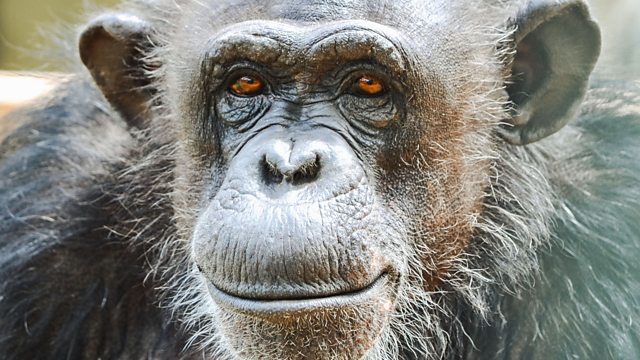
Sheba: Just like us?
Primate experimentation: we have the need, but do we have the right?
The documentary tells a story of scientific hubris through the extraordinary life of one chimp: Sheba. Now 44, she lives in sanctuary at Chimp Haven in Louisiana. Born in a cage, raised in a zoo, she spent 24 years in a research laboratory. Her life mirrors our evolving relationship with the animal world.
Sheba is the daughter of Nim, a famous chimp who learned sign language. Like her father, she demonstrated remarkable intelligence, learning to add, subtract, and paint. Her story traces back to a bold 1970s idea: if chimps are so genetically and behaviourally close to humans, could they help us learn about ourselves? Many scientists like Bob Ingersoll pursued that question through a series of behavioural, and social experiments. Others pursued it through invasive bio-medical research.
But the deeper they went, the shakier the premise became. As Bob reflects, much of the research proved not only scientifically flawed, but ethically troubling, often meaningless and cruel. That realisation sparked a shift. By 2016, biomedical research on chimpanzees in the US had come to an end. In the UK and European Union biomedical research ended a few years earlier.
Through Sheba’s journey, we hear about that turning point.
Featuring interviews with those who knew and worked with her, zoologist Charlotte Uhlenbroek, drawing on years of studying chimps in the wild, guides us inside the world of primate research. The documentary confronts a question that is still unresolved: we have the need to experiment, but do we have the right?
(Photo: Sheba the chimpanzee. Credit: Claire Cottrell/Chimp Haven)
Last on
Broadcasts
- Sat 27 Jun 202611:06GMTBBC World Service except East and Southern Africa & West and Central Africa
- Sun 28 Jun 202602:06GMTBBC World Service
- Sun 28 Jun 202613:06GMTBBC World Service East and Southern Africa & West and Central Africa only
- Sun 28 Jun 202616:06GMTBBC World Service News Internet
- Wed 1 Jul 202609:06GMTBBC World Service
- Wed 1 Jul 202623:06GMTBBC World Service
