Why does paper fold so well?
Paper’s foldability often comes in handy, whether you’re making complex origami or putting a letter in an envelope. But what makes it so good at holding its creases?
CrowdScience listener Haruka has been making origami cranes out of paper since she was a child. Creating one out of a cloth napkin, however, was a next-level challenge. It gave her a new appreciation of paper’s excellent foldability, and made her wonder: what is it about paper’s structure that means it remembers its creases?
We set out to unfold her question as we peer into paper’s secrets. First stop: Frogmore, the world’s first mechanised paper mill. Here, Dr Steven Mann is on hand to explain the papermaking process, the chemistry of paper, and why that makes for a foldable sheet.
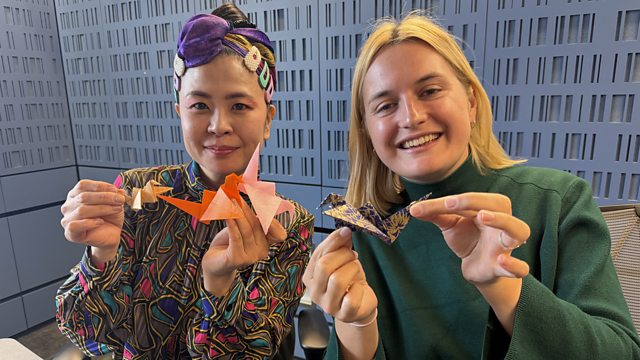
Host Caroline Steel tries to make a paper crane, assisted by both listener Haruka and origami teacher Toshiko Kurata, who also introduces us to an array of paper types. Each type folds differently, and, with the help of a trusty microscope, Professor Bill Sampson from the University of Manchester reveals why.
Finally, we see just how complex paper folding can get, meeting Professor Tomohiro Tachi from the University of Tokyo, and his invention, The Origamizer.
Presenter: Caroline Steel
Producer: Cathy Edwards
Editor: Ben Motley
(Photo: Toshiko Kurata and Caroline Steel with origami creations - Credit:BBC)
Last on

More episodes
Featured
.
Broadcasts
- Fri 12 Jun 202619:32GMTBBC World Service
- Mon 15 Jun 202601:32GMTBBC World Service except Americas and the Caribbean
- Mon 15 Jun 202604:32GMTBBC World Service Australasia, Americas and the Caribbean, South Asia & East Asia only
- Mon 15 Jun 202608:32GMTBBC World Service
- Mon 15 Jun 202612:32GMTBBC World Service Australasia, East and Southern Africa, News Internet & West and Central Africa only
Podcast
![]()
CrowdScience
Answering your questions about life, Earth and the universe
Related Content
