
Katarina Johnson-Thompson
Katarina Johnson-Thompson travels to The Bahamas and Miami in search of her ancestry. She discovers tales of resilience and courage during a period of shocking racial segregation.
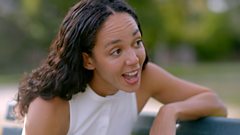
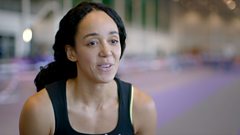
Olympic, Commonwealth and World Champion medal-winning heptathlete Katarina Johnson-Thompson wants to know more about her late dad’s side of the family and her Bahamian ancestry.
Katarina returns to Liverpool, where she grew up with her mum, Tracey. Tracey shows her a family tree from Katarina’s christening book. It shows her paternal grandparents and great-grandparents, but Tracey knows nothing beyond their names. She suggests that Katarina should visit her aunt Toni, her dad’s sister, who lives in The Bahamas.
Toni shares memories of growing up with Katarina’s dad and with their mother and grandmother. They were close to that side of the family, but their dad didn’t live with them, and so she can’t tell Katarina much about the Thompson line.
To find out more, Katarina meets researcher Francine Russell. Katarina discovers that her great-grandparents Elvin Thompson and Clara Farrington were married in the church and that their fathers were Alexander Thompson and Matthew Farrington. Francine couldn’t find any more records relating to Alexander, but on the Farrington line, Katarina discovers that her great-great-grandfather Matthew’s father was also called Matthew. He was married to Christiana, and they lived on Black Point, a settlement on one of the cays that make up the Exumas.
In Black Point, historian Dr Grace Turner explains that there are often gaps in the records in the area, caused by natural disasters among other things, which makes it difficult to do the usual cross-referencing. But Grace thinks she has a record which reveals that Katarina’s four-times great-grandfather Clarence purchased a plot of land in 1857 for six pounds. Grace and Katarina go and look at where the plot of land was and speculate on the struggle it must have taken to purchase it.
Grace has one more document relating to Katarina’s family. A passenger list shows that Matthew Farrington junior, Katarina’s great-great-grandfather, left The Bahamas in September 1913 for Miami.
In Miami, Katarina meets historian Nadege Green, who shows Katarina a photo of Matthew and explains that his wife and children joined him in Miami along with members of his extended family. They lived in Waddell Street in Overtown. At the time, it was called ‘Coloured Town’, and Katarina’s family would have been subject to the Jim Crow laws, which made every aspect of city life racially segregated. Katarina reads a newspaper report that tells how her great-great-grandfather’s brother, her three-times great-uncle, was arrested for vagrancy, a charge often brought against black men. Katarina is shocked by what she has learnt and would now like to find out how Matthew, his wife Emily and their children managed.
At the Black Archives Museum in Overtown, Katarina meets Dr Dorothy Jenkins Fields, who reveals that Katarina’s great-great-grandmother Emily died in 1920 shortly after giving birth to a child called Beulah, who tragically only survived for two-and-a-half hours. Another child, Margaret, also disappears from the records and so sadly is assumed dead. Four years later, Matthew applies for US citizenship. He has married again and has one child living in Miami and another, Katarina’s great-grandmother Clara, has been sent back to The Bahamas. Dorothy speculates that it might have been because living in Overton was becoming increasingly dangerous. Newspaper reports record attacks by white supremacist groups in the area during the 1920s. Katarina wants to know about her great-great-grandfather’s response, and Dorothy tells her that Matthew was an officer in the freemasons.
Wanting to find out more, Katarina meets historian and mason Gerry Urso, who tells her that Matthew joined the Prince Hall freemasons, the oldest African American freemason order in the USA. Founded in 1784, they were dedicated to ending slavery and promoting equality.
In a final reveal, Katarina learns that the research team have tracked down a relative. Leslyn is Katarina’s great-grandmother Clara’s granddaughter. The last Katarina heard about Clara was that she had returned to The Bahamas as a child. Leslyn tells Katarina that Clara came back to Miami in the 1950s and that she was a churchgoer and believed passionately in improving the lives of the community.
Katarina visits St John’s Baptist Church, where Clara worshipped. Here, she meets Cecily Robinson-Duffie. They talk about the role the church played in the civil rights movement, and Cecily shows Katarina Clara’s voter registration form, which dates to just a year after the Voting Rights Act of 1965. Cecily explains that behind the famous men and women who led the civil rights movement were an army of people like Clara who supported the movement.
Despite the sadness she feels returning to The Bahamas and missing her late dad, Katarina talks about how proud she is of all her ancestors who worked to better themselves and their communities.
Last on

Clips
![]()
Katarina's quest to learn about her dad's side of the family
Duration: 00:31
![]()
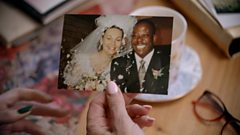
How Katarina Johnson-Thompson's parents met
Duration: 01:06
Credits
| Role | Contributor |
|---|---|
| Presenter | Katarina Johnson-Thompson |
| Narrator | Angela Griffin |
| Series Producer | Lucy Swingler |
| Executive Producer | Colette Flight |
| Production Manager | Demi McGarrell |
| Producer | Georgia Azzi |
| Director | Des Daniels |
| Production Company | Wall to Wall Media |
Broadcasts

Featured in...
![]()
Who Do You Think You Are?
Lost connections and unfamiliar histories are revealed.
![]()
Black Voices, Black Stories
Celebrate the trailblazers, changemakers and storytellers of Black British history.