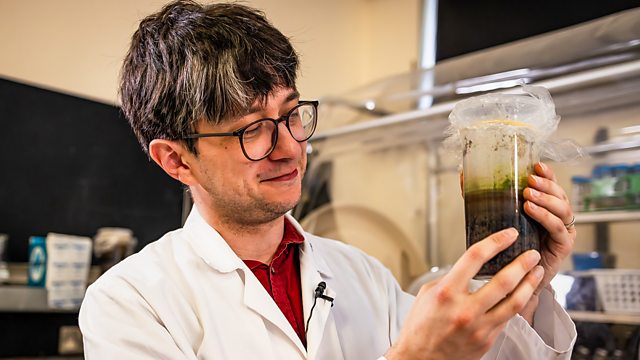
The Aliens Next Door?
Could alien life exist closer than we think - perhaps right next door? The team investigate evidence that suggests the search for life beyond Earth may lie within our own solar system.
Could alien life exist closer than we think - perhaps right next door? A paper published in 2025 suggested that strange markings discovered on Mars could provide some of the strongest evidence yet that life once existed on the Red Planet. The Sky at Night team travels across Great Britain to investigate this and other evidence that suggests the search for life beyond Earth may lie within our own solar system.
Off the east coast of Scotland, Chris Lintott meets Dr Claire Cousins, who explains the fundamental conditions needed for life. She then turns to the ground beneath their feet, where the red rocks along the North Berwick coastline are marked with patterns similar to those seen on Mars. To find out more about how these markings could have formed here - and possibly on Mars - Chris heads to Edinburgh, where Dr Sean McMahon is investigating whether similar patterns can be recreated in the lab.
Meanwhile, in Cardiff, George Dransfield speaks with Professor Jane Greaves, whose paper on the detection of phosphine in the clouds of Venus six years ago caused a stir. Did the phosphine truly exist, and could it point to life? Ongoing research is continuing to build the case for unusual chemistry - and possibly life - on our closest planetary neighbour.
Further out in the solar system, the icy moons of Jupiter and Saturn offer another compelling possibility. Maggie Aderin-Pocock is in Milton Keynes to meet Dr Mark Fox-Powell, whose team are recreating these freezing conditions in the lab to understand how chemistry behaves there. Their work is helping identify what future missions to these icy worlds should look for as potential signs of life, and has even led to the discovery of a new mineral that can only form in such extreme environments.
Across Mars, Venus and the icy moons, one theme emerges: life may not require Earth-like conditions in the way we once assumed. Instead, it could thrive in unexpected environments.
Finally, Pete Lawrence rounds off the programme with a tour of the summer night sky, and we are reminded of how vast our galaxy is and how small our place within it really is.
So, are we alone? The search continues - right here on our cosmic doorstep.
Last on

Credits
| Role | Contributor |
|---|---|
| Presenter | Chris Lintott |
| Presenter | Pete Lawrence |
| Presenter | Maggie Aderin |
| Presenter | George Dransfield |
| Executive Producer | Eileen Inkson |
| Series Producer | Amena Hasan |
| Production Manager | Sam Breslin |
| Producer | Benjamin Smith |
Featured in...
![]()
Family Favourites
Must watch shows from across the BBC
![]()
Family Favourites
All your favourites from across the BBC

Join our photo group

Share images, inspiration and tips with fellow photographers
